Showing posts with label buddhism. Show all posts

Thursday, April 20, 2023

The Curse of Enlightenment


Something I'm grateful to the pandemic for is the development and greater use of Zoom as a method for attending meetings and lectures. This week I've been at several webinars sponsored by the Buddhist magazine Tricycle, an event they're calling The Buddhism and Ecology Summit: Transforming Anxiety into Awakened Action.  Today's seminar was titled From Mindfulness to Movements and featured activists Michelle King, Dekila Chungyalpa, and Bill McKibben

I've been attending because, like I think.many people are, I am anxious about what is happening to the environment. I'm a child of the 60s and recall too clearly the information, new to the public, that the ecosystem (brand new term) was in trouble and certain things needed to be done or be stopped in order for people to live comfortably in the then-far future of the 21st century. Like many, I calmed myself saying, "By then, practices.will be put into place to counteract all that. There's nothing to worry about, the adults will have it taken care of."

Of course, the adults have not, and in terms of our likelihood of avoiding environmental crises, we're at a further remove than we were then, as solutions like solar, wind, geothermal are more controversial among leaders of industry than to their forebears. President Jimmy Carter had solar panels installed on the White House roof. They become a source of ridicule to the opposition and Reagan had them removed.

So yes, I worry about the end of human life and civilization, although I was also startled by my agreement a few days ago with author Michael Hinton's statement that the so-called 6th Extinction which we are doing our best to bring about by doing nothing at all is as natural as previous extinction events brought about by volcanoes, meteors, and ice ages, and may in fact herald "another set of miracles" like all those others. 

Like Hinton observed I am jealous of anything like that because I'm "in love with the environment as it is now" and don't want to see it changed in a huge way. But a remark by Michelle King about "being the practice" rather than just doing it reminded me too of something I was told at Dhammapada monastery so many years ago.

First, we have to recognize we aren't going to solve the crises. It will take many generations to turn them around just as it took many generations to fuck them up. And secondly, we can't abdicate our--those of us who see clearly and dismsyingly what is happening--responsibility for opening the eyes of others to it. After a period of time at Dhammapada I approached the Abbott during my weekly interview and told him, "Well, I've become enlightened." He looked at me blankly for a few moments and then it terrible sadness crossed his face. "I am so very sorry," he said, clinching my diagnosis. Because it's axiomatic in practice that, once you become enlightened you will see all the problems of the world. Once you can no longer ignore them or rationalize them away, you are responsible for doing what you can to rectify them.

Saturday, March 26, 2022

I'd like to think if I was tested I would pass


This has been a busy, busy month and it's been a while since I've had the time and opportunity to post this second recent message from a service at the facility. This was recorded for the first Sunday in March.  

 Luke 4:1-13

4:1 Jesus, full of the Holy Spirit, returned from the Jordan and was led by the Spirit in the wilderness, 4:2 where for forty days he was tempted by the devil. He ate nothing at all during those days, and when they were over, he was famished. 4:3 The devil said to him, If you are the Son of God, command this stone to become a loaf of bread. 4:4 Jesus answered him, It is written, One does not live by bread alone. 4:5 Then the devil led him up and showed him in an instant all the kingdoms of the world. 4:6 And the devil said to him, To you I will give their glory and all this authority; for it has been given over to me, and I give it to anyone I please. 4:7 If you, then, will worship me, it will all be yours. 4:8 Jesus answered him, It is written, Worship the Lord your God, and serve only him. 4:9 Then the devil took him to Jerusalem, and placed him on the pinnacle of the temple, saying to him, If you are the Son of God, throw yourself down from here, 4:10 for it is written, He will command his angels concerning you, to protect you, 4:11 and On their hands they will bear you up, so that you will not dash your foot against a stone. 4:12 Jesus answered him, It is said, Do not put the Lord your God to the test. 4:13 When the devil had finished every test, he departed from him until an opportune time.

 Mara Upasatha Sutra

The holy one directed his steps to that blessed Bodhi-tree beneath whose shade he was to accomplish his search. As he walked, the earth shook and a brilliant light transfigured the world. When he sat down the heavens resounded with joy and all living beings were filled with good cheer. Mara alone, lord of the five desires, bringer of death and enemy of truth, was grieved and rejoiced not. With his three daughters, Tanha, Raga and Arati, the tempters, and with his host of evil demons, he went to the place where the great Samana sat. But Shakyamuni heeded him not. Mara uttered fear-inspiring threats and raised a whirlwind so that the skies were darkened and the ocean roared and trembled. But the Blessed One under the Bodhi-tree remained calm and feared not. The Enlightened One knew that no harm could befall him. The three daughters of Mara tempted the Bodhisattva, but he paid no attention to them, and when Mara saw that he could kindle no desire in the heart of the victorious Samana, he ordered all the evil spirits at his command to attack him and overawe the great Muni. But the Blessed One watched them as one would watch the harmless games of children. All the fierce hatred of the evil spirits was of no avail. The flames of hell became wholesome breezes of perfume, and the angry thunderbolts were changed into lotus-blossoms. 


 I’m not telling you anything new by saying words have meaning. But when we apply it to scriptures like the Bible or the Koran or Buddhist Sutras, we often use words that have come down to us from centuries of use as meaning something they no longer mean. For instance, in this scripture we hear an important word, “devil,” that conjures up an image our parents might have given it that doesn’t quite match the original word. We think of a guy in red with a pointed tail and horns and a pitchfork. 

But that’s not what’s meant by the Greek word, “diabolos.” While it does translate as devil, diabolos meant a different creature like an accuser or a trickster, one who tests the truth of a statement. Think of the devil here as The Tester, one who is fulfilling an important job, like Coyote in Native American stories or Loki in Norse myth. Think of diabolos, not as someone against Jesus or you, but someone whose job is to make sure you’re up to whatever task is ahead of you. 

Diabolos’ job is not to make Jesus transform stone to bread but to see if he’s learned to control his wants. Similarly, when Jesus is told “You can rule everywhere and everyone and all you have to do is worship me,” he controls his greed. The Tester tells him he could rival God and his response is “Only God is God.” Finally, The Tester gives Jesus an ultimate test: “Jump off this temple roof, let yourself be saved by angels. God  has a lot riding on you, God won’t let you die.” But Jesus says, “Don’t test God. Just accept.” We don’t climb to the roof of a building and jump. We know better than that. 

 When we talk about temptation, we’re talking about an urge to do something we wouldn’t normally do. The word itself comes to us from Old French out of the Latin word temptare "to feel, try out, attempt to influence."  We’re tempted sometimes to do something that helps someone. Holding open a door suddenly for someone we see behind us struggling with a box, or picking up the tab for someone we’ve joined for a drink. 

While we obviously don’t have exactly the same temptations as in Luke’s story, to say we have temptations in today’s world is an understatement. In place of commanding stones into bread, we’re tempted to claim of one thing that it’s another. Like if we’ve insulted someone and they catch us in it we’re tempted to say, “No, it’s a joke. I didn’t mean it.” Instead of worshipping Diabolos to rule the kingdoms of the world, we’re tempted to do something we don’t like or that hurts someone to make more money. Or in place of throwing ourselves from a high spot to see if God will send angels to protect us, we might be tempted to put ourselves in danger by refusing to be vaccinated or taking precautions, certain our faith will protect us.

Dickey Barrett, the singer and lyricist of the Mighty Mighty Bosstones, the band playing the song I played you earlier, has a wonderful line: “I’m not a coward, I’ve just never been tested. I like to think if I was I would pass. Look at the tested and think, There but for the grace go I. I might be a coward, I’m afraid of what I might find out.” We test ourselves constantly and sometimes, yes, we prove to be cowards. That’s all right. If you’re tempted to take a bite out of a stone or to jump off the roof, you should be a coward. You’ll only hurt yourself that way. 

Better to test yourself in small ways. This woman’s voice bothers me. Can I be kind to her anyway? My roommate is driving me crazy; can I voluntarily go somewhere I don’t have to see or hear him? I spill juice, I forget my hat sometimes, I misplace my favorite book. Can I be patient with myself about the thousands of mistakes I make daily? It’s in passing the little tests we set for ourselves that we become better people. This is what God intends for us, to become better who we are. 

 [Lord’s Prayer]

 Benediction by Wayne Arneson

“Take courage friends. The way is often hard, the path is never clear, and the stakes are very high. Take courage. For deep down, there is another truth: you are not alone.”

Wednesday, January 24, 2018

Visiting Dad, Day 3

I like Anne Lamott books. The first I read was Bird by Bird, which is an excellent book about writing and one I really enjoyed. Her books I read most, and find most enjoyable, are her religious books. Traveling Mercies, Plan B, Grace (Eventually). These have not only given me comfort but have resonated with what Mary Oliver has called "the soft animal" in me.

This interests me from a separate perspective, because Lamott professes to a Christianity I'm not entirely comfortable with. It is, to be sure, a liberal Christianity but focuses too much on a personal interaction with God as well as an insistence on Jesus' divinity and, frankly, on her own history of drug and alcohol overuse as both the way she came to religion and the reason she continues, as if a missed daily prayer might be replaced by a shot of vodka.

But that's my issue and not hers. So I have been reading Small Victories: Spotting Improbable Moments of Grace while sitting with Dad since he spends most of the hours I'm with him sleeping. Today, I sat with him while he slept for an hour and then joined my cousin for a care conference about him. There wasn't much of anything new to be learned. He continues to decline, has gained and lost about ten pounds since I saw him last, and is continuing to lose his recognition of people close to him (although he also regains it, at least with me, by being with him). He has at least two urinary tract infections each year, which according to the RN, may be caused by his having been colonized by UTI bacteria, so that infection is more his regular state than noninfection.

No one, least of all my dad, thinks he will "improve" or "get better." We are all aware, at least intellectually, that we will reach his same state. Dad, so far as I'm aware, has never been unaware of this. My cousin recounted how he will sometimes cry, saying he wishes he had a gun and could be done with it all, and he said the same to me at one point this afternoon. It's not a sentiment I'm unfamiliar with, not having felt it myself (not yet, anyway), but something I've heard from slowly dying patients. But as I read in Small Victories, "Redefinition is a nightmare--we think we've arrived...and that this or that is true. Then something happens that totally sucks...and it is like changing into clothes that don't fit, that we hate. Yet the essence remains. Essence is malleable, fluid. Everything we lose is Buddhist truth--one more thing that you don't have to grab with your death grip, and protect from theft or decay. It's gone. We can mourn it, but we don't have to get down in the grave with it."

Tuesday, October 25, 2016

258 candles-days16-14

 Rabbinic wisdom holds that we were created so God could talk to himself. Another take is that God wanted us to learn compassion so a plethora of us were made. Someone else also said God wanted people to love and care for others so dogs were created. If all that is so this woman squares the circle. "Taking care of dogs is my religion."

Thursday, April 14, 2016

258 candles-day 50

I've been wracking my brain trying to think of what I can say that will mean anything to anyone about the current dismal, distressing state of politics in this country. And I've come to realize this: There isn't anything I can say. But there is something I can do.

My solution, based on the Chinese proverb that it's better to light a candle than to curse the darkness, is to provide daily candles in the form of links to other people's solutions, simple or complex responses to problems that they see. But as a single candle will hardly provide enough illumination to blot out the darkness that is the pettiness and meanness that characterizes this election cycle, I will light 258 candles, one each day between now and election day. In this way, I will do my part to remind each of us we are better than the baseness of the bases.

Today: A now-viral photo demonstrates an important possibility among police. And while there's no proof the photos are of the situation they're meant to depict, this is the practice of a beloved community.

Wednesday, April 13, 2016

258 candles-day 49

I've been wracking my brain trying to think of what I can say that will mean anything to anyone about the current dismal, distressing state of politics in this country. And I've come to realize this: There isn't anything I can say. But there is something I can do.

My solution, based on the Chinese proverb that it's better to light a candle than to curse the darkness, is to provide daily candles in the form of links to other people's solutions, simple or complex responses to problems that they see. But as a single candle will hardly provide enough illumination to blot out the darkness that is the pettiness and meanness that characterizes this election cycle, I will light 258 candles, one each day between now and election day. In this way, I will do my part to remind each of us we are better than the baseness of the bases.

Today: Someone has said that the true method of determining someone's Bodhisattva nature is that he is willing to act helpfully for someone who can't possibly pay him or her back in this lifetime.

Monday, December 15, 2014

the chapel of the Holy Wheel

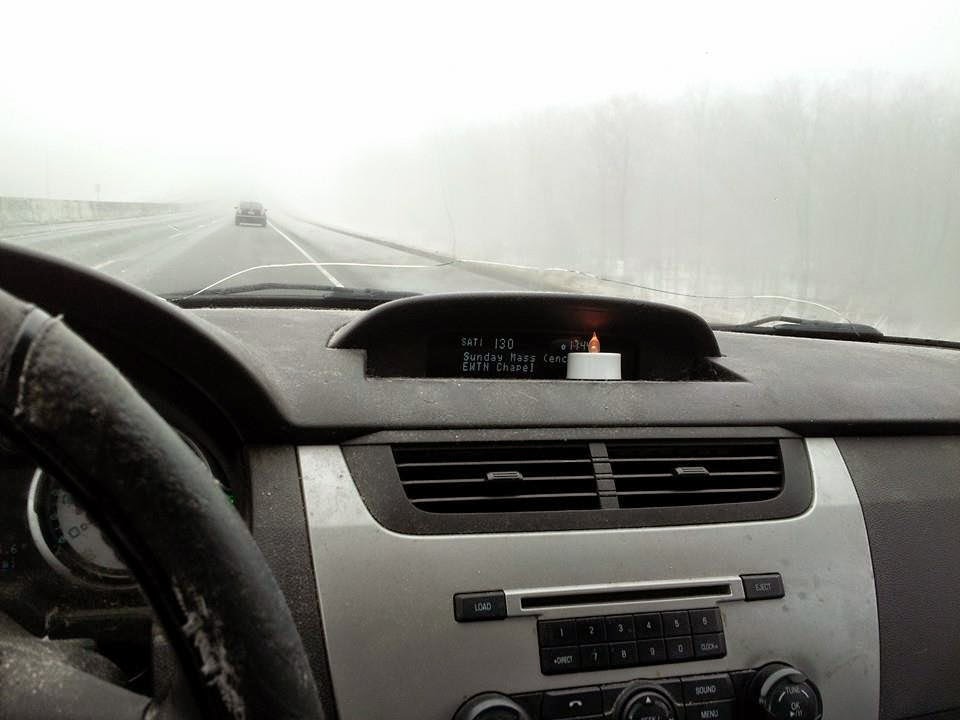
I'm a Unitarian Universalist, and I suppose it's a sop to my Puritan ancestors that the church I've been attending lately runs to six hour services. As I've mentioned in the past, we are in the process of moving from the rim to a hub on the other side of Wisconsin, and my wife and animals are already living there. As a result, my Sundays are spent driving back to the hub to minister to the kids I work with. I think of it as attending at The Chapel of The Holy Wheel.

I have my elements. My liturgy is made up of the BBC news and political shows I listen to, my hymns the music, some sacred some profane, mostly blues, I scroll through. I attend mass, partaking of the Eucharist with the crackers and grape juice I keep in the car for communion at the girls' facility (the boys are much less interested in any kind of religious services, while some of the girls want me to do almost nothing else). There is a calm that comes over me in my rolling tabernacle. I have always loved to drive, and combining the acts of reverence and of moving strikes me as a kind of mega variation on moving meditation. As if my body, ensconced in the safety of my vehicle while it hurtles down the road, mimics my body hurtling through space on the larger vehicle that I don't, can't drive. My prayers, such as they are, are for the people surrounding me. That they arrive relaxedly, like me, wherever they're going. If I succumb to grandiosity t's in seeing in myself some of the Holy Fool Neal Cassidy exhibited in his best moments.

Thursday, October 2, 2014

eulogy for a homeless father

About a week ago I was contacted by a friend on behalf of his friend whose homeless father's body had been found in a park in the hub. Both his death and his homelessness was a surprise to the two families he had left behind: other than sporadic phone calls, no one had heard from him in fifteen years and had no idea where he was. His son had contacted my friend, a Lutheran minister, for a suggestion of someone to perform the funeral who was "not too religious." My friend suggested me because of my own bout of homelessness.

After a couple meetings, we held the memorial yesterday in the son's apartment. The two families--a first wife and her adule children, and a second and her teenage children--came together for the first time in a decade and a half to mourn the death and celebrate the life of a man none of them knew what had become of.

I'm not only a minister but also a member of several online homeless and vagabond Facebook groups. I put to their members what they, as people for whom exactly this situation might happen, thought I should tell the families. Their responses, numbering a couple hundred, inform the following eulogy.

We don’t know what the last hours or days or even years of Jonathon’s life was like. We do know some things. That he had multiple health problems, including heart and lung issues, that he was addicted, at least for a while, to alcohol, that he was fending for himself in a losing battle against the entropy all of us are heir to, to the extent that this man, a mere 49 years old, could be discovered dead and that it could be considered a natural death. It is fitting that the person who discovered Jonathon’s body was also probably homeless. In the final analysis, each of us has only each other. 
It’s easy to mistake pride for self-sufficiency. As most of you are aware, I was myself homeless for several years, so I feel comfortable telling you that while it might be tempting to think of Jonathon’s last years in terms of unremitting pain, depression, and desperation, that isn’t all there was to it. Those elements were there, certainly, but just like we can’t subsist entirely on a diet of charred toast, his life was undoubtedly leavened by the sweetness of life. Gratitude at the kiss of warm sunlight on his face when he least expected it. Appreciation at the gifts of money and food and shelter offered him. Warmth in his belly at the taste of liquor or cigarettes, the delicious succulence of a peanut butter and jelly sandwich. The sweet release of lying down to rest, the wonder of dreams. He felt love, perhaps a little ashamed at the families he left behind, but also perhaps relief in, in his mind, rescuing them from the burden of his deterioration.
Enough with idle speculation. What we do know is this: he was ill his last years, he lived on the streets here and maybe spent time in shelters, he died from the combination of his diseases and exposure, and he did not reach out to anyone here for help. Those are hard, uncomfortable truths. Perhaps they should be. Not that anyone should feel bad at not having provided help or feel anger with Jonathon because he didn’t ask for it. They’re hard because people, like life itself, are complicated. For whatever reasons, to conquer whatever demons, Jonathon made the decisions he did and accepting them and him is the final dignity we can give him.
Loving him in death is the best we can hope for. Or, if not love, acceptance of the way he chose to live his last years. We are all each other has got, and trying to change anyone, in death as in life, only leads to frustration. Jonathon’s life and death, for all the ways it hurts us, has dignity to it, as all life has dignity. We are born, we live, and we die. A single known sandwiched between two portals to the unknown. Buddhists tell the story that the earth is made up of ocean and a single ring floats on it. Every thousand years an ancient tortoise crawls from the bottom mud and rises achingly for a breath of fresh air. He breaks free of his resting place, journeys to where the sky can be seen, gulps a single lungful of air, and descends rest again in the mud. They say as often as that tortoise crests the surface with his head in that ring during each thousand year event, just as often are we born. To be born is rare and lucky. It must be honored. Jonathon’s life was no more or less dignified than any of ours. You are lucky to have known him, to have loved him.
In my faith there’s a ritual we sometimes perform at the death of a member of our community. Will you gather in a ring and take hold of the hand of the persons next to you. We sing the words but since you don't know the tune, we'll just say them together. Please repeat after me: “Spirit of Life, come unto me. Sing in my heart all the stirrings of compassion. Blow in the wind, rise in the sea; move in the hand, giving life the shape of justice. Roots hold me close, wings set me free. Spirit of Life, come to me. Come to me.”
 [Prayer] God of tears and the mysterious silence, God of suffering and God of hope, you have made for everything a season. This is the season of our sorrow, of our grief, and we pray for grace to deal with what seems impossible to deal with. We remember the promise made to those who mourn, yet too often it seems that comfort is beyond our grasp. We know that we cannot bear this burden alone. Should we pray for our grief to be transformed or, is the purpose of our grief to transform us? Will our sorrow lead somewhere unexpected? Might it lead us back to life if we follow it? Is it a reminder of the precious reality of life and love? The death of Jonathon has created a vast, empty space within our lives, a great longing within our hearts. Can it ever be filled? Can it be healed by the sacred memory that makes Jonathon forever a part of us?
So many questions, O God, and so much silence. May we be patient toward all that is unanswered in our hearts. And may others be patient with us, with our sorrow, our anger, our fear and our questions. We are those who mourn. We seek the comfort that we can offer each other and the blessings of divine love and grace. Amen.

[Benediction] Take courage, friends. The path is never clear, the end is always in doubt, and the stakes are very high. Take courage. Deep down, there is a greater truth: you are not alone.


Monday, September 29, 2014

early morning driving

We are in the process of moving from the rim to another hub across the state. My wife, who is also a minister, but with a different denomination, has accepted a call to pastor to a small congregation in a Wisconsin village of about 1500. This weekend we moved her and two of our dogs to a small room she'll rent until we can buy another house out there.

But this time, instead of living on the rim and working in the hub, which we've done since moving west in 1994, we'll be living in the hub and she'll be working on the rim. This is a different sort of plan for us; while both of us have lived in cities before, and even in one city together, we've never done so while having our beasts (now numbering eight). Fortunately, her sister is buying our house here on the rim, and will retain her dog that we've been hospicing for nearly a year (no one expected her to live this long: she has a spinal disorder that most of us estimated would have progressed to the putting-down phase by now), so the number will be reduced to seven, but that remains six beasts more than we had during our previous city stay.

Yesterday, as I had chapel services at work starting at three o'clock, I left the room she and the small rat terriers are staying in at six and managed to get back here by noon. But what's compelled this post is the interview I picked up shortly after leaving. It was a roundtable discussion hosted by Krista Tippett and comprising the Dalai Lama, Rabbi Lord Jonathon Sacks, Seyyid Hossein Nasr, and Bishop Katherine Jefferts Schori. The topics ranged from happiness to suffering, from god to the divine in people, from the mind to the body's role in it, and focused not simply the similarities but on the differences too between the four religions. What I was most impressed by was their exhibited personalities. The Dalai Lama often laughs at his own comments (which has given him a reputation for having a sense of humor often lacking in relligious leaders), but Rabbi Sacks had an impressive British dry wit and nearly every comment was evidence of that (favorite examples: asked about happiness, "Reading through Hebrew scripture and history, perhaps 'happiness' is not the first word that comes to mind..."; and in condensing the teachings of scripture, "They tried to kill us. We survived. Let's eat"). Strangely, to me, as I have read and heard more from them, Nasr and Schori were almost subdued in the presence of these two. Neither, I thought, seemed cowed by the company they were in, but neither did they seem elevated by it. Their comments were dry and so low-key as to have been overwhelmed by the othere two.

But the discussion was fascinating and I resolved to reread Nasr's books I have and find something by Sacks, whose speaking style I hope will be as enjoyable rendered in print. But the early hour, the coffee I drank, the radio signal getting fainter and fainter the further I drove, the large vehicle I was piloting (we'd borrowed a friend's van) and the road stretched out before me for miles and hours was missing only a cigar to have completed my experience of living on the road. For a while I was back there and then, and that felt very good.

Wednesday, June 11, 2014

who do I resemble?

I'd gotten this idea from a blog post elsewhere and was intrigued by its implications. Except that, instead of using fictional characters, which are, after all, static personalities, I'm using real people with all their attendent complications.

So, what clergyperson do I most resemble?

Religious person I most physically resemble:

Religious person whose impact I'm most like to resemble:
 
 
I'll have more, I'm sure, to say about this in the near future, but for now I'm just getting back into the habit of blogging prior to starting my workday.

Friday, May 2, 2014

what color was your robe?

I don't think I've told this story before. This was back in my Woodstock days when I was working at Sunflower, a health food store (yes, the one where I met Ed Sanders, Arlo Guthrie, and Pete Seeger). I was working a closing shift and took my lunch break in the office, where I settled into the manager's chair, put my feet up on the desk, and drifted off to sleep.

The dream was incredibly vibrant for what must have been only minutes but seemed as if it lasted for hours. I was back at the Buddhist monastery where I'd attended sesshin the year before, and kneeling before the abbott for my weekly interview. He asked me, "What is the sound of one hand clapping?" And I, thinking I was very clever, held up my right hand and slapped its fingers against the palm.

The abbott remained quite composed, sitting calmly and regarding me. Then he brought out from its hiding place behind him the kyosaku that the head monk used to prod us if we slouched in meditation or smack us loudly if we fell asleep. He screamed "Wrong!" and brought it sharply and loudly on my head.

He composed himself again and repeated, "What is the sound of one hand clapping?" Probably thinking of the story of Huangbo, I leaned forward and slapped the abbott across the face.  He reamained as calm as before until, again as before, he screamed "Wrong!" and slammed the kyosaku against my melon.

This went on over and over. The abbott would ask the same question and I would answer in some way and he would shriek "Wrong!" and smack me on the head. Finally, I answered "I don't know," and at that moment (as I experienced it) my feet slid off the desk and I woke up.

I shook my head several times before going back out on the floor. At the register I told the dream to Nancy, who often worked closing shifts with me. She said, "But what color robe were you wearing?" But I hadn't looked down at myself once during the dream.

I'd like to say that my feet sliding to the floor and waking me was when I became enlightened but the truth is that I'd become enlightened the year before at sesshin. I dutifully reported it to the abbott during one of our interviews and he answered, "Oh, I'm so sorry."

Monday, April 28, 2014

the art of squatting

Although I read this last year, this section has stayed with me since then and I catch myself consciously thinking of its wisdom while I'm squatting somewhere, waiting. I've come no longer to use waiting time to check my FaceBook or email or even, as I used to do, to use the opportunity to catch up on some reading (although I do continue to carry a thick book in my car for such opportunities). Instead, I squat, watching, waiting, thinking a little. Being.
My workers come from many places in Mexico and live in small towns scattered throughout the valley. Del Rey, where many of them stay, is the nearest town to my farm. The estimated population is about 1,500, but during the summer harvest the town swells to twice that size. The workers live in rented rooms, small cramped boardinghouses, or hidden bungalows in converted garages and toolsheds.
I visit one of these apartments. The workers live in a small outbuildings behind my foreman's house. Some of the men are standing, others are crouching in a familiar squat.
My grandmother squatted that way, peasants I saw in South America squatted that way, old folks in rural Japanese villages did the same. It is a common-folk way of resting and a fine observation point from which to watch the world. It's the squat I use when I'm waiting, not for anything in particular but the waiting and resting that's part of farming.
Squatting evens out physical differences. Tall people and short ones become closer in height when squatting. You share with others a common point of view. Once you squat you have to think twice about getting up; you become conscious of choices and decisions. Squatting is a mark of country folk who have worked the land and whose legs are in excellent condition. You can't squat well if you are overweight, if your legs are used to sitting in chairs, or if you are lazy. I wonder if we've lost the art of squatting. In our fast-paced world today, we're too busy or think we're too good to squat.
--From Epitaph for a Peach: Four Seasons on My Family Farm by David Mas Masumoto

Monday, February 3, 2014

johnny thunders died for your sins!

I'll be upfront and say that I'm jealous of this essay from the Orange County Weekly, both in its writing and its subject. I would prefer to be known as the punk pastor.

Having said that, I will admit the writing, by Nate Jackson, is done well. He allows enough of Joe Furey's (great name, that, for a punk) conflicted nature and the conflicts of interest between who he preaches to and the theology he preaches from to speak for itself. Furey is another in that line of preachers who have found a personal savior and want to make others aware that this same salvation can be theirs too. I can't fault anyone for wanting to spread the good news, as it were.

The story I would like to hear, however, is that of his wife, Therese. She has stayed with him nearly full-time from his early days as a catastrophically bad drug runner to his new days in the collar, raising three kids, often without help from him, and losing the eldest, her son, to an overdose. Her trust in life giving her what she needed and her ability to rise each morning is worth listening to and it's unfortunate that this isn't her story.

Which isn't to say Furey's story isn't interesting or worth telling. But it's another in a long spate, reaching back to Augustine, of libertines tamed by the Word and who make their life's work the spreading of that Word to the people they used to be. I can't complain about that, either, in that it's exactly what I want and hope to accomplish. As he comes across in the essay and in the single video I could find, he sounds like an amiable, avuncular, kind presence, and there's a lot to commend about that.

But what I'm uncomfortable with is the theology behind Furey's sermons. It's one that accepts what the Bible says as the end to all things, that there is a good and a bad and that if you would be one of God's People, you must change from one to the other. I don't credit that. It strikes me the Jesus of the Bible didn't seek out the homeless and addicts of his time because he wanted them to change in order to hear his teaching but because they were the ones most willing to hear and credit it. You were encouraged to change--"Go and sin no more"--but actual change didn't come from no longer drinking or hooking. Actual change was harder to accomplish (Matthew 19:22-4). Some people, of course, want to stop drinking or come off the road and they should be encouraged. But others don't. And they shouldn't be discouraged.

If there is a Good News to the messages of Jesus and Buddha and other teachers, it's that people  already have dignity, are of "God's People," through the virtue of being alive. They should be accepted as they are, unconditionally. End of message.

Tuesday, November 12, 2013

I've been everywhere, man


I've been putting together a new packet application for residencies for clinical pastoral experiences and rewriting some of the essays I'd done a year ago. This is actually a revision of both that one and one I'd written originally for my admission into seminary six years ago. I'm pleased with it.

I’m like the trucker in Johnny Cash’s “I’ve Been Everywhere,” only on a theological rather than a geographic level.  My parents were Seventh-Day Adventist—after my mother died my dad returned to his native Methodism—and I was raised that way.  They attended one of the German denominations, which is a pretty strict sect, although they weren’t as observant as they might have been—we ignored the ban on meat, for instance, and I don’t remember ever praying over a meal except when someone from the church was there.  My sister was baptized among them but I never was.

            When I was allowed to make my own choices regarding churches I opted not to attend one.  I’d read about Thomas Jefferson being an agnostic, and since that seemed to mean he didn’t attend church, that’s what I was.  Adventist churches can be a dismal affair, or at least they were in rural New York in the 1960s.  Agnosticism was attractive:  like most young adults, I was uncertain of a lot of things, and it seemed only right to question a divine presence along with everything else.

            My first wife was Lutheran.  We attended church a few times a year with her family.  When Barbara and I split I underwent a profound questioning of the meaning of my life, what I was intended for, how I was intended to live, and where I stood in relation to everyone else.  After a brief flirtation with nihilism and atheism, denying there was a purpose to any of it, I fell into radicality.  I’d been studying Jesuit education for a class, and the intense devotion to god suddenly made sense to me and seemed right.  The ritual and drama of the mass was comforting, as was the prescription that god had to accept me in return for confessing my sins.  Like Frost said of home, heaven was where, when you went there, they had to take you in. 

            Catholicism didn’t stick beyond two intense years.  Too many questions, too many strictures, too much solidity and order.  I’d had enough of order, I wanted chaos.  But in New York, where I was, even if you weren’t Jewish you were a Jew, and I became attracted to the controlled chaos of Jewish women. I was really attracted to the symbolism and mystery of Judaism.  I lived eventually with two Jews at different times, one Reformed and the other Orthodox and a sabra, and kept a kosher house with each.  That was an interesting experience, looking to the domestic to for the order daily worldly experience denied. 

            Eventually the desire for uncertainty moved me out of an apartment and into the streets.  I spent several months in New York City, alternating between people’s couches, some people’s beds, and the safe and relatively warm crawlspace beneath a fenced-in trailer on the Grand Central Overpass.  I visited the Hare Krishna kitchens downtown often and the Sri Chinmoy kitchens in Brooklyn, and listened to both while they filled my ears with chanting and my belly with rice.  I eventually wound up at the Krishna commune near the Newburgh airport for a month, sorting out what remained of my life and trying, unsuccessfully, to get sober.  My parents bought me a station wagon and I disappeared for three years into the US, visiting communes and churches, reservations and tiny communities.  I loved those years:  they were full of exploration, especially spiritual exploration.  I attended Rainbow Gatherings and Powwows, Festivals of Light, ashrams and intentional communities.  My consciousness expanded, as did my intake of drugs, which I saw as gatekeepers to the Absolute. Or something like that. 

            I read up on Buddhism all the time.  I tried peyote with a small Native Church congregation.  I dropped acid as often as possible, consulted Mescalito, took vision quests and Long Walks.  When I was camped for a month atop Wildcat Mountain in the Catskills I had a vision that involved Brother Blue, a storyteller I’d studied with.  I kept a milk crate in the back of the car full of books by Alan Watts, Stephen Diamond, Ram Dass, Carlos Castenada, Sun Bear, D.T. Suzuki, Krishnamurti, Robert Thurman, Robert Pirsig.  My copy of Gary Snyder’s The Old Ways is so well-thumbed I have to hold it together with a rubber band. 

            I never made my intended goal of Arcosanti in Cordes Lakes, Arizona.  Eventually, however, I found my way to sesshin at Dhammapada in Montreal where the abbot, a tiny wizened Japanese man, explained my deficiencies to me in terms even I could understand.  When I left there I was humbled, but no closer to finding some cogent spiritual sense.  I hung out with Santerians I knew back home, kept my head shaved, went to work in a health food store in Woodstock where I met up with cross-country skiing devotees of Ramtha and the community-sharing confrontational lovers of a man named Gavin who called himself Bayard Hora, and converted my upstairs two-room apartment into an electricity-less shrine to discipline.  I ran the four miles each day into work and back in the snow and cold, and eventually found my way back on the road, where I discovered I really belonged. 

            When my mother insisted I either join the Army or attend graduate school, I knew she was onto something. In Mankato, Minnesota I met my second, or as she puts it, my last wife.  Jayne was Methodist at that time, soon to return to Lutheranism and finally to settle among the UCC, and after we married and moved back to New York, she started carting me along to different churches, insisting that I ought to be grateful for the life I’d been given, even if it wasn’t everything I wanted.  I made contact with two delightful Dutch Reformed ministers who made me realize it was possible to be both clergy and relevant, and read Daniel Berrigan. 

            In 1996, returned to the Midwest, and getting a handle on both my drinking and my hitherto undiagnosed depression—I am a poster boy for the wonders of Prozac—I found the White Bear UU Church online.  I’d attended a few UU services back east in my wandering years and hadn’t been terribly impressed.  But something about the photos on the White Bear website suggested I should give this a try.  My first sermon by Christa Wolf, the interim minister, used the terms “Jungian” and “eschatological,” and hearing those I knew I was home.

            Years later I joined a different congregation in Menomonie, Wisconsin, smaller, in greater need of help, and trained as a Commissioned Lay Leader.  I became more and more involved in the ministerial aspect of the CLL position and had an affinity for it. Like Cash’s trucker intimates, Unitarian Universalism may not be where I stay.  I might continue to move on and find my journey takes me elsewhere.  The congregation I served housed Christian UUs, UU atheists, and UU devotees to Kryon, a channeled being. I came to love the difficulty of making current events relevant and comprehendible to their different sensibilities and found a calling among them. I’ve since left that congregation to serve another in the Twin Cities where the makeup is composed of secular and Christian humanists.


Tuesday, June 25, 2013

[god] has teeth

I'll admit that like almost everyone else today I get the bulk of my news from the internet.  But I still keep a toe submerged in old media, maybe because old habits are difficult to break.  I buy one of the papers from the hub three days a week, partly because I like to keep up with hub-related stories but mostly for the NYTimes crossword.  I also receive a few magazines, mostly religious, to keep up with ideas currently in play. 

I also receive Time magazine.  Its usefulness as a news source was made irrelevant a generation ago, and it really hasn't had much in the way of trenchent reporting since at least 2010, when Joe Klein wrote a shocking story about the "useless war" in Afghanistan.  It continues to print controversial images, but that's PR not information.

Still, on occasion I find something that surprises me, something I hadn't heard about before, or wasn't aware of connections between events.  Such is the story "The Face of Buddhist Terror" by Hannah Beech in the current issue.  [Note that the link is not to the story itself--Time insists on a paywall--but to a story about its subject's reaction to the story.]

It isn't that I was unaware of the use by some Buddhists to read (or willfully misread) the precepts in a way that condemns or demonizes an Other.  That is an old, old story, and Beech's somewhat lackluster closer, "It's hard to imagine that the Buddha would have approved" of the violence some monks are fomenting against Muslims, could be the tagline to any story about any religion and the beliefs of its more radical adherents.  I don't think the founder of any religion today, including L. Ron Hubbard, would recognize its contemporary version.

But many of us, and I would include myself, tend to endow Buddhism with the simplistic notion that it's all meditation, rice, and peace.  But that's to infantilize a religion.  We forget, or maybe never know, about the 1999 South Korean brawl between rival Buddhist factions over control of a major temple.  Or the importance of Buddhism to the actions of Aum Shinrikyo.  Or the role of Buddhists in Sri Lankan nationalist violence.  It is easy to forget, in our contemporary metropolism, that for many spiritual people, God, or inifinty or reality or the universe, has teeth.  And is not reticent to use them.

However, I have been aware of all those things, but I wasn't aware of the growing influence of Ashin Wirathu, the self-identified "Burmese bin Laden" who leads a group called 969. His group's violence has been felt in the deaths of many Rohingya Muslims in Myanmar, but may be poised to become more influential.  That is, at least, what I think Wirathu would like.

[On that last link, I think that Dr. Muang Zarni lets off Buddhism too gently by describing the adherents of the 969 movement as "Burmese men in monks’ robes."  This is, again, to infantilize the religion, to suggest that there is nothing in Buddhist history or scripture that can be interpreted as Wirathu does.  This is simply not true.  Zarni's attempt is equivalent to saying that Fred Phelps is merely pretending to be a Christian, that the Taliban merely put on the garb of clerics, or that Baruch Goldstein had merely emigrated to Israel in order to kill some Arabs.  Similarly, in my own faith, it is to pretend that the eugenics movement had no important Unitarian popularizers.]

Saturday, May 4, 2013

the strawberry of memory


That's my friend Rich's voice on the soundtrack of this video.  He died earlier this week, a 37 year old victim of heart attack.  The story of the monk and the strawberry, while it has a lot of history behind it, particularly for Buddhists, also has tremendous import for me.  Decades ago, while still taking myself seriously as a bhikku in training, I determined I'd live my life by its lessons.  It held at least equal resonance for Rich.

This is a video he produced for an arts project at the seminary we attended together and I'd seen it twice, once as he prepared it and again in a class on Zen we took.  He is--was, I have to remind myself--an odd person even among the denizens of my congregations.  He had, even by my standards, an interesting life:  born (and, I think, baptized) a Mormon, converter to Unitarian Universalism, converter to fundamental Christianity, converter to Buddhism, graduate of Liberty University.  Volunteer in the military, veteran of the Bosnian Conflict and the First Iraq War.  Chaplain in training.  World traveler.  Learner of Japanese.  His first marriage ended very badly and bitterly and it was in chewing over the bitterness and learning to accept the hot taste of it that we bonded.  His second marriage to a Japanese woman five years his senior he met at a Buddhism conference.ended with his death. They were married a month.

In a week my seminary will hold a memorial for his memory.  We are very good at memorials, fitting for people whose primary purpose, no matter what we tell ourselves, is to comfort the dying and the surviving.  I am trying not to mourn Rich's death but merely, as I think he would express it, to accept it.  He was a good man who got on my nerves at times--he talked too much at times, pressed his presence on people at times, made too much of his Buddhism at times, refused to observe his own faults at times--but do we know anyone (besides ourselves) who don't get on our nerves at times?  That, as much as dying, is a part of life.

The story of the monk and his strawberry doesn't mention anyone acknowledging the monk's death.  But like the rest of us monks need a community; a monk may live a solitary life but one isn't a monk by oneself.   That's what distinguishes her from a hermit.  Someone notices the monk's absence.  Someone has a moment of silence or a brief word for his life and death. Someone recollects the monk's life.  This reflection may be the sweet part of someone's life, the strawberry plucked, not by the monk but by the monk's survivors, enjoyed in contemplation.

If I could play the guitar or sing I would play this for Rich.  But as I can't do either I'll go to the original.


Wednesday, January 2, 2013

spiritual homelessness 4


The final segment of my essay "Spiritual Homelessness," and again a part of which some of you may have read before.  

Part III:  What is my hope?
A final story, this one about me rather than people I’ve known.  The worship experience that most resonated for me was one where I wasn’t present at first. Decades ago, while I was homeless, I was invited to take meals with a Hare Krishna group that met around Newburgh, New York, and because I was hungry I took them up on it. A part of the understanding, not uncommon among religious charities providing food for people, was that I would take part in one of their services.
A Krishna service is a misnomer. It’s more like a short, extemporaneous lecture punctuated by ecstatic dancing and chanting, similar to Sufi celebration. Individuals were invited to the house where its members communed, sat in a large room listening to one essentially tell the story of his conversion to Krishna or his recognition of Krishna’s influence on his life, then be invited to eat of the prana or gift that Krishna had for us, have short conversation for digestion, and then dance and sing to celebrate our acceptance of Krishna’s prana.
All I wanted was to eat. Having spent the previous days subsisting primarily on peanut butter and crackers, I had been lured by the promise of mounds of hot rice and raisins, dates, oranges, and of course the eyes of the shave-headed girl who’d invited me. I certainly wasn’t interested in a lecture, although the nascent anthropologist in me was open to experiencing it. Still, when the time came for the lecture/personal tribute, I managed to excuse myself to the bathroom and remained there for about 15 minutes, which seemed like the right amount of time.
It was an old house, one of those hundred year and older grand family mansions of the Hudson Valley burghers that had been subdivided and made into apartment housing over the decades and eventually remade back into spaces for family-type living. It had a large bathroom on the first floor, which was where we visitors were relegated to, with plants and guest towels and white walls (the Krishnas make a fetish of the color white) but it was also drafty and unheated. It was set up with books and pamphlets and I knew I could pass time there painlessly.
I sat on the floor and started paging through a book. Several rooms over, the personal testament of some gawky middle class suburban kid began and occasionally sounds came in under the door that I identified as his voice getting louder and then softer and then people muttering appreciatively.
The illustrations in the book were captivating. Nearly 30 years on and I wish I’d noted the title of the book or even snuck it out with me. They were old Hindu woodcuts and paintings of pilgrims and ascetics, monkeys and housewives, merchants and jaguars. I was lost among those illustrations, lingering on page after page, trying to drink in every element of every picture as if it was the dinner I was waiting for.
Eventually the murmuring outside the room grew quieter with a few scattered single loud words. I grew more transfixed by the pictures and then by the silence I experienced in the room. And it dawned on me, this was the prana I was receiving. The food was nice, the food was what I needed, but equally necessary was this silence and meditation I was allowed in the hundred year old bathroom of a Hare Krishna commune. I had been invited to share time and food with them and all they’d asked for in return was a little of my time to listen to them. I had that time to give; it wasn’t as if my life was going anywhere fast anyway.
I jumped up and put the book back on the stack next to the toilet and hurried back out to rejoin the group as the Krishna convert finished his narrative. There were appreciative mutters from people gathered in the room. The eyes of the shave-headed girl were on me as I returned to my place on the floor next to her: she had seen people hide in the bathroom before, people for whom the only prana was food and someplace warm, and my epiphany was that I wasn’t there only for that. I was also there to be given space to develop into something or someone I needed to become and the immediate path was to take me through these people.
I tried to explain that to her during the conversation after we ate. It wasn’t nearly as well-articulated as it may seem now. She smiled and nodded as if she understood but I had no doubt she’d heard something like that before too. But it was real, I assured both her and me; I wouldn’t join them but I’d like to remain near them, learning what I could. (And, I admitted, seeing her and eating on a regular basis.)
When we stood to chant I chanted and then danced with abandon. That summer I returned to the commune for days at a time, staying in my car and studying with the ascetics there. The girl, whose name I’ve forgotten, eventually left to seed another commune in New Jersey. I was asked to join the group moving there but I said no. I hadn’t found a home but I had found one of the landmarks I recognized on the way there.
In loss there is also discovery.  This last story illustrates what it was that I found when I was in need:  a place to be and people to be with.  At this time my Rule of Life was simple:  to exercise, shave, and brush my teeth every day.  That has not changed.  It is still my Rule.
But what do I want to do, if it is not being in a traditional church setting with traditional church people?  I’ve often been most comfortable with people on the edge of civilization, people whose transgressions have put them there or who have put themselves there, liars, cheaters, thieves, the lame and the halt.  My service, if I can design it, would be this:  I would spend my days walking around and talking with street people, listening to their problems and their joys, laughing over coffee, crying over injustice, holding hands.  One of the things that appeals to me about Unitarian Universalism is that it’s not evangelical, so I would not be bringing the Good News of it to people, but would use it to listen to people tell me their good and their bad news.
My problem, of course, lies in the fact that I don’t know anyone who will pay me to do this.  From the Krishnas I have learned such service is often gratis.  My problem is that I have also learned I like being married and having a home to return to each day.  Toward this end I’ve made the decision recently to seek licensure as a chaplain as well as ordination because that is essentially the sort of work I want to do, only on a larger scale than a facility or even an area.  In my dreams I would even do this nation-wide.
It is my calling to be with other people.  While I’ve never seen myself as a chaplain, and I’m still not certain that’s how I see myself, I find I am very comfortable being together with people who need someone there.  I’ve worked for a long time to create what Murray Bowen and Rabbi Edwin Friedman called a “non anxious presence”—Buddhism would call it nonattachment, the Krishnas would call it Krishna-consciousness—in which anxiety over a result is accepted and released. It’s a concept I’d only begun to comprehend when I ate Krishna’s prana, but I know now it’s my gift to present that to others.  I continue, of course, to work on using it on myself.  In my imagination I characterize it as being like a duck, placidly floating above the water, below it peddling like crazy.   It is in this wobbling tension where I find my hope.

Friday, December 28, 2012

spiritual homelessness 1

I've been busy writing this past semester, although little of it has ended up here.  But as a final requirement I've taken a course called final integrative seminar which is meant to pull together many of the threads of my years at seminary.  The exam for this course is what's called a "statement of ministry," and while it may be precocious to call it that--I don't have much of a statement to make about something unless I've been directly involved in it for a long time--it's somewhat accurate.  I'll publish it in 4 sections starting today.


Spiritual Homelessness

My Statement of Ministry


Introduction:  What is my understanding of God?

Like all stories about God, this is a story about loss.  I knew an artist named John Wolfe back east in the 80s.  He was one-legged, had had the other blown off in Vietnam, had a family, a wife, a little girl, and an awfully big talent.  One of the few New Paltz artists to have his own studio, separate from where he lived and not on campus.  He worked in oils primarily.  He didn’t want an artificial leg but hobbled around on two metal canes that ended in cuffs on his forearms, his good right leg, and his stump. 

            He told me a story that took place in the 70s.  He’d just gotten out of the service a few years before, after losing the leg, and was down and out New York.  He couldn’t take it anymore, he said, drinking all the time, angry as hell, in pain when he wasn’t high.  He was sick of people, sick of life, and sick of people in his life, so he decided one night to just get out. 

            “I wanted,” he said between puffs from his Marlboro, “I wanted to be away from people, but not away from people.  You know what I mean?  I was tired of civilization or tired of the people in it.”  He took another drag and stared off into the distance, even though all he could see across the street was the library and the bar.  “People shot at me, they took my leg.  I didn’t blame people, I blamed civilization, or what civilization done to them.  I hated that.” 

            He stubbed out the Marlboro and shook another from the pack into his mouth.  He was fair-haired, wispy bangs blown across a boyish face that was too trusting to live for long on the streets.  His eyes pincered up.  “I got together a lot of money, I don’t know, couple hundred.  Be honest, I don’t remember where I got it from.  Saved it, borrowed it.  Might have stolen some, who remembers back then?”

            He lit the Marlboro, took a long drag, and handed it to me.  I took a single toke—that’s all I did with cigarettes—and gave it back.  He stubbed it back in his mouth and talked around it.

            “I’d heard about this place, down on the Yucatan Peninsula.  Tiny town, no one goes there.  I took a flight to Mexico City, took another flight east to another town.  Had to rent a burro take me up to another town where I caught another flight.  Caught a helicopter from there, one of those passenger things, got a fat belly and room for thirty.  Picked me up from one mountain top and took me across to another mountain top.” 

            He was off in another world by then, watching people come in and out of the library and either head for their cars or the bar next door.  We were sitting in front of the bank, the nicer one in town, but the people inside had never seemed to mind anyone leaning against their wall so we leaned.

            “Whole other air up there.  I could feel like, like my lungs were filling up with something else, something I’d never breathed before.  Something people were really supposed to breathe.  I couldn’t wait for them to open the door.”

            A guy we knew came out of the bar and waved at us.  We shrugged back.  “I was standing on the ledge when the dude opens the door.  What do I see directly across the tarmac?”

            I grinned.  I knew it wouldn’t be good.

            “McDonald’s arches.”  John took a final drag like he’d sucked all the bitterness out of the Marlboro and flicked it in the street. 

            “Did you stay anyway?”

            “Course I did.  I’d put a lot into this place or what I thought it was going to be.  But it ended up it wasn’t nothing.”  He grabbed his cuffs and we headed up the street.  “I came back, started doing some reading, some meditating.  That’s when I started reading Buddhism.  Started painting.  That was the only way I could find that place.”

            John’s canvases were landscapes or cityscapes, sometimes abstractions.  He took life drawing classes on occasion to keep his hand in, but his real work was depopulated, places where people had been and gone.

            I said, “No people?” 

            “No civilization.  People I can handle.  It’s what being around other people does to them I don’t like.”

Monday, July 23, 2012

dead finch

last night a few miles from home I killed a finch.  it was slow in taking off from the center of the road and I didn't see it until the last moment; and then it hit the grill of my car and sailed up the hood and across the edge of my window like a crumpled piece of paper.  I know it was dead because the 1st chance I had I turned around and returned.  3 other finches were investigating its body and I said, "sorry" out loud as they took off, meaning to take in both them and the dead finch and the universe itself.  I picked it up.  its neck was broken and sagged like a sock but its body was still warm.  this had been alive and vital just minutes before.  now it was meat in the weeds.

I reflected, on the rest of my drive, on how I live my life in such a way that, when I do things like this, I try to make certain the consequences are final.  that if I hit an animal it's either dead or I help it (if I can--there have been few of those).  I do the same if I'm driving along and find an animal someone else has struck.  I think of myself as keeping some sort of balance to life by doing this, not in a mystical sense, but in the sense of karma.  I have a responsibility to do what I can about bad situations, especially if I'm responsible for them.

I came home and mentioned the above to my wife and then followed it with, "and I'm thinking, my life is really busy if I'm only doing this for situations I'm involved in accidentally.  I've got to wonder about the karma of people who do this sort of thing purposefully, who hurt other animals and people on purpose."  she said, "they don't care."  I said, "whether they care or not, they've got the burden of somehow paying a price for having done it."

she stopped what she was doing and gave me 1 of Those Looks.  she said, "that's a really xian statement."  I said, "well, it's not just xian, there's a lot of faiths that believe you have to balance the bad you do in life with good.  the buddhists, the jews, muslims, hindus--they've all got this balancing act you're supposed to do."  she repeated, "that's still a really xian statement."

she's right.  it's 1 of the best elements of religions, that there is a sense that what you do to others you have to  accept on yourself, like colin powell's definition of the pottery barn rule.  it's this sense of responsibility that keeps us honest as human beings, or that should keep us honest.  I don't know that there's an afterlife, and while all evidence I've seen convinces me there isn't, I think it's a part of right living to clean up after our own messes whether there's a goalkeeper or not.