Showing posts with label new york. Show all posts

Wednesday, February 12, 2025

Home


 About a week and a half ago the message at my church centered on one's return home, especially to a home town where one doesn't feel welcomed. That's had me thinking about it since. 

I've returned at different times to the area where I grew up, and sometimes it's been good and sometimes not. I think that's most people's experience. I'm a part of the estimated 25% of men who have moved far away from their hometown and I have been for a lot of years. There were periods when I stayed at my parents home or even lived in a cabin at the end of the road I grew up on. But I knew in each case I wouldn't remain there.

Which when I look back seems strange. I grew up thinking my area was a reasonably all right place and I would remain in its environs for life. I mean, it had access to nearly everything I wanted: a big city (NYC, where a lot of my friends moved to), lots of bookstores and schools (including my alma mater), deep woods and nearby mountains (the Berkshires and one end of the Appalachian Trail), good local music I could listen to for free when I wanted, even one of the best art collections in the country (the Clark Art). 

Still, I left early in my late teens, and I've stayed away as far as I can for what's probably the rest of my life. On occasion I imagine it's because of the potential me that might have been if I'd remained: a conservative rednecked mouth-breathing rethuglican. That image warms me for my decision to stay away.

But I really know that's not true. A lot of my friends who are still in the area are not that way at all (especially of course the ones who moved south to The City but even a fair number who stayed in nearby counties). I suspect the truth is it's not the environment that makes you but your reaction to it.

Besides, if stultifying right wingery is what I'd hoped to avoid, I wouldn't have spent the bulk of 30 years living in the central midwest and a few years ago having retired to the deep south. It should seem the opposite.

There's where a part of the paradox may lay, that having grown up in the bastion of red state behavior in one of the bluest states I find myself in adulthood more comfortable in the bluer segments of some of the reddest states. 

I'm well aware it's a privilege to live somewhere one is comfortable, not afforded to everyone. When I was younger and I found where I was staying didn't fulfill me, I'd leave. It was a comfort, knowing I was a step away from being gone if I wanted to be. That's how I disappeared from a lot of people's lives too and as I grow older I wonder where and how they are. The internet and Facebook have been great for catching up and I'm glad for that. But I sometimes wonder what it would have been like to watch the people I knew age and change, both for the better and worse. 

Thursday, December 19, 2024

Poem Toward an Aroma Map of New York City


[After a recent trip to New York City, I tried to recall the odors I experienced as I walked from Grand Central Station east to Junior’s Restaurant in Brooklyn. In looking up previous attempts to do such things, I’m struck by the omnipresent dismay at the odors New Yorkers, especially Manhattanites, seem to experience. Notably, the effort has not been made in poetry. For myself, having been away from the City for decades, the scents were almost uniformly comforting. I walked the four mile route at least partly because I felt at home and wanted to reconnect with my home base of many years ago.]


Grand Central Terminal:

Diesel, oil, steam, human piss, perfumery scent

Park Avenue:

Carrot cake, hot pretzels, ditchweed, spiced halal meat

Union Square:

Ditchweed, roast lamb, hot coffee

Bowery:

Better cannabis, piss, coffee, damp wool, hot pork

Chinatown:

Vinegar, sweet coffee, steaming rice, strong herbs

Manhattan Bridge:

Wildfire Smoke, salty water, cannabis, coffee

Dumbo:

Coffee, cannabis, spiced meat, mixed Chinese herbs

Jay Street:

Exhaust, dust, piss

Walt Whitman Park:

Take out coffee, cannabis, yew pines

Tillary Street:

Hidden beer, coffee, dogs, scent

Flatbush Avenue:

Hot pretzels, cannabis, exhaust

Juniors Restaurant:

Percolating coffee, good beer, warmth, fresh Cole slaw, hot beef

Thursday, November 30, 2023

Shane MacGowan Wishes You a Merry Effing Ho-Ho


[Shane MacGowan died and he was much too young, although at 65 maybe he was also too old. In memorium, and because 'tis the season, I repost this essay I wrote a decade or so ago, a sample for my research classes examining the then-recent development of traditional (read: vanilla) Xmas songs clogging up pre-Thanksgiving radio. This was pre-satellite radio with its devoted channels and the year-round slogfest of a dedicated Hallmark Channel. Shane, we only wanted you to live.]

 
            I was driving my usual commute during the first week of November.  I hit the “scan” button on my radio and various music and talk shows faded in and out.  My attention was caught when dulcet tones sang, “Chestnuts roasting on an open fire…”

            I knew those dulcet tones.  That was Perry Como.  When I was a kid my folks were avid listeners of what’s now called Adult Contemporary Music but in my childhood was simply referred to as Elevator Music.  Perry Como, Mel Torme, Frank Sinatra, Nat King Cole, Kate Smith, Rosemary Clooney.  I’d learned to know those singers in the first couple notes as a child by repetitive play on the stereo.  But the novelty of hearing the late Honeyed Voice in the Sweater on the radio was soon overtaken by the realization that I was listening to a Christmas song.  On the radio.  The first week in November.

            Now, when I was a kid, Christmas was my favorite time of the year.  I didn’t have to come up with excuses not to go outside if I didn’t want to, and the cold nipping at my exposed nose on waking was neat.  Plus it was wonderful to lie on my belly and read a junk novel by the bottom lights on the Christmas tree with a plateful of cookies and some hot chocolate.  I’d start playing Christmas albums around September and not cut it out, despite firm requests from my family, until about the first week of January. 

            But that stopped when puberty kicked in.  Here were adults—Professional Adults!—programming Christmas music when everyone’s Halloween candy was still fresh.

            Rather than ranting and raving about it, I decided to look into the reason for this.  There had to be a reason.  There were several.

            No radio station exists as an island.  Every station, whether owned by a conglomerate like Clear Channel or Fred over at the Fish Shack, exists as part of a market.  The market can be as small as a city and its environs—the Twin Cities, for example—or as large as a region—the Iron Range, which is the full upper third of Minnesota from Bemidji to the Canadian border (excluding Duluth).  There is an unwritten agreement between radio stations that one station, generally the Adult Contemporary or Lite station, within the market will provide twenty-four hour, seven-day-a-week Christmas music starting in November.  On December 24th, every station is welcome to play as much Christmas music as it chooses. 

            The reasons this agreement came about are diffuse.  Some argue it is because, well, someone has to do it, so it might as well be the station whose listeners are accustomed to listening to Easy Listenin’ Music.  If the station is an oldies station, whose listeners are accustomed to the sounds of the classic Christmas songs from mid 20th Century—Patti Page, Mitch Miller, the Jackie Gleason Orchestra, Sinatra, Como, Torme—so much the better.  It should come as no surprise then that the most often played Christmas song is Nat “King” Cole’s version of “The Christmas Song (Chestnuts Roasting on an Open Fire),” but what should surprise us is the number of popular songs with at best a tangential connection to Christmas, often merely a mention, that also pop up regularly in rotation, such as Joni Mitchell’s “River,” the Pretenders’ “2000 Miles,” and DanFogelberg’s “Same Old Lang Syne” (this last divorced not only from the holiday but from reality:  how hard is it to find an open bar on Christmas Eve?), while ignoring several more controversial ones with secure roots in the holiday, like the Kink’s “Father Christmas” and ThePogues’ “Fairytale of New York.”

            The difficulty may come when a market has only, say, country and rock stations.  One of them will likely take on the duty, but this will often be a choke for regular listeners, since there are comparatively few Christmas-themed country or rock songs, and certainly not enough to program twenty-four hours a day for nearly sixty days.

            This is the interesting part to me.  While it’s been a given of every generation to bemoan how quickly the Christmas season begins, as if its generation could wait longer, and while I thought I had some memory that this was an omnipresent condition, radio stations starting earlier and earlier until we’d finally reached saturation point with Halloween, that isn’t the case.  While some stations make a practice of starting earlier—KOSY in Salt Lake CityUtah, is apparently the earliest, beginning its Christmas rotation Halloween night [although this has changed only this past January]—the practice used to have as a common starting point the day after Thanksgiving. 

            Until 2001.  Yes, 9-11 changed everything.  That was the year George W. Bush asked us to help America remain solvent by spending money, and one of the ways gleaned by merchandisers and radio programmers in tandem was to begin the Christmas season early, two weeks before Thanksgiving.  The practice has simply escalated and the dates fallen back since then.

            And here we come to the dirty secret why radio stations, especially Adult Contemporary and Oldies stations, fall all over themselves to be the first to begin the Christmas season:  Stores and shops generally play Christmas music for their customers, the better to suggest “buy early and buy often.”  A few stores, like Walmart and Kmart, have their own radio systems, and some big chains, like Best Buy and [late, unlamented] Circuit City, use piped-in Muzak.  But aside from the big boxes, the majority of stores and shops rely on the good old fashioned free radio signal to accelerate buying habits.  Naturally, the mix of garlanded shelving and spruce-scented spray with tchochkes and knickknacks with the background fuzz of Herb Alpert and His Tijuana Brass and their version of “Sleigh Ride” is a marriage made in Retail Heaven.  Most importantly, these stations are played at least for the operating hours for the store and occasionally simply left turned on for the cleaning crew.  This is a bump in Arbitron ratings for a station, sometimes as much as three points.  Arbitron ratings are an important part of a station’s profile.  The place each fits on the scorecard for its market determines how much it can charge advertisers for 10, 20, and 30 second spots.  In a market of ten stations, getting bumped from number 6 to number 3 for the year can mean a bump of tens of thousands of dollars in advertising revenue. 

            It doesn’t matter, of course, if anyone actually listens to this stuff.  The stations provide “ears” to the advertisers, and they’re selling potential sales.  It isn’t important if the employees end up by the third week of November muttering x-rated versions of “Rudolph the Red-Nosed Reindeer” on its tenth play of the day.  What is important is that at least ten times that day, different customers have heard it and their desire for, say, another twenty dollar stocking stuffer for Jimmy has been pricked. 


Works Cited


·         Virgin, Bill.  2007.  “On Radio: All-Christmas format is a ratings gift for KRWM-FM, boosting it to first.”  Seattlepi.com.  Last Accessed November 25, 2007, at http://seattlepi.nwsource.com/tv/300965_radiobeat25.html. .

Monday, November 27, 2023

Too Young to Lose My Best Friend


 I'm listening to my Cocteau Twins Pandora station. It was one of the groups she'd introduced me to, along with the Bush Tetras, Hazel O'Connor, the Sugarcubes and Bjork, Echo and the Bunnymen, the Violent Femmes, and dozens of others I've forgotten in the ensuing decades. 

I don't remember our meeting but I have an approximate year: 1982 or 83. I was a tutor and she was one of my students in for writing help. I don't remember what her issues were beyond misspellings and the occasional missing punctuation, but somehow we bonded beyond the needs of Composition 1 and our friendship took on greater importance as the years passed. She was the first to get me drunk. It was my 25th birthday and we celebrated with several of her housemates with Melon Balls, Kamikazes, and, in a final booze-filled marathon chess session played among a half dozen sleeping bodies, Malibu Rum. 

We attended a half dozen Rainbow Gatherings together, and at the Nantahala Forest Gathering, the 1st for both of us, she managed to dodge the dysentery that laid most of us low. After, she told me how she accidentally avoided getting arrested 60 miles inside Babylon, by absently reaching down to pet the head of the drug-sniffing dog that was about to find the stash in her pocket. The grateful animal, as she said it, "just looked up into my eyes with her tongue out and such a look of, 'Oh, hi, do you want to play?', that her handler yanked her back hard and that was the end of that. They had to let us go." 

I'm unsure which of us graduated first, or if she graduated. Those years, graduation wasn't really very important to any of us back then, although we all expected to. What was important then were adventures, the sorts of events that happened and you talked about them later. We attended a couple weekend workshops but didn't have the money to stay in a motel. So we slept in my car. At one, after we'd finished for the day and had some dinner, we found an out-of-the-way road, mostly dirt track, and figured it was remote enough to safely sleep there. Along 1 or 2 o'clock I was woken by her insistent, "Someone's at the door" next to my ear, not so much whispered as said in amazement. It was a cop. 

Windows rolled down in cars then so I rolled the one closest to me and said, very quizzically, "Hi?" He said, "Do you know the owner of this property? Has he said you could stay here?" I said, "We didn't even know it was property, we thought we were out in the woods." He said, "Well, you're in someone's driveway and he's not around apparently, but if he comes by you'll have to move." That seemed reasonable to me, the having to move part, so I agreed and he got back in his car and we went back to sleep. In the early morning as the fog lifted, we could dimly see a house at the other end of the drive. The owner had either never come home or he'd never left. 

Another story, this one not involving me, one she told me. She'd been walking through the Student Union on her way somewhere when she'd got a whiff of someone's patchouli as he walked by. The tribe we hung with loved patchouli but found it hard to locate. She walked swiftly beside him and asked, "Is that patchouli? Did you get it around here? I love patchouli and..." He stopped suddenly, looked down at her--in her story he was over 6 feet--and announced, "It's obvious you want to engage me in  conversation but I don't want to." And he strode off, leaving her open-mouthed in his wake, incredulous when she told me, as if it was impossible someone wouldn't want to talk with her. I could not imagine why not. I was honored by her friendship. 

We attended more Gatherings, went more places, did more things. Most everyone wanted to talk with one of us everywhere we went. Somewhere in there we became lovers, although never exclusive, in defiance of everything we'd thought we were to each other. What she became to me, I'm sorry to say, was the human equivalent of home, someone that when you go there she has to take you in. I told myself that's all I was to her as well. Of course, that was wrong, both factually and morally. When she stopped talking to me after I married, my wife encouraged me to contact her. "You're too young to lose your best friend," she told me. 

That's a lousy story to end on, so here's a better one. Another Gathering, we had dropped acid together (when we talked about this last week while she was in hospice and I'd driven 1500 miles to spend time with her she insisted it was her first time, a possibility her sister later doubted, so we'll let it go) and then found ourselves at night at a jam session where, for some reason, she'd needed to take medicine. She dropped it and the two of us bent in the shadows, heads down, rummaging around among the leaves and twigs and loam for the pill. Suddenly, something dropped on her head, bounced, and landed in her open hand. It was the pill. We laughed because the universe opened a rift in time below our hands and another above our heads. It had decided to fuck with us and that was all right with us. That is how I will remember her, laughing. 

Tuesday, February 21, 2023

Uncomfortable Places Where I've Slept


There are no chickens in this story

MY LIVING ROOM FLOOR, NORTH CHESTNUT STREET, 
NEW PALTZ


I’d met this guy Jonathon while working semester opens at the college bookstore. He was really introverted but we got along. He invited me to a party in The City, although who he knew there I never figured out. The two of us rode out on the Trailways bus and took a subway to wherever the apartment was. I’m necessarily a little hazy on the details.

Most of the night for me was in bursts and flashes. I remember drinking tequila and then fashioning some concoction from other alcohols. I remember making out with a woman in a room away from the party but other than long reddish hair I don’t remember anything about her. This is a big part of the reason Jonathon later stopped being friends with me because I found out she was someone he liked and had hoped to get to know at this party. I wasn’t much of one for niceties like that in those years.

When the party broke up at 1 or 2 we took the subway back to Penn Station but there were no busses leaving until 7. So we joined the ranks of the homeless who squatted in the one room inside the station the cops kept open for them. Once an hour they rousted us to another end of the room, saying “No one sleeps!” But I did as I was riotously drunk and between bouts of laughing at the cops (not a practice I’d suggest) and trudging from spot to spot, I huddled on the floor and slept the fitful half-doze known to both the inebriated and those trying to have conversations with them. Jonathon spent the whole time standing and trying both to stay near me, like I was protection, and being as far from other people as he could.

Eventually the sun came up and at 630 we could buy tickets, with which we could stay the half hour to 7 while the others were bounced into the street. The bus ride was two hours but to me it seemed both like hours longer and just a few moments. We reached town, I walked with Jonathon as far as the corner of Main and North Chestnut where we parted, him to his room and me  to my apartment.

Now this is where it becomes uncomfortable.

I’m one of those lucky few born with some immunity to the bad effects of drugs and alcohol. I’ve never had a bad trip from LSD, never gotten paranoid while smoking weed or hash, never experienced anything but stupendous and unremembered epiphanies on shrooms or peyote. Never had a hangover no matter how much I drank. Except that time.

My headache began on the bus but I put it down to the sun in my eyes and lack of solid sleep. As I walked, I could feel each step travel from my foot through my body to the tiny hammer banging my brain. I had never felt so happy getting to my apartment, so much so I opened the door and did a faceplant on the floor. I didn’t feel like I could make it to bed, I just laid there and slept.

Or I tried to. It seemed that day everyone in the world I knew chose to visit me, either in groups or singly. Again, only fleeting memories but I do remember a stream of drool from my mouth to a small pool next to me when the first person, whoever it was, knocked at the door. Stupid me, it never occurred to me not to say, “Come in,” although that wouldn’t have accomplished much as I had a habit of not locking my door and encouraging people to walk in.

I alternately curled into the fetal position or spread full out like DaVinci’s Vitruvian Man. I may have even resembled that drawing a little as my hair was curly and long and sweat-plastered to the floor. I vaguely recall Jonathon coming by with another friend of ours, I don’t remember who, and looking smugly down on my pain. I probably cried once or twice. No one, fortunately, stayed long, or I don’t think they did, because I kept drifting back off to sleep after a few sentences describing my head variously as a deflated basketball, a cracked egg, a fishbowl full of fecal water, a balloon blown up by a congested drunken bum. There may have been more.

Eventually the night came, and far from being refreshed, I was so worn by the exhaustion of breathing through a mouth equal parts dry and swampy I fell finally into bed wearing the same clothes I’d worn to the party now 24 hours before and drifted in and out of consciousness until 5 or 6 the next morning, when I got up, stretched my 45 minute routine, and then put on running shorts and took a ginger mile and a half jog. Outside the day-long, incessant hammering, that was my usual start to the morning, which may have been why I didn’t usually suffer otherwise

Sunday, February 12, 2023

Showering Starfish


I've volunteered at a day program for travelers and homeless in town the past couple weeks. For two afternoon I'm at the shower table, giving out baskets of body wash, shampoo and conditioner, deodorant, towels, sometimes socks, and checking for folks' mail. In between guests, I mop and spray down the shower stalls. It's not what I envisioned doing there but it's solid and it's a ministry.

My single fret is, no matter how I try, I can't get everyone in a shower who wants one. When I arrive in early afternoon, there can be as many as twenty names listed. Each person gets fifteen minutes before I begin to ask them to finish up. But the program closes at 3 and the showers end at 230. Even when everyone complies, it still won't work.

My initial impulse is to stay later in order to get the last folks through but I know the downside to that.  If I do so for one I need to do it for all, and it's unfair to the volunteers on the days I'm not there. A couple days ago I caught myself getting frazzled as I tried to get everyone through, so much so one of the staff touched my back and said, "You're all right, you can do this."

I move slowly and purposefully because I want everyone I come into contact with to know they aren't a burden on my time, that I have the time and patience to give them. The stalls are clean and sanitary. I remember the showers on the lower levels of Grand Central Station. There were two, you paid 50¢ for maybe ten minutes and the attendant was very aware of the number of people waiting, telling you to hurry. He sat on an overturned box in e corner of the tiny anteroom you waited in. There was a communal bar of soap, no shampoo, probably a towel. The dim light was a blessing because you couldn't see how grungy it was. But you could still feel the film on the floor and the slime if you touched the walls. But I still felt cleaner on leaving.

This informs my work and I've realized that, like counseling the dying and listening to the mentally ill, I can't do far them all. Like the fellow on the beach told his throwing a star fish back in the ocean makes no difference, it makes a difference for that one.

Thursday, May 27, 2021

Flashy queer stuff


A new patient this morning, a retired funeral home director, said to me something along the lines of, When you're older you start reminiscing more often. He thought it was funny that, some 20+ years younger than him, I was already doing that. But it's true that much of my time while driving or doing crosswords is spent with the equivalent of 16mm film clacking in the back of my head. 

In 1973, I was a fat, ungainly, probably acned tween, although the term wasn't used then, on the way from middle school to high school. In the next year I'd start acting in school productions, reading pulp novels, and lose my virginity. But at 13 I was just a schlub who, on Friday nights, stayed up late to watch The Midnight Special. 

Most of the artists they played were pretty good, if not terribly innovative. I mean, I was just starting to listen to groups like the Doobie Brothers and Steely Dan and appreciate the comedy of Monty Python. But Mac Davis and Anne Murray were more the stuff I'd see, and they were all right, although I could hear them in regular rotation on local radio. But in November they played the David Bowie 1980 Floor Show. 

I can't say if I knew Bowie was appearing on that show or not. I'd heard "Space Oddity" of course. It had penetrated even the stodgy AM wasteland of rural upstate New York. There had been something to the sound that appealed to me, so it's possible I was paying attention that he was headlining. 

But the first minutes of the show, a videoed version of the two night farewell to Ziggy Stardust Bowie performed at London's Marquee Club that previous October, did not prepare me adequately for the moment as he began the title song "1984" and two of his backup singers stepped forward to rip the gaudy gauzy costume he was wearing from him to show he was actually wearing a spangled bustier with fishnets and garters and high heels. That moment smacked me across the forehead with a force it would take me decades and my first experiences with LSD to identify as pleasure in the unexpected and unexplainable. 

I would go to bed that night having sat on the edge of my dad's padded rocker for an hour and a half hearing sounds and seeing things I couldn't articulate to anyone. On Monday, no one I knew or asked had remained with the show much beyond the first minutes. "You kidding, that flashy queer stuff? What was that, anyway?"

It was flashy queer stuff, no mistaking. And while my response was not equal to the imagined reaction of Christian Bale in Velvet Goldmine, it was a solid, rock hard love that's lasted my life since. Bowie's sexually charged pas de deux with strutting Mick Ronson awakened feelings in me I couldn't articulate and certainly couldn't act on for years. My first Bowie was the Changes One album bought that week at Barker's, the local department store that everyone knew had the better selection, and played deep grooves into the nylon. 

Decades later, teaching the Orwell novel, I tried to introduce it and make its messages relatable to classes by playing cuts from Diamond Dogs for them, trying to explain what seeing the songs acted out was like. But it left them staring at me like I was showing them nude photos of their mothers. I suppose some things, like the life-altering media experience one goes through at that certain age, are  untranslatable. 


Tuesday, January 30, 2018

Visiting Dad, Day 5

Well, it's not really the fifth day of seeing my father. Actually, it's the ninth day in real time, but the fifth in terms of arriving, then leaving for several days to visit my sister in New York, and then returning to see dad. I arrived back in his part of Pennsylvania around four o'clock this afternoon, checked into the motel where I often stay because of both its cheapness and its proximity to dad's nursing facility. Then I walked over to see him. I was surprised because he was awake and alert and sitting in the hallway. He recognized me immediately and had even remembered I was returning to see him (although he'd forgotten the day). I sat with him and we talked for a bit about small things: the weather, his sweater, how he felt. I walked him to the dining room and then we discussed when I'd come back tomorrow, and then returned to my motel room to watch nerdy TV.

What I did while I was away: I spent Friday until this morning with my sister and her family, eating, drinking, watching pro wrestling with my niece and nephew, going out to dinner, napping. During the time I spent a day visiting an old friend back where I grew up who had a stroke a year ago and remains in a rehab facility. On my way there, I wandered along the Red Trail at James Baird State Park.

I spent another day in my old haunts in New Paltz where I ran into several old friends while walking on the Wallkill Valley Rail Trail, hung out in one of the places I most enjoyed as someone with a lot of time to kill, then visited the wife of another friend who is in Italy. It was wonderful, one of those days which, if it's true heaven is where you spend eternity reliving the most pleasurable day of your life, would be among the top twenty.

In addition, I operated a little Grammar Nazi monkeywrenching on a not-so-innocent sandwich board along the road.
 

But, because I think when people who live the type of life we live get together to catch up there is always the stories about the lost and the dead, I also learned of the sad end of a friend of mine from so long ago. This is the story the locals managed to cobble together.


Monday, September 4, 2017

My John Ashbery Story

Lost in the bustle yesterday of both Labor Day weekend and Walter Becker's death (and that is tragic; I am a closet Steely Dan fan) was the death too of American poet John Ashbery. Ashbery is eulogized quite nicely by the New York Times but I want to add my memory too.

My friend Rick Robbins has a collection titled Famous Persons We Have Known and I've often thought about writing a book with just such a title. My John Ashbery story would be one of the best, in my opinion, because I've rarely met anyone as full of grace and politesse as John.

In the late-80s, between my divorce and last marriage, I spent a lot of time spooning with many, many people (sorry, none of them were famous), and one of them was Shelley. I've spoken a little of what's become of her since but she's not the focus here. Anyway, Shelley came from money and she knew a lot of moneyed people, most of them through her dad, a nutrition guru. One day she was driving me back from somewhere up north we'd gone, Vermont or the Adirondacks, and we passed through the town I'd grown up near, Hudson, New York, in those days just becoming a tourist mecca, and as we drove down Fairview Avenue, the main drag into town, she pointed at a pretty, older home  and said, "My friend John lives there. Let's go see him."

Now, keep in mind two things. While I had grown up near the town I knew almost nothing about it or the more well-heeled people who lived there. And that this was 12:30 at night and we had been drinking wine since probably 3 the afternoon before.

Shelley swung into the driveway--there was almost no traffic on the street--and we noisily got out of the car and giggled our way to the door, where she rang the bell. The bell's sound was mellifluous, less like a buzz summoning the host and more like a relaxed chime saying, "Hello, I've come to see you." A light came on in the hallway and the curtains covering the window on the door parted a bit to admit a white, questioning face, that became more questioning as it recognized who had rung the bell.

The door opened and John Ashbery asked, "Shelley? Is something wrong?" And she said quickly, "No, we just dropped by so I could introduce my friend Bobby to you." I was a dabbler in poetry then, writing some and reading more, and while I hadn't read any of his work, I had heard the name John Ashbery, so I knew if I'd heard it then it must have been a well-known name. We shook hands and he said, "Well, come in, please." He led us to a small cozy room that I could probably remember if I'd been more sober, but I was not. He offered us something to drink, and we wisely asked for water as we had at least an hour's drive ahead of us.

So the three of us sat there in his little sitting room in the town near where I'd grown up, the so-famous-I'd-heard-of-him poet, the drunk girl from money, and the drunker me who didn't need fame or money. The two of them carried the conversation, which was good, because it mostly revolved around Shelley's family and other wealthy people they knew, and my head was reeling at the recognition we'd just rung the doorbell of a famous person and waltzed in during the middle of the night when by rights we should be sleeping our drunks off and he should have been let alone. His water I can describe in detail: It was wet and cold, probably Poland Spring and doubtless kept cold in the refrigerator, and the glass, which was the same heavy, dull glass my parents had, sweated in my hand. It tasted lemony and clear, not like the water I'd grown up with around there. John asked me some polite questions--"What do you do? Where do you live? How do you know Shelley?"--none of which really had the sorts of answers I wished I could have told him.

But I mentioned his politesse and I can describe that, if not as completely as his glass of water, then nearly so. The word I would use about him was attentive. I felt as if he was completely there in the room with us, which again remember were two people who had invaded his home in the middle of the night for no better reason than an introduction. That he should be that way with Shelley, the daughter of a friend, didn't surprise me. But that I should be treated the same way did surprise me. I remember thinking, "This man is paying attention to me, an overfed, long-haired hippie who showed up on his doorstep out of nowhere to drink his water and take up his time, and who really has no claim on that time beyond sharing his sitting room for a little while." (This is in retrospect. I think I thought more in pictographs back then as I was rarely coherent enough for words.) I never felt, either, that I was being watched closely because of what I might do or break or steal--a sort of watching I was very familiar with in those days--but because this was how he sat with everyone. This attention I think came from his being at peace with himself and with the world, an impression that he knew what his place in life was and how he was to live it. I have since tried to emulate that peace, and if I have, it's a tribute to how well John Ashbery treated me.

After about 20 minutes, he said, "Well, if it's all right with you I would like to go to bed," which sounded from him less like an invitation to leave and more a straightforward telling us of his plans. I drank the rest of my water--Shelley had gulped hers down in a quick, impulsive way, the way she did everything--and we stood up and he walked us back to his porch and bade us goodnight. We got back in the car and drove the rest of the way talking about mundane things. At one point she asked, "What did you think of John?" and I said, "I liked him. I really liked him. He was a real human being."

Here is a poem by Ashbery. I like to pretend he might have written if he'd known what my meeting him had done for me.

"My Philosophy of Life"

Just when I thought there wasn't room enough
for another thought in my head, I had this great idea--
call it a philosophy of life, if you will.Briefly,
it involved living the way philosophers live,
according to a set of principles. OK, but which ones?

That was the hardest part, I admit, but I had a
kind of dark foreknowledge of what it would be like.
Everything, from eating watermelon or going to the bathroom
or just standing on a subway platform, lost in thought
for a few minutes, or worrying about rain forests,
would be affected, or more precisely, inflected
by my new attitude.I wouldn't be preachy,
or worry about children and old people, except
in the general way prescribed by our clockwork universe.
Instead I'd sort of let things be what they are
while injecting them with the serum of the new moral climate
I thought I'd stumbled into, as a stranger
accidentally presses against a panel and a bookcase slides back,
revealing a winding staircase with greenish light
somewhere down below, and he automatically steps inside
and the bookcase slides shut, as is customary on such occasions.
At once a fragrance overwhelms him--not saffron, not lavender,
but something in between.He thinks of cushions, like the one
his uncle's Boston bull terrier used to lie on watching him
quizzically, pointed ear-tips folded over. And then the great rush
is on.Not a single idea emerges from it.It's enough
to disgust you with thought.But then you remember something William James
wrote in some book of his you never read--it was fine, it had the fineness,
the powder of life dusted over it, by chance, of course, yet still looking
for evidence of fingerprints. Someone had handled it
even before he formulated it, though the thought was his and his alone.

It's fine, in summer, to visit the seashore.
There are lots of little trips to be made.
A grove of fledgling aspens welcomes the traveler.Nearby
are the public toilets where weary pilgrims have carved
their names and addresses, and perhaps messages as well,
messages to the world, as they sat
and thought about what they'd do after using the toilet
and washing their hands at the sink, prior to stepping out
into the open again.Had they been coaxed in by principles,
and were their words philosophy, of however crude a sort?
I confess I can move no farther along this train of thought--
something's blocking it.Something I'm
not big enough to see over.Or maybe I'm frankly scared.
What was the matter with how I acted before?
But maybe I can come up with a compromise--I'll let
things be what they are, sort of.In the autumn I'll put up jellies
and preserves, against the winter cold and futility,
and that will be a human thing, and intelligent as well.
I won't be embarrassed by my friends' dumb remarks,
or even my own, though admittedly that's the hardest part,
as when you are in a crowded theater and something you say
riles the spectator in front of you, who doesn't even like the idea
of two people near him talking together. Well he's
got to be flushed out so the hunters can have a crack at him--
this thing works both ways, you know. You can't always
be worrying about others and keeping track of yourself
at the same time.That would be abusive, and about as much fun
as attending the wedding of two people you don't know.
Still, there's a lot of fun to be had in the gaps between ideas.
That's what they're made for!Now I want you to go out there
and enjoy yourself, and yes, enjoy your philosophy of life, too.
They don't come along every day. Look out!There's a big one... 

Saturday, November 19, 2016

Truth Matters

Daniel Patrick Moynihan, a New York senator and ambassador from my young adulthood to whom I might attribute my love for politics, famously asserted, "Everyone is entitled to his own opinion, but not to his own facts." That quote has had quite a workout this past year, and if anything the recent election seems to have put the lie to it. Everyone, particularly Donald Trump and his supporters, are apparently entitled to their own facts, as if some objective concept called "truth" doesn't matter.

Let's set aside the questions of whether there is something like an Ultimate Truth or Cosmic Truth; those are both too broad and too big for a consideration of this Little Orange Man. But a few days ago I got into an argument with several co-workers, people who work with medicine and health care, for whom there has to be a down-to-the-bones truth that the body operates this way and these substances have this effect on it and cleaning the limbs this way affect it in this way in order for them to do their jobs and expect good results. They absolutely asserted that, bad as Trump "may be," Hillary Clinton was worse because she ignored the telephone call from the American embassy under attack in Libya.

Simply: Untrue. (Yes, I rely on "notoriously liberal" Snopes.com for information and credentialing because we need to have a final authority to which we can appeal, and while the site isn't perfect, and couldn't be, its fact-checkers try their best to both get at the truth and be objective and are free of the lure of advertisers and friends in high political places. Particularly now, when fake news sites are easy and profitable to create.)

It matters what is true, not only in political decisions but in everything. Medicine and biology is replicable and matters. Climate change theory is replicable and matters. Demographics matters. Donald Trump's lies matter, especially now he has won the election. This matters: Plain and simple, truth matters. Assert the truth in the face of lies.

Wednesday, September 28, 2016

258 candles-days 48-41

When I was a kid, I knew two things (well, I knew a lot more, but I knew two things about the New York Post): They had the best selections of comic strips (two full pages!); and they were pretty reactionary in their outlook on the City. Rupert Murdoch's purchase of the paper in the mid-70s solidified that outlook and codified the neo-conservative view.

As I grew up I discovered that a lot of good writers also wrote for the Post: Pete Hamill, Murray Kempton whose work I'd come to admire in The New York Review of Books, and Drew Pearson whose book Washington Merry-Go-Round I found long after his death.

The point is that as a result it comes as a surprise to me that the Post published a feel-good, touchy-feely, "That smile made it all worthwhile" human experience like the following. But it's a good surprise.

Monday, March 28, 2016

258 candles-day 33

I've been wracking my brain trying to think of what I can say that will mean anything to anyone about the current dismal, distressing state of politics in this country. And I've come to realize this: There isn't anything I can say. But there is something I can do.

My solution, based on the Chinese proverb that it's better to light a candle than to curse the darkness, is to provide daily candles in the form of links to other people's solutions, simple or complex responses to problems that they see. But as a single candle will hardly provide enough illumination to blot out the darkness that is the pettiness and meanness that characterizes this election cycle, I will light 258 candles, one each day between now and election day. In this way, I will do my part to remind each of us we are better than the baseness of the bases

Today: Frank O'Hara on the inspiration of Larry Rivers.

Sunday, March 6, 2016

Octopus Pie still exists!

Unrelated to the project I've been publishing, I had thought one of the online comics I used to read regularly had finished last summer. But it turns out it was only the storyline that had finished and the author and artist took a break. I've only discovered today that it's still publishing. It makes me happy.

Saturday, March 5, 2016

258 candles-day 12

I've been wracking my brain trying to think of what I can say that will mean anything to anyone about the current dismal, distressing state of politics in this country. And I've come to realize this: There isn't anything I can say. But there is something I can do.

My solution, based on the Chinese proverb that it's better to light a candle than to curse the darkness, is to provide daily candles in the form of links to other people's solutions, simple or complex responses to problems that they see. But as a single candle will hardly provide enough illumination to blot out the darkness that is the pettiness and meanness that characterizes this election cycle, I will light 258 candles, one each day between now and election day. In this way, I will do my part to remind each of us we are better than the baseness of the bases.

Today: KPISS Radio.

Tuesday, February 23, 2016

258 candles and counting

Like a lot of people, I've been watching this election cycle with dismay. Unlike a  lot of them, I have a real love for politics. I believe strongly that humanity is homo politico (or however that might shake out), a social animal that thrives on give and take. Politics, after all, comes from polis and describes how we live in proximity to one another.

That said: Yes, I repeat, a lot of people are watching this election cycle with our fingers in our mouths, afraid for what may be. For the first time since the millennium, this is the Democrats' election to lose, and lose it they seem determined. As is so often the case, they are their own destruction, because ideal is the enemy of good. Is one Democratic candidate preferable to another? Probably. Regardless, each candidate's partisans (not, I stress, the candidates themselves, who are conducting old fashioned, strong electioneering without rancor) strain themselves to proclaim that unless their candidate becomes the party's candidate, they will sit this one out.

That, of course, may hand the election over to one of three possible Republican candidates, two of which are bad enough but the third makes an absolute sham of the process. He is not a candidate in the traditional sense (for better or worse), offering positions and potential solutions to social and economic problems. He's simply saying whatever comes to his mind or what he knows will give him play in the next 24 hour news cycle. He is a boon to news directors, who really don't need to have reporters cover any of the others; they need only to play, sometimes in entirety, that guy's latest speech or conversation. In place of suggestions for how he will handle a given situation, he offers tripe suggesting that, when elected, he will do what needs to be done. He will get us the biggest, the best, the largest, the most effective government money can buy.

I've been wracking my brain trying to think of what I can say that will mean anything to anyone about any of this. And I've come to realize this: There isn't anything I can say. But there is something I can do.

My solution, based on the Chinese proverb that it's better to light a candle than to curse the darkness, is to provide daily candles in the form of links to other people's solutions, simple or complex responses to problems that they see. But as a single candle will hardly provide enough illumination to blot out the darkness that is the pettiness and meanness that characterizes this election cycle, I will light 258 candles, one each day between now and election day. In this way, I will do my part to remind each of us we are better than the baseness of the bases.

Today: True Colors Residence.

Wednesday, October 22, 2014

goodbye, village voice

I don't remember when I first read the Village Voice, let alone when I first saw it. But growing up in New York it was ubiquitous. I remember buying copies when I could find them upstate from the mid-70s through the 80s, and for a time when I lived in New Paltz, I had a subscription that, I remember, promised--and made good on--delivery by Saturday after new issues came out on Tuesday.

Here's what I remember best about it. There was a sense that, by cracking open the pages, you were plugging into a source, if not of Truth, then of Questing. I learned about new things, new outrages, new music, new movies, new books, new ideas that I couldn't locate anywhere else. It's the reason why if I'm in any new town I look for the local cultural weekly. And while I couldn't always take part in them--rarely did films like The Little Theif make it upstate--sometimes I could. I took the trip down to The City (and reading the Voice you always thought of it as The City) to see that Truffaut, and somehow Stranger Than Paradise made it up there. When it did I knew I was seeing a movie by a new talent with absolutely new ideas about filmmaking and what constituted a story. By age 24 I'd seen enough explosions and guns going off. I was ready for nuance.

I read all the greats in the Voice: Mailer, Christgau, Sarris, Hentoff, Bastone, Feiffer, Stamaty, Mack, Willis, Goldstein, Johnson, Plachy (okay, I looked at her stuff, but I drank it in like it was written), Barry, Rall, Barrett, Hoberman, Brown, Indiana. Listen how those names trip off my tongue! I knew I was part of a special constituency. I read Ellen Frankfort's histrionic The Voice and Kevin McAuliffe's Great American Newspaper (which was already sounding the Voice's death knell in 78). I stuck with it through the Murdoch years and when it was funded by the sales of flea collars. I stuck with it through the disgraceful firings of Eddy, Christgau, Goldstein, Hentoff, Feingold and Musto. I even stuck with it through the painful constrictions online as it became a watered-down spacewaster where, at best, one could mine it for little nuggets of tough observation.

But no more. The final sole reason I've continued to read it online, Roy Edroso's weekly Exploring the Right Wing Blogosphere, has departed, vanished, disincorporated. It is a late column. Runnin' Scared, the blog where Edroso's column appeared, is still there, and one can read archived columns. But it's not the same. I'll continue to occasionally skim Runnin' Scared, because I like seeing what the miscreants back in The City are doing. But as a regular weekly destination, as a place where I will wait up til 10 on a Sunday night because 11 east is when he updated, it will no longer exist for me. Village Voice, I shake the dust of you from my shoes.

Thursday, February 20, 2014

an underappreciated breakup album

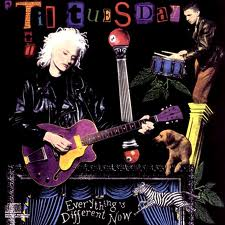
Yesterday I was driving to an appointment and had reached satiation with songs on the radio, so I grabbed the top CD off a stack I keep in my car for just such emergencies. As it happened it was Til Tuesday's final 1988 album Everything's Different Now. Most of the songs chronicle Aimee Mann's breakup with Jules Shear.

I was instantly transported to that period when it seemed all my relationships were, at best, practice at what not to do to be in a relationship. The late 80s was an especially rich sexual time for me when I experienced as much fucking as I could stand, and then more. Men and women were completely open to me, so much so I actually turned some interested parties down, which for a formerly fat kid with a complex was something I never thought I'd do.

But I tried steering some of those short-term escapades into more permanent waters and one of them was something I called The Great Marybeth Romance. Marybeth was much younger than me, 18 to my 27 (ironically, I think, for as much overthinking as I engaged in about the dicrepancy between our ages--and she wasn't even the partner with whom I had greatest age difference--I ended up marrying a woman born the same year as Marybeth and who keeps me honest [whether I want to be or not]), and our coupling was the result of sharing a bed on a weekend New England sojourn to hike the snow-covered trails with another couple.

I don't remember when I first heard music from the Til Tuesday album or where I acquired it, but when Marybeth and I inevitably crashed and burned a month or so later, I played the hell out of the tape. True, some of the songs were too specific to Mann's experience for me ("J for Jules," "Limits to Love," "Long Gone (Buddy)"), but I realized yesterday how much I had taken in all those decades ago. I could sing "Everything's Different Now," "Why Must I," "The Other End of the Telescope," and "Rip in Heaven" word for word, matching Mann's voice inflection for inflection, pause for pause.

The most deliciously painful is "(Beleived You Were) Lucky" whose message I imagined addressed to Marybeth as she sat quietly in a dark room, fantasizing (so I imagined) all the things we could have been and that (for reasons I genuinely can't remember but may have been partly because of our ages) we could never be, a heartfelt and disjointed stream-of-consciousness letter she was writing me abandoned at her feet. (And the album version has the gut-wrenching shift in one word so Mann sings how life "would be fucking great.") Two years later, enough time having gone by to allow a one-night reconciliation, the mix-tape I gave her (foolish romantics still did things like that then) did not include the song, however.

The phrase "deliciously painful" is accurate as I think anyone experienced in this can attest. Even now, there is a luscious hurt composed of equal parts shame, anxiety, pride, wish-fulfillment, and any number of other terms you'd like to add that comes bubbling up at the confluence of such a song and such memories. Some people never have that experience and I simultaneously envy and pity them. It is one of those tightly-held, jealously-guarded, queasy emotions some of us have access to and, for the lucky ones, delight in. For us, the emotion of the breakup is our best memory.

Wednesday, January 29, 2014

my pete seeger story

Like every hippie on the east coast I have my Pete Seeger story. Back in the late 80s I worked at a health food store in Woodstock. There were a number of old personalities that flitted around the place often enough to become nodding acquaintances if not friends. Ed Sanders was one. Arlo Guthrie was another.

One day as I was working the register Arlo came in with an older gentleman, although he must have only been in his late 60s at the time. They bought a couple coffees--we were renowned locally in that age before coffee shops for our organic coffee--and were in the middle of conversation. But both had the grace to acknowledge me when they got to the register. Pete gave me that dazzling smile he always had and Arlo grinned.

I said, "That coffee's especially good today." Pete said, "Oh?" I said, "I made it myself. Nature's magic." Arlo said, "This is, um, Bob, in'tit?" I said yes and reached over to shake Pete's hand. It was gnarled and big and warm.

I said, "Actually, Pete, we met once before." He said, "Oh? Oh sure, you were on the sloop, weren't you?"

He meant his sloop, the Clearwater. I had, indeed, done a day's volunteer turn on it.

I nodded and he said, "A few years out now, wasn't it?" "About two," I said. Pete said, "You know, no one thought we would do much of anything with that old boat but with a little belief and hope we made a difference. Remember that, Bob. You can always make a difference."

He said a few more things but I don't remember much what they were. And I'm greatly condensing what I've written above. Arlo said a few things in there, too.

None of that is important. Here's what makes it a Pete Seeger story. I've met considerably fewer people in half the lifetime Pete lived and I can't keep straight someone I've met a few days ago from someone I met decades ago. Pete didn't remember me. Thousands, tens of thousands, of guys who looked like me and who didn't shuffled across the Clearwater's deck. It was no great prognostication in that town where someone wearing tie dye was probably concerned about the environment and that close to the Hudson River who suggested he'd met the most famous local environmentalist before had probably done so on the deck of his ship. But for a moment Pete made me believe I'd made an impression on him, that he'd remembered me, and that I was important enough to impart a little wisdom to.

But most tellingly, it was true that I was important enough for him to interrupt his conversation with his friend and spend a minute and a half talking with. That, even more than the nickel's worth of advice he gave me, is what I took from him. That everybody, even the guy you were giving fifty cents to for coffee, had an innate dignity deserving acknowledgement. A smile. A few words. A handshake and a chuckle. That's a lesson I like to think I pass on to everyone I meet. That they're worth my time.