Showing posts with label protest. Show all posts

Thursday, February 26, 2026

“What is Happening to Me?”


A Sermon Delivered to 

High Street UU Church, 

February 15, 2026

I used to live about 45 minutes from Minneapolis. My wife says that when I start out with something like that, I should give fair warning that I’m about to tell you an amusing anecdote about myself. But this isn’t amusing and as you’ll see I’m peripheral to the story. Like today, a lot of protests and rallies were happening in the Twin Cities. Most I attended were uneventful, but in September 2008 the Republican National Convention came to town. Joining about 10,000 others on the streets of St Paul, I took with me a young member of my congregation. Keith had been to some protests in his sleepy Wisconsin town but not a large gathering or one with a sizable police presence. I suggested to him before we got out of the car he should leave his backpack of cigarettes and jacket, phone, instruments, and homemade signs in the car. But he was sure he’d need them.

We joined the anarchist contingent, a part of which was the so-called “black bloc,” the masked protesters dumping trash cans, breaking windows, setting small fires. One group eventually set a police cruiser on fire. I didn’t join them. I believe destruction gets you nothing except bad publicity, but I understand also publicity has its place.

Keith and I got separated soon after arrival and later I saw him do a brave thing. There was a large group of protestors at one end of a street and on the other end a large group of police. Now it’s a common sight today to watch videos from Minneapolis and Portland and Seattle and see all these militarized, armed cops in tactical gear and helmets, but in 2008 it was new. I stood with a part of the crowd at one end of the street, observing the standoff, when suddenly Keith emerged from the crowd. He walked to a point about midway between the two groups and sat down on the street. He sat in the lotus position, opening his arms to the cops, miming “Why?” Believe it or not, this had an ameliorating effect on the cops. They were ordered back a few blocks and the protestors marched further.

I saw a lot of things, places being vandalized, tear gas unleashed. Famously, a police car was burned. One protestor who’d thought to bring his own gas mask put it on and was surrounded and pummeled by the police about 20 feet away from where I stood. I stayed upwind avoiding the group collecting on the Wabasha Street bridge. There’s a police tactic called kettling, allowing a group to herd themselves into an area, then cutting off the means to and from that area, effectively boxing the group in. Most of those on the bridge were arrested.

There’s more to this day I’d relate but I’m talking about Keith, so I’ll skip to the end. After his action on the street, I didn’t see Keith again and when I returned to the car at our agreed-on time, he wasn’t there. I waited another hour before I called his cell phone, and it rolled into voicemail. I left a message and then drove the streets looking for him. Many streets were blocked off, however, so I knew there was a chance I wouldn’t find him. About 10 that night I called his mom and reported I hadn’t found him and needed to leave, as I had an 8 AM class next morning. She said she and her wife and her ex-husband, Keith’s father, would drive over and start looking.

Here’s the story as I heard it later. The three of them drove around the now-opened streets of Minneapolis until 3 when they found him wandering one of the streets with a small group of other teens. He’d been arrested a few blocks away from where I’d last seen him while getting a lighter out of his backpack. I knew that backpack was bad business. He’d been pressed down so hard by the cop he had a boot indentation on his back. Somewhere I still have a picture of it. He’d been taken to juvenile and kept in lockup for at least 8 hours. Juveniles don’t receive the fabled one phone call and his cell had long since died.

The cops remained on the streets of Minneapolis for about a week. The image of at least 2 officers armed with semi-automatics and bulletproof vests on every corner became a daily sight.

Here’s why I’m telling you this story. As nasty as the 2008 elections were—you remember the election? Sarah Palin was a Donald trump without either the charisma or the cash. John McCain referred to Barak Obama as “That one” in the second debate but made up for it by interrupting his own supporters’ allegations to describe him as “a decent family man with whom I have some disagreements.” Leading up to the election and after, Obama was described as anything from a secret Muslim, a Kenyan by birth, to the Antichrist. During the crackdown on the protestors that lasted a week, dozens were arrested. Some were hurt. But no one was killed. Other than gas masks when they deployed gas, I never saw a masked cop. Every one of them had his badge on the outside of his gear; Keith’s family eventually sued the officer who’d used excessive force in arresting him and we knew who she was because someone had taken a picture of her and her badge. My court appearance on Keith’s behalf was the first time I’d worn my brand-new clerical collar. People were hurt. No one died. As messy as things got, as adrenalized as everyone was.

Rush forward 18 years and things have changed. We look at one another and at ourselves differently. In under a year we have gone from, well, maybe not a Capraesque Bedford Falls, but it’s hard to deny we’re living in some version of Pottersville. You might remember in Bedford Falls there was a sizable community of hardworking immigrants, but there are no visible immigrants of any kind in Pottersville.

In my instance, I’ve come to see myself differently than before. I’m angry sometimes, at nothing in particular or at nothing I can identify. I avoid the news, and when I don’t I doomscroll. I brood. I don’t brood well. My brooding is less Heathcliff on the moors and more Charlie Brown reflecting on his team’s 156th consecutive loss. “Rats.” I snipe at people whose only crime is being related to people who continue to support trump. I don’t think of myself as depressed, rather as echoing the poet of the Biblical Book of Lamentations who writes, “My eyes! My eyes! They stream with tears! How far from me is anyone to comfort, anyone to restore my life. My children are desolate; the enemy has prevailed.”

In his “autobiographical sketch” of his childhood, “The Ethics of Living Jim Crow,” Richard Wright’s there was a clear distinction between the Black and white children. Among other things, Black children threw clumps of railway cinders at one another in play, while white boys were allowed to throw broken bottles at them. Young Richard catches one of these projectiles in his neck, requiring three stitches.

When night fell, my mother came from the white folks’ kitchen. I raced down the street to meet her…I grabbed her hand and babbled out the whole story. She examined my wound, then slapped me.

“How come yuh didn’t hide?” she asked me. “How come yuh always fightin’?”

I was outraged, and bawled. Between sobs I told her I didn’t have any trees or hedges to hide behind. There wasn’t a thing I could have used as a trench. And you couldn’t throw very far when you were hiding behind the brick pillars of a house. She grabbed a barrel stave, dragged me home, stripped me naked, and beat me till I had a fever of one hundred and two. She would smack my rump with the stave, and, while the skin was still smarting, impart to me gems of Jim Crow wisdom. I was never to throw cinders any more. I was never to fight in any more wars. I was never, never, under any conditions, to fight white folks again, and they were absolutely right in clouting me with the broken milk bottle. Didn’t I know she was working hard every day in the hot kitchens of the white folks to make money to take care of me? When was I ever going to learn to be a good boy? She couldn’t be bothered with my fights. She finished by telling me that I ought to be thankful to God as long as I lived that they didn’t kill me.

What’s happening to me, at least partly, is my disheartening realization that this self-identification with the authorities like Richard’s mother is something we have already seen. Hispanics, Blacks, and women have all joined the Border Patrol and ICE and are, maybe not unilaterally, but sufficiently content with their orders and their targets. My fantasy solution is suggested by the line of a song by The Devil Said Jump. These MFers are gonna “Make Me Buy a Gun.” So far, it remains fantasy because I’m really too much the coward and pacifist to do that. But I will admit I’ve looked up the price of high-end long-distance slingshots. My rationale around that is to echo that of the pastoral character Shepherd Book of the TV series Firefly. When the ship is attacked by government agents and along with everyone else onboard he picks up a gun to fight back, he is asked, facetiously, whether there isn’t something specific in the Bible about killing, he answers, “Quite specific. It is, however, much fuzzier on the subject of kneecaps.”

My point is it can be done, it has been done, without people dying or being maimed. We can’t support a government that acts out of the barrel of a gun. We will not support such a government, we will not forgive such a government, we will remember the government that did this and the people who cheered it on or who, at best, ignored that it was happening. People point out, rightly, if we, by which I mean the predominantly white liberal community, had refused to allow the government to behave this way with Black citizens, Asian citizens, Native Americans, we would not be dealing with the government treating people this way now. Yes, 20-20 hindsight and all that, but there’s at least a salt lick’s worth of truth to that.

I quoted Lamentations earlier. Now I quote the Psalms: “The Lord is near to the brokenhearted and saves the crushed in spirit.” We can surely use some of that certainty, can’t we, the surety of UU minister Wayne Arneson who wrote “Take courage, friends. The way is often hard, the path is never clear, and the stakes are very high. Take courage. For deep down, there is another truth: you are not alone.

It may be time, may be past time, to cut loose MAGA from political thought. Remember the John Birch Society? There’s an argument to be made that Bircherism is echoed by contemporary Trumpism. Long thought dead, it declined in membership from a high in the 1960s of 100,000 to somewhere in the hundreds. It isn’t just numbers. More Americans profess belief in UFOs than voted for Trump—yes, I looked that up—and we don’t take them into political account. They have set themselves outside society. It’s time to metaphorically vote them off the island. I remember during the first trump administration coming across the comment that the only things that would separate most of his supporters from him would be finding a dead woman or a live child in his bed, and there was some question about the dead woman. With each day revealing more evidence, it is obvious the live child makes no difference either.

Am I suggesting we drop those people from our lives? In so many words, I am. It’s possible to love someone and hate his actions. I used to teach in the Minnesota prison system. I liked my students. They were personable. I didn’t ask anyone what his crime was because, a, that’s not something you ask a person, and b, I wasn’t so certain I’d like them after finding out. They looked forward to class days and did all the work because it was a way, as one inmate put it to me, “to remind me my life isn’t just punishment.”

One of my best students and a favorite of mine insisted one evening on telling me why, in his early 20s, he had a life sentence. Without putting too much of a spin on it, he told me he’d raped and killed a young girl in his mid-teens. I had to sort out for myself whether I wanted to keep him in class. I had that kind of power, to drop anyone from class if I felt their contributions ran counter to it. It was a week of some soul searching, and I decided that despite how I felt about his crime, he had earned an opportunity to better himself. It is the same kind of self-questioning anyone with a father, brother, mother, sister, cousin in prison must ask themselves.

I like to think he took some comfort in that, that as bad as he had made his life he could read and talk about good books. I would rewrite the benediction of Reverend Arneson from “Take courage, friends” to “Take comfort.” Where do I take comfort? I take comfort in the love of my family. I take comfort in my animals, the dogs and cats who make up my pack. I take comfort in my work, helping people. I take comfort in my daily walk around my neighborhood, greeting the dogs and cats, and yes, even my neighbors who wear red caps. I take comfort in my activism, in showing up to rallies and protests and marches. I rarely help to organize these and less often speak at them, taking my comfort instead by being a part of the crowd, a quiet body standing in solidarity with like-minded people. It reminds me I am not alone. I take comfort in the words of fellow Unitarian TheodoreParker, that “The arc of the moral universe is long, but it bends toward justice.” But if we would see justice come in our lifetimes we must lean on one end.

Thursday, January 15, 2026

Speak Boldly


"Things fall apart; the centre cannot hold;

Mere anarchy is loosed upon the world,
The blood-dimmed tide is loosed, and everywhere   
The ceremony of innocence is drowned;
The best lack all conviction, while the worst   
Are full of passionate intensity."

These lines from William Butler Yeats "The Second Coming", written over a century ago and describing a world on the brink after and before world wars, remain relevant to our situation. We aren't talking like we should. We should be howling from the rooftops that we are lost and our leaders are behaving the way we were taught were ways associated with the Soviet Union and its satellites. That is, what we have is not to be shared among a just and wise people but hoarded for the few and their favorites. 
There is a cautiousness to our speech today, as if we aren't sure what we believe is believable or that we want to put ourselves out that far to where we could be swatted down. Some individuals are making themselves heard--folks in Minneapolis angered at the death of Renee Nicole Good and people in other cities reacting to the kidnapping and spiriting away of citizens, documented and not, by a trump-anointed militia given the go-ahead to make things as untenable as possible to unloose that mere anarchy so to avoid justice and accountability--and these are good things. 
But what I'm talking about is individuals talking among themselves at the post office, the market, on the street. It is as if we've all agreed to avoid the discomfort of saying something that will somehow offend our listener. Unless of course we are MAGA, and then we can't shut up.
I am as guilty of this as anyone. I am passionate about the criminality of this administration but don't bring it up in regular conversation. There is a weirdness to my conversations. It's a day-to-day unwillingness to comment on the things happening directly in front of us unless we are already certain we're in a safe space, a church group, a protest, a meeting, where we are all basically agreed that this is a bad place to be. 
It isn't as if we're afraid to speak on these things because someone is listening. That's Orwellian enough. But we're self-censoring because we're not certain we're not imagining the illicitness of it all, that we're the ones who are crazy. 
We aren't crazy. We are awake and we see what's going on. For the sake of our future and our communities, we must say so. 

Tuesday, April 22, 2025

Upstanders


 In "A Problem from Hell": America in the Age of Genocide, Samantha Power introduces the concept of being an "upstander" rather than a bystander. "An upstander is a person who goes against the tide and will protect a victim from injustice. The word is contrasted with bystander, which describes a person who does nothing to help when someone is being mistreated."  In her memoir, The Education of an Idealist, Power reflects on and explains the term:

Somewhere along the way, I began describing the book's protagonists--those who tried to prevent or otherwise "stand up" against genocide--as "upstanders," contrasting them with bystanders. I noted that very few of us were likely to find ourselves the victims or perpetrators of genocide. But every day, almost all of us find ourselves weighing whether we can or should do something to help others. We decide, on issues large and small, whether we will be bystanders or upstanders. 

While Power used it initially to describe people who take action against genocide, it has been broadened, as in the above quote from a teaching website, to mean anyone who stands between the oppressed and their oppressor. It doesn't have to be literally standing, of course, but can be protesting, witnessing, writing, performing, preaching against oppressive policies. Whatever the opposite of ignoring them may be.

Senator Chris Van Hollen, in bringing public attention to the lack of due process for undocumented (or in the case of Kilmar Abrego Garcia, of having documentation proving his asylum status and withholding of removal) people being shipped, against court decisions, to a prison in El Salvador, is an upstander. The lawyers representing New Jersey State and others in litigation against trump's Executive Order denying Constitutional birth citizenship to children of undocumented are upstanders. The millions of people taking part in thousands of protests around the world decrying trump policies and the rise of fascist politicians through the 50501 and other organizations are upstanders. 

It's important to note that these are all legal actions done by folks who, in many cases, have little at stake themselves in the situations they protest. They take the higher ground of determining that, in the words of Fannie Lou Hamer, "Nobody's free until everybody's free." 

Monday, December 13, 2021

You matter


WITNESSED IN MILWAUKEE

A little girl, handholding

Two possible mothers, sometimes lifted

By them off the street, shouting,

Louder and louder, “Black Lives Matter!”

Joyous, the way it ought to be shouted.

And a guy turning around, smiling,

Showing her his makeshift sign,

That reads, “You Matter!”

Monday, November 29, 2021

Street debate


DEBATE ON THE STREET DURING A MILWAUKEE PROTEST

Indignant, she
Demands of me, “Well,
Six years later, can you show me what you were afraid
Would come to pass?” I look around,
Seeing in the street moving beside us like foam on the river
Signs about children sepa
Rated from families and encaged; poor
Women in Texas traveling hundreds of miles
For a legal procedure; violence against
Any number of citizens whose only offense is
Being neither white nor straight nor having documents,
 
Finally at her and so many others who would put him right back, and I answer,
“No, I can’t show you anything at all.”

Saturday, October 2, 2021

People the barricades without me


 I hadn't promised to anyone except perhaps myself, and had only mentioned my intention to my wife and mother-in-law, but I expected to attend a small protest here in my small midwestern city. It was sponsored by the March for Women's Rights, the same organization that had set up the anti-trump protest in DC around 2017's inauguration I had missed, as well as one in 2019 in Madison I managed to attend. 

I had somewhat made plans  in the way I do, keeping in the back of my mind while my day goes on were I intend to go and what I intend to do once there. But I read an article this morning--I forget where and can't locate it again--that was a recognition of the necessity of this sort of constant protest, spurred by the recent Texas Law and the number of states trying to ape it. It is a bad law and I am against both it and the attempts by other places to make the same law. But this article had one interview that stuck in my head all day and kept me finally away.

One of the article's interviews was with an older woman who said, and I am paraphrasing here, "Will I be at the protest today? No. It's a protest against the right thing, but Roe v Wade was decided 50 years ago, and I've marched in hundreds of protests to keep it safe, and it's obviously had no effect at all. We shouldn't have to keep marching after something becomes law. I'm tired. Maybe we need to lose the right for a generation in order to remember why we fought for it."

Bitter? Oh, definitely. But it's an earned bitterness. In driving my mother-in-law home, I passed the park where the protest had just started. I saw a number of people I know, all of them over 60. 

Of course, there were other protests in other larger cities and I don't doubt there were thousands of people of child-bearing age marching and shouting and making a ruckus. But that isn't the point. This woman, whose name I can't locate, is right about one thing. We shouldn't have to keep marching after something becomes law. We've marched and made noise for a half century, and if all that has led to is the ease with which a Republican majority can effectively ban a legal and safe procedure, then we have done nothing. Is it wrong of me to agree with her that perhaps we need to lose the right to them for a generation to remind us why we marched? Maybe. But I speak from the perspective of metaphoric sore feet. Those women with more at stake and sorer feet have the right to suggest maybe it's time to step back. 

Wednesday, February 10, 2021

"And I'll be there with you"

This must not be lost down the memory hole. We risk this violence becoming the norm--as the Senate managers say, "our future"--if we do nothing or minimize it. While it's a certainty, given the numbers of Rethuglicans already on record as saying they will not vote to convict, that trump will not be held to account for his months-long incitement that led to it, his actions and his words must be remembered and their result become infamous.

Tuesday, January 26, 2021

Black Lives are Sacred


I'd been asked to say a few words and do a public prayer at a rally for Black Lives in Mequon, near Milwaukee, over the weekend. I did so and enjoyed the company. 

These are my remarks. "As we were setting up today, someone drove by and shouted 'Get a life!' And what they fail to recognize is that we are here because so many lives have been taken. We come together because people have died. Died frightened, died pleading, died unheard. We mourn those deaths. But we come together too because of the living. Living in despair, in fear, in poverty of spirit. We come together to make this known, to point to it and swear that lives are no less sacred for that. We would be whole. When one of us cries, we all cry. When one bleeds, we all bleed. When one dies, we all die. Today, we all mourn. We ask to be brought together. Make us one. If we've forgotten, remind us it is good to be together. It is good to be beside one another in fortune and in pain. It is good to look into each other's eyes, to hear each other's voices. Remember the sacredness of our brothers and sister's lives as our own. We would be one. To make all lives safe and meaningful. To be as one and act as one, we would be one." 

The prayer is one I cribbed from John and Sarah Gibb Millspaugh, an adaptation from Pali canons. 

Opening: In the UU tradition, it's not just ministers and religious professionals who have the power to bless. Each of us has the power to bless one another, and therefore bless the world. The words are ordinary words, but we make our blessing real through our shared intent. 

Prayer: "As we have been blessed, so we bless one another to be a blessing. Breathe in, breathe out, this breath we share with all that breathes. Feel the love of the universe flowing through this joint community into you and out into the universe again. Let the love of all the universe--your love--flow outward, to its height, its depth, its broad extent. You are more than you know, more beloved than you know. Take up what power is yours to create safe haven, and make of earth a heaven. Give hope to those you encounter, that they may know safety from inner and outer harm, be happy and at peace, healthy and strong, caring and joyful. Be the blessing that you already are. That is enough. Amen." 

Wednesday, January 6, 2021

Peaceful transition is the difference


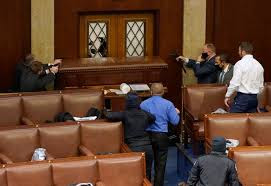
 There is so much to be said about this attempt today to delegitimize the otherwise dull, ritualistic ceremony that, like clockwork, simply move forward the result of the presidential election. Like a commentator I listened to today pointed out, normally no one reports on the record of electoral college votes. It's one of those things, like asking at a wedding if anyone objects to the marriage, that is a holdover from a time when there was really a reason to make the result public. 

But that wasn't the case today. Hundreds, perhaps a couple thousand (reports vary) of trump supporters marched from the White House, where they were given "instructions" by trump, to disrupt the otherwise rote recitation of electoral results. They stormed the chambers and succeeded in postponing the naming of Joe Biden as the winner of the election. 

There's been a lot of anger aimed at the disruption by trump-supporters and I'm not entirely certain where I stand on that. I'll admit there's some jealousy I feel that a group I can't agree with has been able to do what groups I can identify with have been unable to do. Rituals are nice but they can and should be questioned and maybe thrown out. If these were Black Lives Matter or some anti-trump group, I might have been tempted to join them. But I am furious at the disruption of the most important facet of the American experience, the peaceful transfer of power. 

Democracy demands the loser of a contest recognize it and allow the winner, an expression of the will of the people, to take the reins. Four years ago, while it sickened me that he was that expression, trump peacefully and legally took the office. I protested him and protested his administration. But I wasn't going to join others in rioting against the ceremony or the final decision of the process. It would not have been peaceful or right.

Friday, November 9, 2018

Slow, steady, resiliant

Yes, this is a photo of part of the group
There are a number of solid progressive advances made in the midterm elections--and for those without a historical memory, I'll tell you of the steady incremental election strategy of the Moral Majority, whose elevation of populist Xian "values," most of which are about exclusion rather than inclusion, and its tremendous continuing success under other names and leadership--that most of us may be unaware of or that are buried in the back pages of local outlets. But it is those small, solid, progressive victories that we must build on if we want to make lasting change at any level.

Last evening I joined a number of like-minded progressives on a street corner in downtown Sheboygan in the cold and early darkness. I was surprised by two things. One was the number of people who had shown up. When I had signed on as a participant the night before, there had been about 8 others in solidarity. As I drove there, I vowed that if I was the only one to show, I would at least stand at the corner myself (I was thinking specifically of this example). But between 40 and 50 people, ranging in age from late teens to early 90s, appeared, some with signs, some with kids, one with her dog. We made noise and we were a presence.

And it was the reaction to this presence that supplied me with my second surprise. Unlike most protest marches or rallies where I've walked or stood, the response from people passing, both walking and driving or cycling, was overwhelmingly positive. Horns honking, hands waving out of windows, shouts of encouragement and support, a few walkers and cyclists who chose to stop and stand with us, swelling us beyond the 50+ mark. Negative responses? One or two shouts of "Go home!" delivered from cars that had already passed us.

My takeaway? We are on the right side of both history and a majority of the American people. At least that sample passing through a main thoroughfare of Sheboygan at ~6PM on a Thursday.

Sunday, July 1, 2018

Lift Every Voice

I will confess to feeling, if not burned out, then exhausted by the massive, deaf wall that is Trump and his supporters. They feign to be doing either what the law demands or what the economy demands or what the American people demand, and when it is proven, by polls or votes, that the people do not demand it but demand exactly the opposite, they purport that the polls are wrong or biased or lie or simply that the people don't really know what it is they want.

But as British columnist Emma Brockes reminds us, 
Trump’s presidency has been one long series of outrages [between] the twin risks of normalisation and outrage fatigue... [Citizens] are reduced to a state of numbness and apathy, caught up in a cycle of responding to each buffoonish Trump tweet while the bigger picture pixelates away to abstraction.
We run the risk by being so absorbed in the latest Trump scandal, insult, evasion, even missteps, that they become a huge Trump lump of just "another example how Trump and his supporters don't care about or pay attention to either the law or other people." As a result, we become that luckless employee who, with each new offense by his employer, rather than working to change it, prides himself on crossing off another day until retirement. 

I understand that because I feel it myself. I become mired in the constant battles with Trump supporters who insist people "like me" either don't understand the law/politics/history/reality or that our only problem with the situation is that it's Trump rather than Hillary or Obama making the policy. And when "people like me" post, over and over, proof in the form of primary sources or analysis by historians or research done by what for the majority of us satisfies the requirement of objectivity, we're told it's fake news, or that its source is biased against Trump, often in the form of a post from someplace purporting to prove Snopes is financed by Soros or The New York Times is a liberal front. There are only so many times we can be told Richard Specter is more legitimate a resource than Paul Krugman.  When everything is true, nothing is true. 

But I have to repress the natural instinct to turn from these blasts against reality because in the meanwhile, real people are suffering and afraid. I can't justify to myself staying out of the fray because it's too hot, it's too exhausting, it's endless, it's frustrating. To do so is to deny the humanity of the people whose humanity I want to uphold. 

I was among the hundreds of thousands of protestors (in the US alone; I don't have figures for the world sites of protests) at the Families Belong Together rallies. At mine, Congresswoman Gwen Moore of Wisconsin's 4th District spoke, and while I don't remember what she said I was impressed by the passion and indignation in her voice. Such fiery voices, speaking truth to power, are perhaps all we have in our arsenal. Can voices change abuse and evil into something better? It may seem like they can't, but voices after all were all the abolitionists had, and Women's Suffragists, and Civil Rights workers. It worked for them. It will work for us. Si si puede

Wednesday, August 16, 2017

It's gone too far

The past couple weeks have been maddening, chaotic, not only personally but, more importantly, nationally. It can't be mistaken that I'm in any way a Trump supporter or apologist, but I couldn't have wished on him the clusterfuck he has brought on himself.

I don't think I have to explain much of anything about what happened this past weekend in Charlottesville, VA. By now just about everyone knows at least the basic facts: that an event calling itself Unite the Right obtained a permit for a march on Saturday, ostensibly to protest the removal and relocating of some local statues to the Confederacy. That the Friday night before, various groups there for the march held a pre-march march through the campus of the University of Virginia, chanting slogans like "You will not replace us," "Jews will not replace us," and "Blood and soil." That this encouraged more counter-protesters to appear the next morning; that the rally was declared an illegal assembly after there were violent outbreaks that included beatings of counter-protesters by Unite marchers, in one infamous instance using poles (warning: not only a brutal scene but very annoying ads to get through for the video). That in one related instance a helicopter crashed a few miles from the rally, for as-yet-unknown reasons, killing the two VA State Troopers inside; but not before, tragically, a car driven by a rally attendee rammed into several groups of counter-protesters, injuring nearly twenty and killing one.

At least it used to be that just about everyone would know that back when we had three channels with nightly news. With innumerable sources claiming to be collectors and disseminaters of what they call "news," some of it legitimate, most of it conjecture if not outright wishing, a reasonable commentator can't assume everyone is up to speed in the same way. Trump, famously, is primarily a consumer of a single network that provides news entertainment and a few websites, most of which present him in as positive a light as possible. Most recently, we have learned that he may be given a twice-daily set of memos detailing nothing other than "screenshots of positive cable news chyrons..., admiring tweets, transcripts of fawning TV interviews, praise-filled news stories, and sometimes just pictures of Trump on TV looking powerful."

Which may be why Trump reported in his initial statement on the violent events as the deaths and injuries were something that could be blamed on "many sides," a statement that defies analysis. We don't say that a mugger or an arsonist has "a side." Beyond his version of events, he doesn't have a side for having done what he did that we need to pay attention to. Barring exceptional circumstances, robbery and arson are bad acts unto themselves, not to be addressed as if they have a "side." Similarly, assault and intimidation by self-identified Nazis and KKK members against unarmed protesters don't have a side. 

If we had thought Trump had reached his nadir, then we weren't prepared for what was to come. Having made a further statement on Monday making more explicit his condemnation of racism, naming "the KKK, neo-Nazis, white supremacists, and other hate groups," on Tuesday night he made what one supposes he hoped would be a final word on the subject. Naturally, being Trump, it will not be. At least not by commentators and, one hopes, by Republican lawmakers. 

His comments were nothing less than offensive and accusatory. “I’m not putting anybody on a moral plane,” he began, before going on to do exactly that. In the ensuing days somehow the counter-protesters had become armed attackers. “You had a group on one side and group on the other and they came at each other with clubs – there is another side, you can call them the left, that came violently attacking the other group." That defies verified videos of the events, although Trump explained to reporters he had watched videos "closer than you did." 

He made the further argument, "You had people that were very fine people on both sides...Not all those people were neo-Nazis, not all those people were white supremacists. Many of those people were there to protest the taking down of the statue of Robert E Lee." There is an argument to be made that not everyone who joined the National Socialists believed in their policies or their actions. That argument can be made for members in the 1930s and 1940s. Not for members in 2017. There is no parallel argument to be made, by the way, for members of the Ku Klux Klan at any period of history. Both groups and their auxilliaries have, by their words and actions , put themselves beyond the scope of society, and while their right to exist and to present their "side" is protected by the Constitution, it is only so long as it is done peacefully, not with guns, poles, and torches, and certainly not with hurtling cars. So far as the comment about people there to protest the statues' removal, yes, they are probably "fine people," but it isn't their argument about the statue that's at contest here, it's their actions of rushing the counter-demonstrators, hitting them, and intimidating them with guns and ersatz riot gear intended to make them look like official police. 

We are at an important moment in history. Trump and the thirty-five percent of Americans who somehow continue to think he is doing a job worth approving are at the end of their influence on the important policies of American governance. I've often pointed out that more people believe in ghosts than believe in Trump and we don't allow them to run the country. 

Trump has reached his sell-by date; in fact, in the fact that it's cost at least three Americans their lives, he's passed it. The sooner he resigns (preferable because we don't want the martyrdom that might come with impeachment), the sooner the reconstruction of American political life can begin. I don't like Mike Pence as the president, I think in some ways he'll be worse than Trump. But he'll be consistent, he'll play by the rules. And he'll know not to confuse self-proclaimed neo-Nazis and members of the KKK with voters whose endorsement he wants. 

Tuesday, January 24, 2017

The Women's March at human scale

I could not make it to the March, as I've reported, but the host I was going to stay with took several photos and gave me permission to post them here. And while they are not as staggering as the aerial pictures in breadth or scope, they help bring the event to human scale.


Sunday, January 22, 2017

Democracy wears pink

Listening to the speeches during yesterday's coverage, I heard this conclusion to one that turned out to be by Van Jones"[Trump's supporters] came to this town yesterday. They had red hats on. They were proud of their accomplishment. And they thought they had taken America back. What they never counted on was a million women in pink hats that are going to take America forward." 

Saturday, January 21, 2017

Why I didn't end up in DC

It's a sort of a for-want-of-a-nail type story. Except in reverse. And not really about a nail, unless that's what the thing in the above photo started as. I expected to be in Washington, DC, for the Women's March the day after Trump's inauguration. I had the time off, I had a place to stay thanks to the UU congregation in the city.

But from the beginning it was almost as if I wasn't going to end up there. I planned to leave home around nine o'clock Friday, but I didn't leave the house until nearly eleven. My GPS had timed my drive at about thirteen hours, so that would put me in DC after midnight. Then as I was crossing the Chicago Skyway Bridge, a mere couple hundred yards from the Indiana border, my tire went flat. I spent roughly an hour on the Bridge changing the tire, which threw my shoulder out something fierce. I was successful, but then I had to get a new tire. A donut simply wasn't going to last from Chicago to DC. Waiting around for another tire and for it to be changed chewed up at least another hour.

I got back on the road, but shortly after leaving Gary, I was engulfed by fog, dropping visibility to nearly a half mile. By seven o'clock, I had only made Elkhart, Indiana, perhaps a third the distance I needed to cover. So I hedged my bets, decided my best option was to travel on straight to Pennsylvania to visit my father (my intent for the vacation anyway), contacted my host, and stopped for the night at a place on the Michigan border.

I called my wife this morning and told her of my divided sensibility, this feeling of wanting to be in one place but opting to be in another. But my wife, who likes to downplay her own wisdom, pointed out that my decision to visit my father was more what was necessary than another body at the protest. The elderly, she said, were among the most vulnerable of populations, and it's the vulnerable who need the greatest love and help during what will come. Wisdom, as I say.

So today I spent driving the rest of the distance, listening to the coverage on Sirius XM's Progressive 127. It was, in some ways, both an enjoyable and humbling experience. I was envious, looking at occasion at FB friends' pictures from their own marches, some in DC and some in other cities, feeling I was missing out, having given up an opportunity to be a part of history. But I was also made hopeful in new and unexpected ways by the numbers of people who were. Listening to the radio, songs playing on the radio seemed to me like messages of kismet from deejays: "Revolution" by the Beatles, "Evolve" by Ani DiFranco, "People Have the Power" by Patti Smith, "Volunteers" by Jefferson Airplane, "Stand" by Sly and the Family Stone, "Talkin' Bout a Revolution" by both Tracy Chapman and Living Colour. I felt, if not the pangs of birth for a revolution, then the opening salvo across the bow of the Trumpocalypse.

Monday, December 12, 2016

Your silence will not protect you

To say I remember Audre Lorde fondly may seem like an odd thing--her messages were intended to generate nearly every kind of feedback except fondness--but in her I had the sensation of a fellow-traveler, a black, lesbian me who could write better and had a better sense of what it was she fought. She wrote in 1977 in "The Transformation of Silence into Languge and Action":
To question or to speak...could have meant pain, or death. But we all hurt in so many different ways, all the time, and pain will either change or end. Death, on the other hand, is the final silence. And that might be coming quickly now [she had been diagnosed with breast cancer and then with liver cancer], without regard for whether I had ever spoken what needed to be said, or had only betrayed myself into small silences, while I planned someday to speak, or waited for someone else’s words.
 I was going to die, if not sooner then later, whether or not I had ever spoken myself. My silences had not protected me. Your silence will not protect you.

Monday, July 11, 2016

258 candles-day 136

It's the sort of picture that becomes iconic, although whether it becomes as much so as the ones it's being compared with, like Tank Man in Tienanmen Square or Walter Gadsden at Birmingham, is up to history. Nonetheless, it's a powerful image, so much so I don't think anyone needs to explain it. Johnathon Bachman, the photographer, reported, "It wasn’t very violent. She didn’t say anything. She didn’t resist, and the police didn’t drag her off." There are reports that the woman, who was arrested Saturday and released Sunday evening, is named Iesha Evans, and that she's a nurse and mother, although I stress that even that simple information, so soon after the event, is uncertain. What is certain is this: That the photo evokes both what we are fighting against and exactly the way and the manner in which we need to do it.

Thursday, June 30, 2016

258 candles-day 126

I've been wracking my brain trying to think of what I can say that will mean anything to anyone about the current dismal, distressing state of politics in this country. And I've come to realize this: There isn't anything I can say. But there is something I can do.

My solution, based on the Chinese proverb that it's better to light a candle than to curse the darkness, is to provide daily candles in the form of links to other people's solutions, simple or complex responses to problems that they see. But as a single candle will hardly provide enough illumination to blot out the darkness that is the pettiness and meanness that characterizes this election cycle, I will light 258 candles, one each day between now and election day. In this way, I will do my part to remind each of us we are better than the baseness of the bases.

Today: I might have chosen a few other examples--the West African Muslims and Christians who protected each other's congregations on holy days, the spontaneous response by airline passengers to a grandmother's grief, or even my own denomination's Standing on the Side of Love--but this is a good beginning. 

Saturday, November 21, 2015

on being a shit-stirrer

This morning I was engaged in an argument with someone on Facebook about my stance on Black Lives Matter, and at the end she called me just a person "stirring the shit pot." At first I was taken aback. We were having an argument about things that have an answer-does BLM have a right to protest (of course it does); has the leadership disavowed violence that was done during its protest (yes, it has); is there an objective study suggesting young black men are likelier to be recipients of police violence (yes, there is)?

After reflection I told her she is right. I am a shit-stirrer. Shit doesn't just hop out of the pot on its own. It settles at the bottom where it poisons everyone. Stirring the pot brings it to the surface, where someone can scoop it out.

Monday, May 4, 2015

as we watch Baltimore burn

I have been in Baltimore a handful of times, usually on my way somewhere else. I don't think I've spent more than a day there. Most everything I know about the city comes from the novels of Anne Tyler. And the Baltimore she writes about, needless to say, is not the Baltimore of Freddie Gray.

But I'm not an impartial third party either, insofar as I believe we can and should live in a single, worldwide beloved community. My recognition that we don't isn't an admission to the impossibility of the dream, only of our unwillingness to accomplish it. And I know if my city was aflame, I'd certainly want other people caring about it.

I read this essay by Brittney Cooper several days ago and it won't let me go. Try as will to understand the positions of the three black women who are the official faces of Baltimore-Stephanie Rawlings-Blake, it's mayor; General Linda Singh, of the Maryland National Guard; and just-confirmed Attorney General Loretta Lynch-indeed, even to commiserate with them (as she writes, "Not one of these women stands in the place of power she stands in without having battled for it"), she ends up recognizing that "American empire, in its most democratic iteration, is no respecter of persons. Any person willing to do the state's bidding can have a role to play." Cooper locates the sound of the shattering of the peace among the poor and disenfranchised of Baltimore in the sound of the snapping of Freddie Gray' s neck.

That is a horrible metaphor. It is also resolutely true and it's in the truth of it that the horror lies. No one in my community ought to be familiar with that sound.

More troubling has been the response of strangers, and even some people I know, to the riot in Baltimore as if Freddie Gray's death is excused because of the reactions to it. As if Baltimore police were somehow punishing him in advance for the temerity to ignite the CVS with his death.

The simple truth of the situation is that Freddie Gray should not have died. I contend he should not have been arrested in the first place, but even if we grant he had committed a crime, including murder, there is no reason for any person to die in police custody. To quote the character ML from the great Do the Right Thing, a film whose subject, the death of a young black man while being arrested, should not be nearly as contemporary twenty-five years later as it is: "It's as plain as day. They didn't have to kill the boy."

But most troubling is the epiphany I have come to. If I was in Baltimore would I join the riots and looting? And the answer is yes. Yes, I would. Not because there are things I want but that there are things I don't want. I don't want predatory lending in my neighborhood. I don't want a military presence in my neighborhood. I don't want to be called a thug when I strike back against a system that threatens me and my future. I don't want police killing anyone whose most criminal act is running away from them. And because of where I live and who I am, or specifically who I am not, I don't experience any of that.

Neither should anyone else. It's as plain as day.