Showing posts with label polls. Show all posts

Tuesday, January 16, 2024

It's About How We React


No doubt, it has to be one of the most frightening experiences, made more so by the recognition there isn't anything you can do about it. That it doesn't happen more often is a miracle of design in itself. That anyone can remain calm in the wind and blast of it is amazing.

I speak, of course, of Donald trump's appalling ascendence in the republican polls.

A week ago, this happened as well. The panel of an Alaska Airlines plane dropped off midair. No warning, no immediate explanation, just a sudden bang and blast of cold air. Who wouldn't scream at that? Well, not the pilot. Note the calm in her voice. Apparently none of the passengers either. All witnesses report that, whatever people might have been feeling as individuals, the immediate effect other than the sound of rushing air was silence. 

And while that also precipitates the certainty of doom and collapse, I want to point out what the passengers and flight crew of Flight 1282 out of Portland did not do. They did not panic. They did not put themselves or others in danger by ignoring the dropping air masks or unbuckling their seatbelts in order to move back further from what more than one witness has called "the gaping hole two-thirds the size of a refrigerator." 

What they did was, after I'm certain an immediate round of screams and expressions of astonishment, to behave the way people are supposed to in an emergency: they trusted themselves to the professionalism of the trained crew to keep them safe and return them to land. And it happened, exactly the way it should have. If it weren't for the novelty that a panel blew off in view of the passengers it might not have even been reported beyond the local news. 

The latter is the way we must react to the news of the former. After acknowledging trump's resurgence  as something unprecedented, we need to relax, damp our individual panic, allow that it is happening, and allow the crew, which is us too, to get us through this safely and securely. It's unlikely trump will reach the presidency again, and if he does we will deal with it, but American voters are our own best pilots. We know what we must do and trust ourselves to get us back on the ground without casualty. 

Sunday, April 16, 2023

The Fred Durst of Presidents

I'll own to more than a frisson of schadenfreude at trump's indictment and arrest. And while it's a shame not to see him frog-marched ahead of members of his administration, or the sight of trump Force One disappearing over the horizon carrying him, his family, and the clothes on their backs and bound for Argentina or Moscow, there is some pleasure to be had by his being taken down a peg by the petty act of not having a door held for him. But that is petty on my part too, and the truth is he's not worthy of my disappointment or disdain.

Those I save for the United States and the rethuglicans in Congress, the Senate, state and local offices, and individuals in the streets and on TV who support him and would, given the opportunity, vote for him. Again. 

It says something repugnant about our nation that trump won the 2016 election and avoided removal from office for four  very long years in which the policies his sycophants enacted under his--well, you can't call it "supervision" or "governance," so call it "willingness"--caused the deaths and misfortunes of countless citizens and would-be citizens. They were allowed not only to occur but encouraged those results. Donald trump, in retrospect, should have been allowed no closer to the Oval Office than Fred Durst should be allowed on a stage without the involvement of a broom. 

So while I delight somewhat in his troubles, I mourn our own acquiescence in the the fact he was allowed to make them. It should not have happened, and once it did, should have been repaired as quickly as possible. We have the legal means granted by the Constitution and laws to have done so but that we did not is a black mark against us, adult US citizens, a millstone that will hang on our necks. It should. We are finally, finally seeing the results of careful investigation and prosecution, and even if he never spends an hour in an orange jumpsuit, his loss of prestige will inevitably lead to the loss of his apologists. Or it should. I don't think we're headed in any way toward an active war, civil or otherwise, but that trumpanistas and rethuglicans are entrenched in their spider holes and mom's basements, as well as in the seats of power, tells us all we need to know about what they believe. 

We should not have to think about him any more, and that we do is our own fault. 

Thursday, August 11, 2016

258 candles-days 158-160

An important element of the American experiment is our dedication to the contributions by immigrants and our celebration of the diversity they bring to the melange of American society. Back in the hub where I used to live, there's been a battle for the opportunity to represent a Minneapolis district in the state legislature. The incumbent, Phyllis Khan, has been in office since 1972. Two challengers, Mohamud Noor and Ilhan Omar, were given little chance at replacing her. However, in the August 8 primary, Ilhan Omar won.

This is significant, not only for Omar and her potential constituents, but for what it means to America. She will not be the first former refugee to become a legislator or the first Muslim, but if she wins she will be the first Somali to serve in a legislative role in American politics, and in a landscape where we ask  whether we have a responsibility to, say, Syrian asylum-seekers or whether the so-called War on Terror is a euphemism for a War on Islam, that is an important voice. This is what makes American culture not only a fascinating experiment but one that's worthwhile as well.


Tuesday, February 23, 2016

258 candles and counting

Like a lot of people, I've been watching this election cycle with dismay. Unlike a  lot of them, I have a real love for politics. I believe strongly that humanity is homo politico (or however that might shake out), a social animal that thrives on give and take. Politics, after all, comes from polis and describes how we live in proximity to one another.

That said: Yes, I repeat, a lot of people are watching this election cycle with our fingers in our mouths, afraid for what may be. For the first time since the millennium, this is the Democrats' election to lose, and lose it they seem determined. As is so often the case, they are their own destruction, because ideal is the enemy of good. Is one Democratic candidate preferable to another? Probably. Regardless, each candidate's partisans (not, I stress, the candidates themselves, who are conducting old fashioned, strong electioneering without rancor) strain themselves to proclaim that unless their candidate becomes the party's candidate, they will sit this one out.

That, of course, may hand the election over to one of three possible Republican candidates, two of which are bad enough but the third makes an absolute sham of the process. He is not a candidate in the traditional sense (for better or worse), offering positions and potential solutions to social and economic problems. He's simply saying whatever comes to his mind or what he knows will give him play in the next 24 hour news cycle. He is a boon to news directors, who really don't need to have reporters cover any of the others; they need only to play, sometimes in entirety, that guy's latest speech or conversation. In place of suggestions for how he will handle a given situation, he offers tripe suggesting that, when elected, he will do what needs to be done. He will get us the biggest, the best, the largest, the most effective government money can buy.

I've been wracking my brain trying to think of what I can say that will mean anything to anyone about any of this. And I've come to realize this: There isn't anything I can say. But there is something I can do.

My solution, based on the Chinese proverb that it's better to light a candle than to curse the darkness, is to provide daily candles in the form of links to other people's solutions, simple or complex responses to problems that they see. But as a single candle will hardly provide enough illumination to blot out the darkness that is the pettiness and meanness that characterizes this election cycle, I will light 258 candles, one each day between now and election day. In this way, I will do my part to remind each of us we are better than the baseness of the bases.

Today: True Colors Residence.

Monday, December 1, 2014

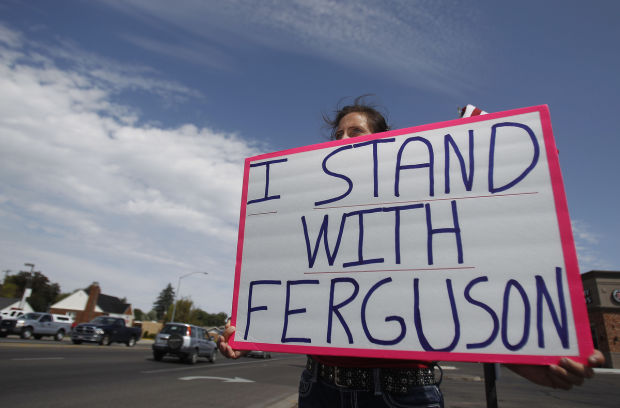
no one should still be protesting this shit

Guys I knew in high school have posted links on Facebook, from notes of solidarity with soon-to-be-former Officer Darren Wilson to strenuous denunciations of the Ferguson black community and Michael Brown and his family. I've responded to many of them, sometimes letting my frustration and anger show. I would love to simply sit back and let their remarks flow over me like it is water and I am a duck' s ass. But as I pointed out, that is the definition of privilege. And I am prodded by the words of Desmond Tutu, that if we try to be neutral in the face of oppression then we have joined the side of the oppressors.

What galls me, not only in relation to the arguments they've put forward, but about similar arguments that regressives as a group have parroted, is the idea, as if it has never occurred to them, that what they accuse Michael Brown-and it is severely fucked up that anyone would use that term, willfully blind to the notion a killed black kid should be accused of participating in his own death-of doing is exactly the same as many of them have themselves done in the past, or have known people who have done similar things. No one deserves to be shot for having stolen from a store. No one who is unarmed deserves to be shot for charging a cop who is hundreds of feet away. (And despite the claims of Fox News, neither question is settled.)

If there is a people in America who should least have to protest against still having to protest this shit, it should be black people. Yet we are here, over two centuries after a revolution declared all Americans free, a century and a half after the last slave-bearing ship entered an American port, after a destructive Civil War, nearly five decades after passage of acts devoted to reconciling civil rights, and nearly a decade after a majority of Americans elected and then reelected a half black man with a funny name, still, still, protesting this shit. I like to think the sons and daughters of these guys with whom I've been arguing will not have to hold a similar sign or have similar arguments, but I am learning that hope, in addition to being feathered, may also be vain.

Tuesday, November 25, 2014

maigret and the white privilege


[The old vagrant's] murder must have been premeditated, since people do not as a rule go around [modern cities] with...firearms in their pockets.
--from Maigret and the Loner by Georges Simenon

I have loved mystery novels from an early age, and in my early adulthood I discovered Georges Simenon's Maigret series. This is a police procedural involving a rumpled, middle-aged superintendent in late century Paris who does not always get his man, but always locates him. The books are short, often less than 150 pages, and rush along. Simenon wrote them for money, in as little as a week sometimes, and they are legion (his output hovers at around 200 novels; it is uncertain as even he forgot some of the pseudonyms under which he published). The English translations, fittingly, are often fast and loose with meaning, and where there are cultural differences a Parisian reading them would easily understand, there is no attempt made to accommodate a young American also from the late 20th century. Their titles are always, invariably the same, Maigret and the..., as if the superintendent is not seeking an individual but a class or a type. They are my comfort food.

I have been following the events in Ferguson, Missouri, pretty closely, from Michael Brown's death to last night's announcement that there would be no charges filed against Officer Darren Wilson. I'll admit, I had made up my mind already that Officer Wilson was culpable. I hoped that the grand jury would see the evidence that way and he would be held responsible for the shooting, but I also had made up my mind that was unlikely.

On my way back to where I am staying last night I listened to the press conference on one of the stations I often listen to, Urban View, which airs shows by Reverend Al Sharpton, Tavis Smiley, Karen Walker and Joe Madison (The Black Eagle, my favorite), among others. When the announcement was made that he was not going to be indicted, I turned off the radio for four minutes and thirty seconds, a request made by Brown's parents memorialize the four and a half hours their son's body lay open in the street after the police arrived. Then I switched it back on and listened to the people calling in to make their opinions known.

Yes, opinions are like assholes and all that, and most of them said exactly what I assumed they would say. But what came across to me was the anger and sense of betrayal they felt. These were the words and immediate reactions of a people who had climbed their way out of a cynical belief that maybe, this time, things would be different. Like the Trayvon Martin case, it had taken the outcry from social media for the police even to do the minimum investigation and to hold the self-admitted killer of a teenaged black boy to some form of accountability. They had made their way to the upper layers of hope, and had been sunk by the announcement down again into cynicism and despair. Nothing, every one of them said in varying words, Nothing has changed. Black murders don't count. We live in a police state in which we can be picked off for as simple a threat as walking down the center of the street.

I allowed myself, after reaching my in-laws' home, to take advantage of my privileges and turn off my computer and radio and sink into the comforting embrace of Maigret.

I have listened to the evidence that's available and I understand how the grand jury can find Officer Wilson's account believable. My own belief, for what it's worth, is that the situation unfolded at least in part as he reported, but grew terribly, terribly larger than he expected. I don't pretend to know what happened. But as a person who worked in direct care with adults with enormous mental deficits, I know that he is not the first person to have had a situation backfire on him, overreacted to the situation and someone was hurt, and then relied on the privilege his status automatically gave him to downplay his own responsibility as much as possible, and put the fault on the victim. I am convinced that is what happened here.

Perhaps the grand jury is correct. Perhaps Officer Darren Wilson is not at fault. Perhaps he was only acting on what his training, his communities--police, geographical, cultural--and his prejudices had told him were the right ones. Perhaps it is those, and thus us, who are at fault. Of course, as someone once said, when everyone is at fault, no one is at fault.

The voices on the radio were right, nothing has changed. And nothing will change in the immediate future. As with the aftermath of the release of George Zimmerman and the incredible amount of time (admittedly, this may be a good sign) devoted to the grand jury in the case of the chokehold death of Eric Garner, the hoopla will surge for a few days, maybe a week, maybe longer. But eventually it will disappear down the memory hole we seem to have for people killed for complicated reasons by people we are told we should see as protectors. And when it happens again Michael Brown's name will be listed with Emmet Till, Eleanor Bumpers, Michael Stewart, Amidou Diallou, and many others who have been killed by people who know better but who chose to treat them as if their lives were, at best, less important than other people's. And we will cry and protest and perhaps even riot again. And nothing will change.

Until one day, for better and for worse, it suddenly will. Woe to us all then.

Wednesday, November 5, 2014

we are not hedgehogs: progressive in a season of despair

Many of us are waking this morning to the news of the overwhelming victory by republican tea partiers in states and at local levels. This, their resurgence, after we have been promised that they were dying, a dinosaur interest group struggling one last time against pull of the tar pits. For those of us who suffer from seasonal affective disorder, this has become a season of despair, a Fall.

I will not lie to you, it is bad. In my own state, the governor who easily beat back a historic recall effort has won reelection by a wide margin. Regressive candidates won handily in a state whose watchwords not so long ago were "there is strength in a union." A congressman whose primary strength is his name recognition as a member of a reality show, won a third term.

On a national level, Wendy Davis, in whose campaign many of us saw a grassroots effort to turn around the deeply regressive state of Texas, lost in a landslide victory to a candidate who boasts of the two dozen lawsuits he's pushed against the federal government whose policies he must administer. Republicans not only held the House of Representatives, but won control of the Senate. A conservative friend has posted on Facebook, "[With Harry Reid no longer Senate leader,] America will see Obama is the real obstructionist." And I'm sure, from her perspective, this is true. If, as they've promised, the Tea Party members put forward impeachment proceedings against him, attempts to repeal the Affordable Care Act, draconian Mexican border rules like the infamous Arizona "Where are your papers?" law, and similar attempts, then yes, they will see that Obama is indeed obstructive.

There are, of course, small victories, most of which are the retention of incumbent Democrats, and the defeat of Pennsylvania governor Tom Corbett. That's about it. I wish I could say these Tea Party victories (and they are Tea Party victories, despite the strenuous effort of Republicans to deny their influence) were the result of mass fraud, disappeared ballots, or deliberate intimidation. But I can't. The truth is that their supporters turned out in greater numbers than ours did. And while many Americans decry the complacent, worse-than-useless politician, it is always the other guy's representative who needs to go, not mine. While the numbers for voter turnout aren't available yet, the chances are that they will mirror previous midterm election years, when people show in smaller, more centralized numbers (although if anecdote is allowed, the turnout in my little corner of the hub had already reached number 107 when I voted at 9:45 a.m., a heavy showing in a township of about 500 voters.

It is a hard time. We will see advances rolled back, people who rely on the government for help more marginalized, if not fully scapegoated as under Reagan, the further erosion of the remains of the middle class and greater emphasis on what the upper classes want, more scandals, greater instances of hypocrisy, angrier turning inward on ourselves and villainizing the outer world. Progressives could be forgiven our cynicism, if we turn hedgehog, burrowing into our dens to hibernate until the sweet resurgence of spring.

But there is no such promise. Unlike spring, progressivism isn't a given, a season naturally following the winter of despair. It will not come on its own and all we need to do is duck our heads and wait. We are not hedgehogs. Spring is not guaranteed, we must bring it, bud by bud, thaw by thaw. We can no more give in to easy cynicism than we can dig a hole in the backyard and curl up in it. We will not survive in either case. We must call shit for what it is, and we must continue, despite the odds, despite how unseemly it may seem, despite how much we must ourselves pay for it in terms of public and personal condemnation, to fight and fight hard. When Barack Obama won the presidency nothing was settled, we knew we would have to continue working, sometimes in opposition to him. Nothing has changed. We must be underdogs victorious.

Tuesday, February 25, 2014

do we want to be gated?

As America grows more liberal, conservatives are retreating into a variety of isolated subcultures and, when necessary, making or manipulating law to insulate them from contact with the masses. Like a cultural manifestation of Going Galt. Welcome to white America’s waiver society.

For years I've noticed, on the periphery, the carving out of small enclaves of privilege and paid-for security on the margins of big cities and thought it only the backlash of a wealthy, formerly dominent class. Sort of reverse Bantustans. But this essay also suggests the attempt to inoculate some groups from the rule of social laws they're increasingly uncomfortable with. As the author points out, it's of a piece with stand-your-ground laws and Affordable Care Act opt-outs, as well as proliferation of members-only communities where private security services operate as if they're in a Green Zone. Such a development should be offensive in America. We justifiably pride ourselves on everyone being equal before the law, and while that's not always true, and maybe never has been, it's an ideal worth seeking. "I want my country back"? It's debatable it was ever yours to begin with, but beyond that it excluded far, far too many people from its largesse. We are better than that. Good pride, like good religion, should be inclusive.

Thursday, June 27, 2013

"I may be...on the wrong side of history"

In connection with a project, I have been reading the "Faith" chapter of Barack Obama's The Audacity of Hope and came across the following passage.  I will be the first to admit that on many issues--following through with his attempts to close Guantanamo, continuing his predecessor's wars and predator drone programs, his recent defence of the worst aspects of the Patriot Act--he has proved to accomplish less than I would like.  But in this passage he recognizes he was wrong in a political stance and in his own beliefs, and then admits it. It reinforces my belief in the basic dignity and humanity of my president.
For many practicing Christians, the...inability to compromise may apply to gay marriage.  I find such a position troubling, pasticularly in a society in which Christian men and women have been known to engage in adultery or other violations of their faith without penalty...I believe that American society can choose to carve out a special place for the union of a man and a woman as the unit of child rearing most common to every culture.  I am not willing to have the state deny American citizens a civil union that confers equivalent rights on such basic matters a hospital visitation or health insurance coverage simply because the people they love are of the same sex--nor am I willing to accept a reading of the Bible that considers an obscure line in Romans to be more defining of Christianity than the Sermon on the Mount.
Perhaps I am sensitive on this issue because I have seen the pain my own carelessness has caused.  Before my election [to the Illinois senate]...I received a phone message from one of my strongest supporters.  She was a small-business owner, a mother, and a thoughtful, generous person.  She was also a lesbian who had lived in a monogamous relationship with her partner for the last decade.
She knew when she decided to support me that I was opposed to same-sex marriage, and she had heard me argue that, in the absence of any meaningful consensus, the heightened focus on marriage was a distraction from other, obtainable measures to prevent discrimination against gays and lesbians.  Her phone message in this instance had been prompted by a radio interview she had heard in which I had referenced my religious traditions in explaining my position on the issue.  She told me that she had been hurt by my remarks; she felt that by bringing religion into the equation, I was suggesting that she, and others like her, were somehow bad people.
I felt bad, and told her so in a return call...I was reminded that no matter how much Christians who oppose homosexuality may claim that they hate the sin but love the sinner, such a judgement inflicts pain on good people--people who are made in the image of God, and who are often truer to Christ's message than those who condemn them.  And I was reminded that it is my obligation, not only as an elected official in a pluralistic society but also as a Christian, to remain open to the possibility that my unwillingness to support gay marriage is misguided...I must admit that I may have been infected with society's prejudices and predilictions and attributed them to God; that Jesus' call to love one another might demand a different conclusion; and that in years hence I may be seen as someone who was on the wrong side of history.  I don't believe such doubts make me a bad Christian.  I believe they make me human...[my emphasis]

Wednesday, April 10, 2013

what is a who?


Over the past weekend I was the guest preacher at a mid-size Unitarian Universalist fellowship in Bismarck, North Dakota, where I sermonized on the recent Personhood Bills passed there (and in other states).  I was not only welcomed and given an enthusiastic ear, I was fortunate to happen to have come when students (several of them pictured on the school's website) from the local Seventh Day Adventist academy came to visit.  That's not sarcasm:  I was raised in the church and I took a few moments to introduce myself to the group before the service and offer to talk with them afterward as someone who had left the church at about their age but not out of anger or hurt but because I was looking for something it couldn't offer me.  Half the group took me up on that and we had a wonderful discussion in the hall.  That was probably the highest point for me in a weekend full of high points.


WHAT IS A WHO?
A Sermon Delivered to the
Bismarck-Mandan (ND) 
Unitarian Universalist Fellowship and Church
On April 8, 2013

            If we had the technology available to us I’d show it to you, but since we haven’t I’ll have to settle for telling you about this movie I saw a few days ago.  It was called Cargo, and at seven minutes long it was a finalist in Australia’s Tropfest short movie competition. 
            It’s entirely wordless although not silent and signs are written in English.  Our protagonist wakes from a car wreck and in the first minutes we begin to understand he’s in the midst of a zombie infestation.  Now, stay with me here, especially if you don’t like zombie or horror movies, because unlike most of them this film has an upbeat ending. 
            Anyway, he wakes to what we assume is his wife zombified and kept away from him only by the seatbelt she’s wearing.  He flings himself out of the car but returns to do two things:  to kill his zombie-wife and to retrieve the cargo of the title:  their infant daughter in the back seat.  He hoists her onto his back in one of those backpack baby carriers you probably remember from the 80s and 90s and pushes himself to start walking.  There are zombie snuffles and groans and such sounds all around him as he makes his way through a forest.
            Before long, though, as he stops to catch his breath, he sees something that the viewer has already noticed:  There is a nasty gouge out of his left arm; his wife, or someone, has bitten him.    We realize by the look on his face what this bite means, and he begins preparations for his transformation.
            Now if you, like me, are a watcher of zombie movies, this is something we have never seen before.  Someone preparing to become a zombie.  What he does is the following:  he makes notes on the map in his pocket, x-ing out some areas previously labeled “safe” and marking some other places previously unmarked as “safe”; he writes on his left arm the amount of time since he was bitten; he collects from an interrupted child’s birthday party a balloon that he hands back to his daughter to hold; and then he pulls from somewhere below the screen so we don’t see where he’s getting it from some bloody, gory viscera we assume comes from a recent victim.  This last he puts into a regular plastic shopping bag and attaches to one end of a tree branch he carries.
            We follow our pair for a while through the forest, his gait getting slower and slower, his shoulders hunching further up with the weight of his child on his back, until finally he stops as he hears his daughter cry.  He turns and in that moment we discover what has happened.  He has fully changed and in our horror we know he is scenting his daughter on his back. 
            But his attention is drawn instead to the viscera dripping from the plastic bag just out of reach at the other end of the branch he’s shoved between his shoulder and the carrier strap.  It’s this smell that keeps his attention away from her and keeps him moving forward. 
            Finally he reaches a rise and the balloon dislodged from his daughter’s hand catches his eye and he follows it as it ascends.  Suddenly there’s a sharp pop and at first we think the balloon has burst but instead it is a human sniper who has targeted and shot him.  A moment later three armed survivors approach him and determine he is a zombie and fully dead.  For a moment we think they will leave his body there, but they stay back a moment longer than maybe they ought to and hear the hidden child’s whimper.  They find his daughter strapped to his back; across her belly is written “My name is Rosie.” 
            In the final scene we see two of the survivors digging a marked grave for the zombie while the third holds the baby to her like it’s the last salvation anyone has.  What has happened in this seven minutes is that the director and writer, Ben Howling and Yolanda Ramke, have managed what no horror film has managed before:  they have remade a stock horror trope into a complex, multifaceted, fully realized character.  Reversing the process, they have made a zombie a person.
            It is an odd juxtaposition to what has been done in North Dakota by the governor’s signatures affixed on March 26th to HouseBills 1305 and 1456 and Senate Bill 2305, the so-called Personhood bills, which effectively ban legal abortion in the state after a fetal heartbeat is detected—most experts agree that is at about six weeks after conception—and denies allowances in the case of rape, incest, or genetic disorders.  In effect, the state of North Dakota has bestowed personhood on fetuses in many cases before the mother has even realized she is pregnant. 
            To his credit, Governor Jack Dalrymple recognizes the probable fate of these bills:  The bills’ requirements “greatly increase the chances that this measure will face a court challenge [while] the likelihood of this measure surviving a court challenge remains in question.”  However, he has also stated that “this bill is nevertheless a legitimate attempt by a state legislature to discover the boundaries of Roe v. Wade [and represents a] new question for the courts regarding a precise restriction on doctors who perform abortions.”  That is certainly one way of putting it.  Another might be to suggest this is a shot across the bow by a greatly emboldened, massively financed conservative party whose cries against wasteful government spending and intrusion by big government into the lives of the governed ring hollow when it pushes an agenda like this.
            But in the words of the sainted Arlo Guthrie, that’s not what I came to tell you about.  You know more about that than I do.  You live this and I’m just watching it from the outside.  I came to talk about where the law got its ideas about who rates personhood and how that accords with our Unitarian Universalist principles and beliefs.   
While it is not true we are a Judeo-Christian nation it is true that many of our legislators subscribe to those beliefs. Judaism, Christianity and Islam follow a simple trajectory to determine who becomes a person.  A person is someone who has been born.  While the writers of Jeremiah, Isaiah, and Psalm 139 refer to knowing a person in the womb prior to her birth, this refers to an omniscient God who is also aware of the fall of a sparrow, and not to fallible, unobservant people.   The Talmud explicitly states that “you cannot choose between one human life and another.” Only birth confers personhood.  Until the emergence of the child, literally the crowning of the head, a fetus is part of the mother and she, and not the potential human, has personhood.  Conservative Muslimsrecognize a ‘person’ as someone having been alive 120 days, or four months, the point at which a fetus becomes “ensouled,” although as with much Scriptural writing, the number is probably not meant as a literal time period but a poetic method for naming an uncertain amount, like Jesus’ answer that someone should forgive anoffender seventy times seven times. 
PhilipMitchell, professor of English at Dallas Baptist University, has articulated a solid summary of how Biblical peoples recognized personhood:  “Being [in] the image of God,” he explains, includes the following elements:  “dignity, glory, and honor…a specific…purpose and end…[whose]  intermediate goal and purpose in this world [is] the furthering of God's shalom--his reign of perfect peace and justice over all humanity…Humans have certain God-given rights, even if we are also capable of voluntarily giving those rights up …[and] our personhood is developed and renewed by the work of the Holy Spirit upon us.”  The great Biblical scholar Dr. Suess encapsulates this definition as a person’s a person no matter how small. 
The Biblical definition is not exclusionary since there is no suggestion that someone’s disability, say, a man blind since birth, is denied personhood, that is, has sinned.  In fact, the writer of John 9 explicitly rejects that:  “His disciples asked [Jesus], ‘Rabbi, who sinned, this man or his parents, that he was born blind?’ “Neither this man nor his parents sinned,” said Jesus, “but this happened so that the works of God might be displayed in him.’” A person’s a person, then, no matter how unabled by disease, injury, or even by choice.  Once conferred on her, a person never gives up his personhood, even in death.
            Historically, Unitarians and Universalists followed the Biblical definition of how a person formed.  There is, of course, a vast difference between belief and practice, and while nearly every nation has submitted its government to one or another theology, probably none actually held fast to the injunction to, as the writer of Matthew put it, “do for the least of these as you would for me.”  Nevertheless, there was a concerted effort in the nineteenth century United States to compel society to live up to its rhetoric.  Unitarian sympathizer Margaret Fuller’s relational Transcendentalism recognized “all persons, regardless of their relative power [or lack of it], as moral agents…often unjustly deprived of the opportunity to exercise self-determination.”  In the bitter pre-Civil War years this included not only women and slaves and natives, but children and prisoners, immigrants and laborers, the ill and the crazy.  The abolition of slavery, a product of Quakerand Universalist principles, both solidly Christian, solidly Biblically based, finally took hold of the popular will and Abraham Lincoln was inspired by it to declare the near-impossible-to-imagine Emancipation Proclamation.  
But it wasn’t until the 1932 drafting of the “Humanist Manifesto” that religious liberals appealed to something other than a Biblical rationale for what makes a person a person.  Curtis Reese, a founder of Religious Humanism, insisted human beings be treated as having inherent worth.  “Whatever purposes…the cosmos is working out, [people] are not to be regarded as a means for their realization.” Our very existence is worthy of celebration, as are our attempts to change our behavior on reflection.  God may or may not have known us in the womb but once out of it our responsibility is to know ourselves.
Religious liberals were confident enough to assert that, rather than its dominator, people “are a part of nature and [have] emerged as the result [of it].”  In so doing, these proto-Unitarian Universalists were convinced that “Nothing human is alien to the religious…the complete realization of human personality [is] the end of a [person’s] life and seeks its development and fulfillment in the here and now.”  Further, “Religious humanism maintains that all associations and institutions exist for the fulfillment of human life”  and that “humanism will:  affirm life rather than deny it; seek to elicit the possibilities of life, not flee from it; and endeavor to establish the conditions of a satisfactory life for all, not merely for a few.” 
            Big, heavy, heady words.  We read in them the genesis of our principles of inherent worth and dignity for everyone; justice, equity and compassion in our relationships; the rights of conscience and a responsible search for meaning; and respect for the interdependent web of which we are a part. 
            If this, then, is the way a Unitarian Universalist ought to recognize the personhood of an individual—that is, that the being in question has inherent worth and dignity, has the equivalent rights for justice and compassion, a right of conscience and making a meaningful search for truth, and is a part of the interdependent web—how should he or she respond to the so-called Personhood Bills that seeks to claim these rights for the fetus whose claim to personhood is a beating heart?
            Here is where individual conscience and search for meaning comes in.  It is a hard question. It should be, the way anything worth really thinking about is hard.  My own answer, which may not be yours, is, yes, an unborn fetus is a person, not because it has a heartbeat or looks less like a fish than in an earlier stage or because it can hiccup, but because it is a part of nature no less than eggs and spermatozoa and cells.  Like any of us it has the potential for becoming more than the sum of its parts.
            However, its personhood cannot and should not trump its mother’s personhood, which is not a potential or a possibility but is a real, breathing, thinking, yearning being whose decision-making abilities must be held paramount above possibility.  There is no more moral right to insist a mother carry her charge to full term than there is to insist a brooding hen remain on its egg until it hatches. 
            Return to the story I started this sermon with, the short film Cargo.  Keep in mind it’s not meant to be an allegory or something heady.  Yolanda Ramke is not likely to have meant it to be anything more than a good story worth a few minutes’ think.  Consider all the decisions, most of them self-denying and all of them hopeful, that the unnamed father makes.  He marks a map for whoever finds his body; he takes care to avoid attacking his daughter; he arranges to have her familiar name used, giving her an identity.  I like to think that if the roles were reversed and it was the mother who wakens to the car wreck and lurches out of the door, we would have exactly the same film.  In the final shot we are shown that the survivors are giving him a marked grave, presumably so that an adult Rosie can visit it, probably not an activity most people would stop to do in the midst of a zombie infestation.  The father is himself given an identity even after death.
            A zombie carrying a child, a mother carrying a child. The authors of the Personhood Bills have written them so that a doctor who performs an abortion after a detectable heartbeat is punished, not the mother who seeks it out.  Is their assumption that women, subject to those wildly firing hormones, are incapable of making a balanced decision?  Would Governor Dalrymple and Senator Margaret Sitte and the other proponents of these bills come away from this film with the conviction that a pregnant woman has worse decision-making abilities than a man turning into a zombie?
            Unitarian Universalists are proud inheritors and upholders of humanist principles, of liberal religious convictions, of a historical progressive view that our obligation—maybe not out of the womb but once we are aware of injustice—is to make as much positive change as we can.  In the words of Lauralyn Bellamy, to give back love to a bruised and hurting world.
            A sermon ends with a call to action but I’m not going to tell you what that actions ought to be.  Again, this is your fight and I’m watching from the sidelines.  But here is what I want you to do now.  Take the hands of the people on both sides of you.  Feel the warmth, the flutter of their pulses, the throbbing life beside you.  However you act, whatever you choose to do, these are the people affected by it.

Saturday, November 10, 2012

it is time for us to be prophets

I am an unabashed liberal.  I have been reading in a number of places and hearing from a number of people that now, on the other side of political victory, it is time to lead our nation to heal, to draw us back together into a single community. 

It is not. 

No, it is time to press our advantage for all it is worth and remind our opponents--by which I don't mean Romney-supporters but supporters of hurtful policies and beliefs who may have supported Romney or not but certainly supported the losing side--that they are finally, undeniably, irrecoverably wrong.

We should model ourselves on the prophets of the Older Testament who did not suggest that the way to save the Hebrew people was for everyone to get over their differences and see one another's point of view.  Deborah reminds the general Barak(!) that victory comes to the one who takes presses a situation's advantage.  Amos directs his angry words at the "fat cows" who "oppress the poor and crush the needy."  Jeremiah railed against the false prophets and their followers, "They were not even ashamed at all; They did not even know how to blush...I will pour out their own wickedness on them." 

It is time for us to be prophets, to tell them that they are wrong.  Those who believe Fox News tells them the truth; they are wrong.  Those who are convinced the president was born in a foreign country and is an illegitimate leader; they are wrong.  Those who behave as if "God helps he who helps himself" is a Biblical teaching; they are wrong.  Those who are certain that a ring and pledge of purity will somehow keep teen pregnancy at bay; they are wrong.  Those who think that their casual racism is somehow protected self-expression; they are wrong.  Those who feel themselves "taxed enough already"; they are wrong.  It is time to stop being humble about our views, as if they are somehow less-realistic, less-rigorous, less-accepted by the American people. 


We won and we won big.  We saw more clearly where the country is headed and what people are concerned with.  We must not be embarrassed by our having been right.  We are the ones with vision and we are the ones who have been proved right.  We may not be right in the future--in fact, about some things we are as certain to be wrong in the future as we are right now.  But we are right today.  Own that. 


Wednesday, November 7, 2012

homily in a time of soul-stirring victory

I have a number of friends and acquaintances who are conservative, both politically and religiously, and many of them crossed party and denominational lines to return President Obama to office and to overturn some poor legislation that limited others' rights.  For them, the benefit to other people trumped their own views of sound economic policy or morality.

This is hope of my faith, that when it comes down to the edge of the knife, I will do what helps rather than hurts another person.  The point of a faith or a moral code is to help you learn to live a better life, and most say the way to do that is through providing a better life for others.  In very practical, desert-island-type terms, we have nothing if not one another.

Most people understand this.  It's why they vote in the first place.  I'm convinced the policies of the Obama Administration are beneficial to the majority of American people, even if, in the words of the Reagan soundbite, I'm worse off than I was four years ago.  Bad as things are for me, they aren't all that bad.  I'm voting to help the people worse off than I am. 

A lot of people don't see it that way and that's all right.  To paraphrase something from my tradition, we don't have to vote alike to love alike.  A lot of those people are hurt and bruising this morning, the  same way me and my friends were hurt and bruising in 2004.  It's part of our faith, not just as social and religious liberals but as people who care about other people, to be kind to them.  That does not mean we don't point out to them they're wrong because everyone, all the time, needs to give what he and she believes a thorough airing-out, especially after a resounding public defeat.  But it does mean we don't rub their faces in it or taunt them.  It's hard not to do that; I'm already guilty of it myself.  It's a human response to celebrate victory over an opponant especially when that opponant has led you a hard race.  So while we need to get that out of our systems, we can't let it become our sole response to this victory.  We learned something from the way the president responded to his victory, tweeting, not a snide dismissal of the opposition or a glorification of himself, but the words "four more years"--no emphasis--and a photo of he and his wife embracing.  That is what an election ought to be about: embracing one another.  There's a time for celebration--we've earned it--and then there's work. 

If you were on the victors' side, take this opportunity to cheer.  Cheering is good for the lungs.  If you were not, be as gracious in defeat as you would have expected of us.  And then smile, embrace, and get to work.  We have a hell of a lot to do.

Thursday, June 28, 2012

how we should behave when we win

as we would mourn when we lose the great decisions that mean a little death for many of us, let us also celebrate the great decisions that mean a better life for all of us.

Wednesday, June 13, 2012

a sermon in the time of humiliating defeat

as many know by now, out here on the rim we lost a major and historic election to unseat governor scott walker for his assaults on workers' rights, the working poor, the just plain poor, and education.  when I made a comment the day after that defeat a friend said she wished she could hear me preach the following sunday.  I realized I didn't need a pulpit to preach and composed the following, recording it last night, and putting imagery to it today.  it won't leave you feeling any better about the result--you shouldn't feel better about the result--but it will remind you where your priorities lie.

Tuesday, June 5, 2012

in the time of humiliating defeat

I'm tired of living on hope.  out here on the rim we made history by forcing a recall election of scott walker, only the third time in american history, and then put up against him the same guy who was trounced by him two years ago and who was now trounced by him again, only by a larger margin.  depressing doesn't begin to cover how some of us feel.

it's gutwrenching to see this happen, to have our hopes, which are all we have, really, dashed so completely and irrevocably, to have to watch the opposing team, carried to victory, dance in the end zone and then rub our faces in it.  that, of course, is politics, but it's depressing to no end.  and disheartening.  and humiliating.

in the midst of all this, as I sat and watched the returns and got further and further into a funk, my dog who is nearly always nervous and afraid came in and lept onto the couch with me, then leaned against me until she was folded on my lap and compressed against my chest like she was a blade and I was the handlecover she was melded to.  I petted her, saying "you really do count on me, don't you?"  her respoonse was a soft, thick thump of her tail.  her eyes closed and she fell into a deep sleep, trusting that I would keep her from sliding off me.

this, in the midst of all the rest, is what we must do.  we must hug and hold one another and be equal to the trust of our dogs. 

Wednesday, September 21, 2011

at least we're not dave

this is an interesting essay introducing an idea I'd never even considered in the plethora of reasons for the conservative knee-jerk reaction against "wealth redistribution"--that some people fear there will not be a layer of people poorer than themselves. if there is a single objective truth to the newer testament it's jesus' observation that the poor will always be around but it has never occured to me that some people might be afraid that they might be that poor themselves. while I am currently unemployed with little hope of work before january at the earliest and the fear of sliding further is a visceral one that haunts my thoughts, I've never thought that my ego could be placated by there being a class or a group I end up looking better by comparing myself to and that it's in my interest to ensure they remain there.

my wife and I used to have a friend about whom we could always reassure ourselves, no matter how bad things got for us, "at least we're not dave." but dave came from the wealthy family my wife worked for and his future, no matter how he screwed up (so long as he kept his head low beyond the occasional dui or possession charge), was ensured and his ride through life welllubed with women and drugs. the last we'd heard from him, he was married to a wealthy lawyer in the city and his family, remaining upstate with the business, paid him an enormous salary to keep quiet and occasionally appear at trade shows. at the point we knew him--and it's true, part of the reason we were friends with him was the free wine and smoke he brought with him when he visited--we had so little money that we subsidized our dog's diet with boiled government rice. we sometimes skipped meals to make certain he had enough rice and kibble although we always had nice wine to drink while we watched him eat.

and we'd tap our glasses together and say, "at least we're not dave."

Friday, September 16, 2011

a fully enclosed paranoid universe

crooks and liars has an excellent essay by matt osborne positing that the social conservative right and the religious right have become a single entity, at least as played out in the tea party. he notes they have a creation story, a creed, rituals and sacred words, and other holy articles that mimic fundamentalist belief systems. someone brings up, in the comments, an excellent point regarding the distinction between fundamentalism, evangelicalism, dominionism and "plain old protestantism," and thinks it threatens the foundation of osborne's point, but I don't agree. true, those -isms are rarely more than wary cousins to one another, but as with the tendency of the tea party to ignore the differences between, say, liberals and progressives in order to make their salient points, it's just as fair to elide distinctions between prosperity gospel adherents and premillenial dispensationalists in order to make the larger point that there has been an awkward shift to a new religion of the righteous that is "a fully enclosed paranoid universe where the ice is not melting, the government is too big, and freedom is threatened by change."

Tuesday, September 13, 2011

pissing in our faces

the response by a conservative audience to wolf blitzer's question at last night's republican candidate debate to ron paul--"congressman, are you saying society should just let [a hypothetical coma victim who has refused to buy medical insurance] die?": shouts of "yeah!" and "let him die!" and applause--absolutely freezes my soul. to be fair to paul, while he simply did not answer the question and didn't seem to have any clue how to answer it without contradicting his own healthcare plan, he also seemed taken aback by the response.

these are the catcalls of the anonymous crowds that gather where someone teeters on a ledge thinking about ending it all. they have nothing at stake in the matter and are interested only in entertainment, wagering that the wouldbe suicide might be less likely to kill himself if there are people insulting him but if he does, they'll be able to say they were there. that's the response of internet trolls and drunken fratboys, hangerson that want to appear tough and outside social niceties. theoretically, a debate audience ought to be made up of individuals who are really interested in the way society functions. but there is obviously a point that we've reached where the 2 groups, usually seen as separate and at odds, have become a single, nasty, meanspirited mob.

I hasten to point out this is a single, apparently focussed group, one that's presumably representative of the new, more conservative, less social right wing of the republican party. destpite their presence at the debate as representatives, I don't think they necessarily represent most republicans or conservatives. but I cannot imagine a similar reaction to the hypothetical at a meeting of obama supporters, liberals, or even late 60s dixiecrats. it is beyond the pale. such a response by an audience of made up of a group seeking political legitimacy and the presidency pisses in all our faces.

Monday, August 22, 2011

teach naked

I haven't done this before but this blog entry from mock, paper, scissors is worth posting a link to. it's a pretty accurate and unsentimental reflection of what a lot of us who have been turned out by states where anti-government starve-the-beast policies have gained sway are experiencing. similarly, I'm also feeling the loneliness of the 1st day of school with nowhere to go...