Showing posts with label bigotry. Show all posts

Thursday, January 23, 2025

I Just Like It: Walk Humbly Together


Like many millions of you, I could not bring myself to watch trump's second inauguration, with its political overreach and underhandedness. But like also many millions of you, I have watched the now-famous inaugural prayer service from the following morning by The Right Reverend Mariann Edgar Budde, Bishop of Washington, DC, at the Washington National Cathedral. You should also watch it. It is inspiring. 

Her sermon, preached to the nation, gave voice to the hopes and fears so many of us face as we enter a second phase of rule by That Felon Guy, and her final words, delivered directly to him, resound with compassion. 

In a tone both measured yet commanding, she reminds us not only of the ideals of the American Experiment but of the best of our ideals that lead to unity, dignity, honesty, and humility. She asks for mercy. 

(I've heard some of my queer friends and others complain about her last word choice, that they would not ask for mercy from trump and it's a fair point; my own tradition might have used "compassion" rather than "mercy," but in her Episcopal tradition mercy is an important idea, reverberating as it does down the ages and translations, and I honor that). 

She is not strident, she is not placating, she does not harass, she does not deliver a Jeremiad denouncing the king before her. But she is a teacher and a shepherd, guiding the thoughts and behaviors of the faithful who would follow her. 

We would all do well to live by her words to trump. 

Monday, December 9, 2024

Should We Cheer On the Lone Ranger?


[Quick note: This was published this morning prior to reports a suspect had been found and detained in Altoona, PA. Some answers may be forthcoming.]

I've been thinking a lot about the unsettling murder of Brian Thompson. It is a murder and it unsettles me because I only have guesses, and they aren't very reliable ones, for its cause. Putting aside the possibility that it was done with no connection to what he did for a living (!), should we be comfortable with a murder done on a person whose fortune came from essentially deciding who lives and who dies? (The words inscribed on the bullet casings imply Thompson was killed because of his work, but we've all watched mysteries where such clues are red herrings.)

That is, when you come right down to it, the job of every insurance executive. Their decisions are based on what will generate the most money for their stockholders, and that isn't damning in itself, because that is the reason companies like United Health exist. The rules they operate under, admittedly mostly self-defined, are often Byzantine and designed for profit rather than an individual's health, and that is how capitalism works. Whether that's justifiable is a different topic.

This is the world we are in and we need to maneuver in it, preferably keeping our sense of right and wrong intact. So I guess the question is, How should we react to a murder possibly done for vengeance? 

The overwhelming consensus expressed online is that the act is understandable, if not justified. That assumes a lot of background that we might find is wrong. But let's say all these guesses are true: That the murderer lost a loved one due, at least in part, to the unthinking juggernaut of the capitalist healthcare system, and he is acting, in the best Levitical tradition, on the basis of an eye for an eye. In this way he's acting as a stand in for justice, and I've seen him compared to the Lone Ranger or the Equalizer. 

The Equalizer deaths are gorier and nastier than a quick bullet to the back, so let's say he's acting like the more romantic Lone Ranger, albeit with the caveat he shot Thompson in the back. The Lone Ranger, of course, never shot anyone in the back. In fact, according to canon, the Ranger never killed anybody, always aiming to disarm, sometimes by wounding. 

But again, we're in the world in which guns are used more often to kill than to wound. We might not even be having this conversation if Thompson had only been wounded. There might have been a news blip, a short unsuccessful search for the shooter, and we'd hear no more about it. Presumably, executives would rest easier and there would be a lingering question whether their own insurance claims cover being shot, but in the end nothing more. 

Instead we have what Aja Romano and Sigal Samuel in Vox call "people [who are] posting vitriolic comments about Thompson feel justified in being smug about the death of this human in particular." There are some funny ones, I won't deny it--the "thoughts and prayers" and "my empathy is out of network" memes being two of the most clever if also the easiest--but the overall response by many people I'd consider comrades is exactly that, a smug assertion that Thompson got what he deserved. 

Here's why that gives me pause. Romano and Samuel recognize "The humanity we show each other is a complicated thing." Their solution suggests we expand our compassion so that we align with both Thompson's family and those families affected by his decisions, and that's one way to accept it. But in that rationale there's no reason to change anything, it's a "tut tut, isn't that terrible" response, and it's like saying everyone is responsible and no one is responsible. 

Part of the reason I'd consider many of these smug posters comrades is because we reacted together in horror at the fact that Donald Trump won the popular vote (yes, I accept it), that a majority of people accept and relish his view that people they don't like need to be brought to justice in some way, that laws need to change to make them pay, either by exile or prison, fines at the very least. 

Trump, on the other hand, was found guilty in a court of law of at least 34 felonies, and there might have been more had he not won the election and will definitely negate his convictions and trials to the extent he can, whether through Constitutional means or not. Trump is the opposite of what Lincoln called "the angels of our better nature." He has voiced his primary desire (and many of his supporters echo this) as vengeance on his perceived enemies, the people who would hold him to the laws. 

To cheer on Thompson's killer is to join sides with Trump, only changing the list of the deserving punished from right-wing enemies to left-wing enemies. Do not join his side. The urge to punish, poetically justifiable or no, sits in the cavern of our hearts where anger and frustration and hatred reside. They are angels of our baser nature and we must have the courage to refuse to give in to them.

Sunday, November 10, 2024

An Essay You Should Read


This is a good, hard look at what our immediate future can look like if we can look beyond our own fears and trepidations and stay in touch with the people we trust, not just to bitch but to bitch and work toward solutions. Don't allow yourself to be isolated, that's the way these motherfuckers get their way. Love each other and stay safe. 

Take courage friends.
The way is often hard, the path is never clear,
and the stakes are very high.
Take courage.
For deep down, there is another truth:
you are not alone.

Sunday, November 17, 2019

Trump is a virus

The closer we come to the potential, whether acted on by the Senate or not, of trump's impeachment, the more some of us are accused by right-leaning friends of enjoying the proceedings and of wanting impeachment. Nothing could be further from the truth. While I would prefer the sight of the entire trump family and administration and its toadies schlepping onto a jet with nothing but the clothes on their backs moments before the arrival on the runway of vans full of FBI, only to see the plane take off for the Ukraine where, like the Duvaliers or the Pahlevis or the Marcoses, they live out their days in asylum on state aid, I know that's unlikely.

Much as that fantasy tickles my sense of justice, and even if impeachment arrives, as promised by Moscow Mitch McConnell, dead in the water, I am not looking at it gladly or seeing its possible playing-out gleefully. I don't think anyone seriously is.

I'm old enough to remember how the Nixon impeachment went down and the observation that it's a positive event because it meant the system works. But I think it means exactly the opposite, that the system is so befuddled that, like a wanky program, our only way to fix things is to hit the reset and hope for the best. In this instance we can't even return to the factory settings.

Donald trump has been such a malignant insertion into our nation's system, think of him as spyware or a zombie bot, that our only solution is bodily removal of him and his infections from the system. He has operated the presidency as a business in the most criminal sense, as a way to enrich himself and his cronies by looting. He has not provided a service--ask any supporter for an example of something he's accomplished that provides for anyone other than his coterie and at best you get splutters of "America First"--but an excuse, a sense of greed justified by fear, hatred, and false self-victimization. Removing him won't, of course, make things better because he isn't the problem on his own. At worst he's the popularizer of a way to look at government-by-looting, and at best he provides cover for the worst natures of people who have waited for just his sort of greed. But kill the head and the body will fall. He shows no sign he recognizes his oversteps or misbehavior. His supporters ignore or cover them. Those of us who recognize that sin is treating other people like steps to your own advantage have to show them it isn't acceptable. He must be removed like a weed, wholly, so not even a root remains.


Sunday, November 25, 2018

Making Judea Great Again

This is the text of a sermon I wrote and read this morning when I led worship for a friend who was on vacation. It is a different topic than I would normally write about, or is aimed differently, because she is minister of a Christian church and follows the lectionary. Today was Christ the King Sunday, so a reading from John 18:33-7 is my reference.


Making Judea Great Again
          A couple decades ago, when we were first married, my wife and I developed the habit of describing anything that was garishly colored—cerulean, aquamarine, taupe, copper, any neon hue—as a prom dress. As in, “That’s not a whatever, that’s a prom dress.”
          I was working at a group home for adults with emotional and developmental disabilities back then. One day, one of the residents had the day off from work and I took him shopping. When we parked in the mall parking lot, we were a couple yards from a small car that was colored a lurid lilac color. My passenger, who loved cars, pointed it out to me. “Look at that car!”
          Instinctively I said, “That’s not a car, that’s a prom dress.”
          He looked at me, he looked at the car, looked back at me, looked back at the car. Then he said, in exactly the same slow, deliberate cadence I’m sure had been used more than once on him, “That’s a car.”
          Words mean. They make solid the ephemeral world around us. They can hurt and they can heal. Before I became a full time preacher I was a full time writing teacher so you can perhaps imagine how important getting the right word or choosing the right interpretation of a word can be for me. When I taught technical writing, I had an exercise asking students to imagine I was a knight from the Middle Ages and they had to explain how a car worked to me.
          One of the most important elements of communication, whether written or oral, is to meet the audience where he or she is. To use the language that makes someone’s world real. This means using the terminology or words and phrases that the person you want to communicate with uses to make them mean roughly the same idea you want to get across. In my exercise, this meant using terms like “horse,” “spark,” and “chain,” and avoiding words like “gas”, “combustion”, “engine”, not necessarily because the words were unfamiliar but because their meanings had changed so dramatically from how someone a millennium ago would have understood them.
          The original speaker of what came to us as the Book of John may have used some word or phrase his audience had long since come to understand by virtue of its repetition. But a century later, the writer of John’s gospel, in trying to get across the newness of God’s community without bogging down his readers with questions about what exactly an unfamiliar word means, used words they had heard and understood all their lives. Hence, we get a God who is king, a Jesus who is Lord, and a place below them for the rest of us we comfortably understand.
          “Are you the king of the Jews?” “My kingdom is not from this world.” “So you are a king?” “You say that I am a king.” Why king? The John writer’s Jesus, who’s speaking Aramaic, a now nearly-extinct Semitic language related to Hebrew and Syriac, being supplanted by Arabic eventually in most places a few centuries into the Common Era, uses a word that seems, in nearly everything we understand about his theology, contrary to the freedom he otherwise espouses. If Jesus were to preach this message today, he would use a different terminology. We might get instead a God who is Chief Executive Officer, a Jesus who is our Supervisor. “Thy corporation come, thy will be done.”
To understand this, and why the John writer makes a lot about it, we need to read ahead. In seminary, I was taught two important rules in interpreting selections from the Bible: read the chapters before and after the selection and place yourself in the position of the original hearers of the selection.
          We know the books that comprise the Bible, like all ancient literature, were initially oral recitation for small audiences of believers meeting to hear the Word. These were eventually written down over the course of several hundred years. The oldest scrap of the Gospel of John has been dated to the Second Century Common Era, at least a hundred years after the death of anyone who would actually have laid eyes on the historical Jesus So to make sense of what is said, to hear it fully, we have to place ourselves in the minds of men and women who have heard scraps of the teachings of this peasant killed by an imperial force which was still very much in charge.  
It’s in chapter 19 we are given the ultimate rejection of Jesus by the people he came to Jerusalem to save. Having had Jesus whipped, Pilate presents him to the crowd gathered for Passover, saying “Here is your King!” But the crowd refuses to accept responsibility for Jesus, crying for his execution. Pilate, in John’s account, tries one last time, asking incredulously, “Shall I crucify your King?” Caiaphas and his cohorts answer him, “We have no king but Caesar.”
          The initial listeners of John’s gospel would have heard something very different. At the time of its telling, a common hymn sung during Passover contained the declaration, “We have no king but you [God].” Caiaphas and the high priests’ words make explicit their rejection not only of Jesus but of God. As followers of the Scriptures, intimately familiar with the story known to us as Exodus, the first century listeners would have heard something familiar and frightening.
Caesar is a Latin word, and in Greek is Kaiser, a word we still use. But there is no word for Caesar in Aramaic or in Hebrew, the languages the original hearers might have heard. They would have heard the word malik or king in close relation to Caesar, just as in Exodus they had heard the word Pharaoh. What they hear is a demand to return to the slavery their ancestors had escaped. 
It would be a return to, well, better the devil you know. God may have brought them out of slavery, but the people are electing to return, metaphorically, to Egypt. Knowing full well how badly most of them had it during that period, they wanted to return to that semblance of comfort. Making Judea Great Again, as it were.  
A jaded, servile Pilate famously mocks what Jesus said, that his purpose is to testify to the truth of the new community God will bring about. “What is truth?” Truth is just as malleable today as it was when Pilate said this. We live in an age of “fake news,” of “alternative facts.” We watch a video of a fight and we’re certain we understand who started it and who ended it. But then someone points out that it’s filmed from a perspective ignoring this guy over here, or that the video starts just after the first punch is thrown so we don’t hear what the other guy said. Or it’s been cropped, or speeded up or slowed down, or that the person recording is friends with one of the combatants and shows him in a better light.
Or we listen to a speech and we hear, quite clearly, the speaker make a racist comment. We are certain of what we’ve heard. But when the Pilates who work for Caesar go on TV or the Internet, saying, “That’s not what he said, or it’s not what he meant, or he was clearly joking. You are the real racist for having thought you heard him say something racist,” what are we to believe? When we’re told our eyes or our ears or our intellect is suspect, that our news sources and our schools and history books, the organizations whose intent are to collect what was said and done and tell others, are purveyors of “fake news”, then we have to admit Pilate’s mockery is justified. If Jesus’ intent is to testify to the truth, and the truth is subject to alternative facts, where does the truth lie? Does the truth lie? Scholars have discovered a Gospel of Judas. Will we someday unearth a Gospel of Pilate? 
This is a problem inherent to continuing to use, thousands of years after the event, words that were at the time an approximation of what the writer meant. Pharaohs built monuments to themselves, Caesars named conquered cities and nations after themselves, kings and princes kill people on a whim and declare themselves innocent. They aggrandize themselves, not God.
What’s needed is a different way of looking at the words we bring the world around us to life. Instead of the kingdom of God, perhaps what is to come is the community of beloveds, a phrase popularized by Reverend Martin Luther King, Jr. The beloved community, however, I tell you already exists. Like the John Gospel’s kingdom of god, it is not a place but an agreement between people to care for one another, to help one another, feed one another, keep one another warm and safe. The beloved community is one of radical inclusivity, where someone looks out not for himself but for everyone, knowing that in their humanity they are all him. “My kingdom is of another place,” Jesus says, locating it not in the world of then or now but to come. It requires a lot of work, and 2 millennia after Jesus, we have barely begun.
But examples of the work of the beloved community are all around us. Last month Milwaukee bus driver Natalie Barnes was on her regular route when a stranger came up to her, told her his house had been condemned, and that he was homeless and asked if he could ride the bus all night to stay warm. She did so, and when she stopped for dinner, she bought him some hot food too. When her shift was over, she bought him clothes and supplies, then dropped him off at a homeless shelter where a friend works.
Will there be a happy ending? Well, I hope so. Barnes says she speaks to him every couple days to let him know someone cares. He was a stranger in need asking for a kindness and rewarded with more than he could have hope for. As that prolific speaker, Anonymous, has it, if you have been blessed by God, build a longer table, not a taller fence.

Saturday, July 28, 2018

How to treat offensive words

It's an offensive picture. It should be. It's an offensive word. But some context here is important. This is a stretch of beach near my home that's lately been made inaccessible by both a higher tide and the loss of some boulders people used to get around the fence the owners of this stretch put up. It is also close to the water so it can only be seen if you approach it from the lake. Finally, it seems to have been scratched into the face of one rock using another.

I remember as a young tween being overwhelmed by the power of some words to elicit responses from other people, not always responses I liked, and sometimes totally out of proportion (to me) to the relative smallness of the word or the intent behind it. (In a related way, this is also about the time I began to understand how written or spoken words could have an effect on others, which opened a whole new way of being to me.) I had a litany of words I thought were offensive that I'd mutter under my breath when I was angry or frustrated, including the above word and, for some reason, "booger."

So my suspicion is the above, hidden away as it is, and using a tool that was at hand rather than brought along like a spray can or even a marker, is the result of a young boy (it's almost always boys who write these things) just feeling the immensity of that power, the way a simple (so it may seem to him) word can make some people angry or giggle or turn serious or agreeably nod. For his purpose the word could have as easily been "cunt" or "faggot", words that aren't likely to come up in normal conversation and have no purpose except degradation and insult.

When I was a grad student I wrote a bunch of phrases in chalk on the walls and windowsills of my office, like "Stop praising dust!" and "Fight the power!". I was gratified, visiting a friend a decade later now in the office, to find that the phrases, or what was left of them just above the height of someone with an eraser, remained. This is not, of course, exculpatory but it is suggestive that the proper response is not to react against it (unless you happen to know the person who did it) but to let the rain and waves handle it.

Friday, July 6, 2018

We won't leave

There aren't too many people, at least not that I know of or have heard of, who are seriously considering leaving the country because of trump and his policies, but I speculate about it sometimes. In a time when humanitarian advances in voting rights, women's rights, abortion rights, immigrant rights, gay rights, trans~ rights, worker rights, minority religious rights, and the rights of nearly anyone who isn't white and wealthy and self-described Christian are under fire when not in downright retrograde, it's an exercise in both pleasant self-deception and potential self-defense to daydream about it. 

But I won't. I don't think many will. Most of us, I suspect, will take our cue from this drawing. Many Americans may follow a bully, some Americans may be bullies. But most Americans hate bullying and know the proper response to a bully is protecting the bullied. It's what the angels of our better nature demand. 

Sunday, May 13, 2018

where the horror in Surabaya lies

This is a horrible event, and the horror goes beyond the targeting of people on their way to worship. The horror is that a family, including a 9 year old child, are the ones responsible for the horror.

For Americans, I suspect at least a part of the horror will be (perhaps should be) that the attack by an as-yet unnamed family on three Christian churches occurs on Mother's Day. While Indonesians celebrate Mother's Day in December, so the date isn't an intentional horror, Americans are wont to see every world event through our own lens. There may be several last-minute additions to church homilies mentioning the significance of the day in making their congregations more aware (read: afraid) of international terrorism.

But let's keep this in Indonesia, where the horror is enough without the symbolism. A family consisting of parents, sons in their late teens, and daughters ages 9 and 12, divided into three groups targeting three different churches, one Catholic, one Pentecostal, and a third that sounds like a generic Protestant congregation. That the family was Muslim, or at least saw themselves as Muslim (because many Muslims would argue that by doing such a thing the family gave in to apostasy), is probable since the Islamic State claims responsibility. And the targeting of a populous public space by suicide bombing is a well-known IS tactic, while researchers have noted the rise of intolerance by majority Muslims against other religions. 

But the horror, as I've suggested, lies in this otherwise bland statement in the BBC's report: Women "have become increasingly active in terrorist cells in Indonesia but this would be the first time children have been used."

Not discounting the mid-millenium Christian Children's Crusade, some of whose leaders may have been younger than their early teens, does the active use of children in violent anonymous attacks suggest a surety in the rightness of the groups' cause? Or a sense of desperation in the leadership encouraging them? 

Monday, April 2, 2018

Real-life Where's Waldo


This is an excellent video and explanation for both defining white privilege and explaining ways to use it. If Brittany Packnett is emotional, remember it's her life she's talking about.

It shouldn't be so hard, in 2018, to explain what this privilege is, but it shouldn't be so hard to see how poorly Donald Trump is administering the country, and that's something at least the same number of people refuse to understand. Too many whites focus on the word "privilege," thinking of themselves or their friends, and in their arguments focus on what they can't do. But it's not about what white people can or can't do, it's how they're seen by people with authority.

For better and worse, I often think of this in terms of what I have gotten away with in the past. My years of shoplifting and taking drugs and being drunk in public, and how I was aware I was likely not to be seen as someone who was doing those things. Most black or Hispanic men of the same age could not do so since their simply being there puts the shop owner or cop on a higher alert. It can be a function of just being aware there's a person whose color doesn't blend in with the shades surrounding him. As Packnett puts it, White privilege isn't a blame or an excuse but "a lens to understand how race works in this country, where white people are the default and everyone else has to adjust." It's a condition of the privilege of being seen as just like everyone else, rather than being seen as an anomaly. The same is true of people in wheelchairs or blind people: they stand out by virtue of the majority around them being "normal." For many in authority, it's a real-life game of Where's Waldo. The game is made more serious for both authority and the person singled out because at times both person's livelihood or life is at stake.

But that same normality means it can be valuable to use in bringing attention to how people who aren't white, or aren't capable of blending into the background, face issues the majority are unaware exist. I think here of my old teaching practice of blindfolding students and leading them around by a rope to make them aware how they default to the use of their eyes and not their other senses. In doing so, their writing could be opened to allow in a newer, richer way of describing the world around them. Similarly, being aware how someone benefits from the way he sees the people surrounding him can open him to a newer, richer way of interacting with them.

Saturday, November 18, 2017

On the necessity of our bastards

I have never been a fan of the gay, right-leaning columnist Andrew Sullivan, although I have read individual things he's written and agreed with him. This is one of them. It's a well-written, well-thought out, well-argued and ultimately disturbing examination of what it means to look past your own blinkers to seeing the timber in your own eye. I'm just as guilty, maybe even more so, as anyone else of counting myself on the right side of history (especially when I admit my liberalism is in some ways a distinct counter to William F. Buckley's definition of conservatism as "stand[ing] athwart history, yelling Stop").

Of course, it's possible to read Sullivan's column as his own attempt to place himself on the right side of history, since he made his name in the late 90s as a Clinton scold (having been himself, earlier, a Clinton advocate), and the whole both-siderisms of the 2010s leading to the current imbroglio of accusations, denouncements, Me Toos, apologies (and non-apologies) coming together in the wash to give us such an Interesting Time as the contemporary one. His essay was published the day after the accusation made against Al Franken but was obviously written before that, because he makes no mention of it, and it would have been an interesting spanner to throw in the work.

Be that as it may, even discounting every reason he gives for why he comes to the conclusion that he does--"No party, no cause, no struggle, however worthy, is ever free from evil. No earthly cause is entirely good. And to believe with absolute certainty that you are on 'the right side of history,' or on the right side of a battle between 'good and evil,' is a dangerous and seductive form of idolatry. It flatters yourself. And it will lead you inevitably to lose your moral bearings because soon, you will find yourself doing and justifying things that are evil solely because they advance the cause of the 'good.' These compromises can start as minor and forgivable trade-offs; but they compound over time"--his conclusion is nonetheless correct. Considering yourself on the right side of history is dangerous precisely because it's so seductive, and because, like evil itself, it's the easy way. 

This is why it troubles me. I hold Trump and Roy Moore in utter contempt for their actions and their allies' easy way of denying, attacking, and ignoring their accusers. I am a little more forgiving of Bill Clinton and Al Franken's misbehaviors because both have since owned up and apologized (in Clinton's case, after far too long a period, during which I found lots of reasons why it couldn't have happened; and in Franken's case, immediately). If I look at these cases objectively, am I any different than the worst of Trump's and Moore's attack dogs?

I don't know. That seems too big a question for me to answer, maybe for anyone to answer. There are certainly important differences, and in my mind those differences lend favor to the Democratic perpetrators. But maybe that's what it means to live in Interesting Times, to have events demand responses that are just too big to try to answer then. 

As if in response, Sullivan writes "No party is immune from evil; no tribe has a monopoly of good. If these bipartisan sex-abuse revelations can begin to undermine the tribalism that so poisons our public life, to reveal that beneath the tribes, we are all flawed and human, they may not only be a long-overdue turning point for women. They may be a watershed for all of us." He is right about that. But there is another consideration.

And that's this. A major difference between the Republican and the Democratic responses is that one side denies that the events happened and that the accusers are in it for the fame, for money, or out of pure evil. The other side admits (maybe a bit later than we'd like) that they did happen and that the accusers have told the truth. There have been well-intentioned calls for Franken to prove Democrats are the more responsible party by stepping down from his seat. The rub in that, of course, that there's no demand by the other side that their offending member step down (although there are some who note that Moore should step aside, mostly to avoid controversy tainting the election). 

The thing here is that this is a purity test, a Shibboleth, that only one Party is party to. Democrats and liberals held their candidates to a purity test last year which is partly why we're in the situation we're in. The opposing side, for all its bluster, for all its talk of American and family values, is not going to withdraw itself from power or influence. To whom might Democrats prove they are more responsible? To future historians? To themselves? Because it is not to the other side, and certainly not to anyone who is somehow undecided between these two parties. 

I had a friend who was a realtor and he was my realtor in two house purchases back on the rim. He had a tendency to bend if not break the rules, to go back on promises he had made that weren't written down, and to find all kinds of reasons for the buyer or seller, whichever he was representing, to receive better deals (and inflate his commission). In one instance, on the morning of our signing, he negotiated the buyer to pay upfront costs, and then had the gall to demand an extra few thousand added to the already negotiated cost. He had talked with us about doing this the day before, saying, "If it works, you're ahead. If it doesn't work, you're out nothing." The buyers, who had already sold their previous home and needed the new place, accepted the new negotiation. We looked like bastards. My realtor friend is a bastard. But he was my bastard. He worked on my behalf. Bill Clinton and Al Franken may be a lot of things, but if they are bastards they are our bastards, and if we are going to admit we are on the right side of history--and a lot of things, from abolition to desegregation to women's rights to gay rights to trans~ rights, are unambiguously on the right side of history--then we need to keep our bastards. It is, as Sullivan suggests, a slippery slope, but sometimes the future requires that you slide rather than march into it.  

Wednesday, August 16, 2017

It's gone too far

The past couple weeks have been maddening, chaotic, not only personally but, more importantly, nationally. It can't be mistaken that I'm in any way a Trump supporter or apologist, but I couldn't have wished on him the clusterfuck he has brought on himself.

I don't think I have to explain much of anything about what happened this past weekend in Charlottesville, VA. By now just about everyone knows at least the basic facts: that an event calling itself Unite the Right obtained a permit for a march on Saturday, ostensibly to protest the removal and relocating of some local statues to the Confederacy. That the Friday night before, various groups there for the march held a pre-march march through the campus of the University of Virginia, chanting slogans like "You will not replace us," "Jews will not replace us," and "Blood and soil." That this encouraged more counter-protesters to appear the next morning; that the rally was declared an illegal assembly after there were violent outbreaks that included beatings of counter-protesters by Unite marchers, in one infamous instance using poles (warning: not only a brutal scene but very annoying ads to get through for the video). That in one related instance a helicopter crashed a few miles from the rally, for as-yet-unknown reasons, killing the two VA State Troopers inside; but not before, tragically, a car driven by a rally attendee rammed into several groups of counter-protesters, injuring nearly twenty and killing one.

At least it used to be that just about everyone would know that back when we had three channels with nightly news. With innumerable sources claiming to be collectors and disseminaters of what they call "news," some of it legitimate, most of it conjecture if not outright wishing, a reasonable commentator can't assume everyone is up to speed in the same way. Trump, famously, is primarily a consumer of a single network that provides news entertainment and a few websites, most of which present him in as positive a light as possible. Most recently, we have learned that he may be given a twice-daily set of memos detailing nothing other than "screenshots of positive cable news chyrons..., admiring tweets, transcripts of fawning TV interviews, praise-filled news stories, and sometimes just pictures of Trump on TV looking powerful."

Which may be why Trump reported in his initial statement on the violent events as the deaths and injuries were something that could be blamed on "many sides," a statement that defies analysis. We don't say that a mugger or an arsonist has "a side." Beyond his version of events, he doesn't have a side for having done what he did that we need to pay attention to. Barring exceptional circumstances, robbery and arson are bad acts unto themselves, not to be addressed as if they have a "side." Similarly, assault and intimidation by self-identified Nazis and KKK members against unarmed protesters don't have a side. 

If we had thought Trump had reached his nadir, then we weren't prepared for what was to come. Having made a further statement on Monday making more explicit his condemnation of racism, naming "the KKK, neo-Nazis, white supremacists, and other hate groups," on Tuesday night he made what one supposes he hoped would be a final word on the subject. Naturally, being Trump, it will not be. At least not by commentators and, one hopes, by Republican lawmakers. 

His comments were nothing less than offensive and accusatory. “I’m not putting anybody on a moral plane,” he began, before going on to do exactly that. In the ensuing days somehow the counter-protesters had become armed attackers. “You had a group on one side and group on the other and they came at each other with clubs – there is another side, you can call them the left, that came violently attacking the other group." That defies verified videos of the events, although Trump explained to reporters he had watched videos "closer than you did." 

He made the further argument, "You had people that were very fine people on both sides...Not all those people were neo-Nazis, not all those people were white supremacists. Many of those people were there to protest the taking down of the statue of Robert E Lee." There is an argument to be made that not everyone who joined the National Socialists believed in their policies or their actions. That argument can be made for members in the 1930s and 1940s. Not for members in 2017. There is no parallel argument to be made, by the way, for members of the Ku Klux Klan at any period of history. Both groups and their auxilliaries have, by their words and actions , put themselves beyond the scope of society, and while their right to exist and to present their "side" is protected by the Constitution, it is only so long as it is done peacefully, not with guns, poles, and torches, and certainly not with hurtling cars. So far as the comment about people there to protest the statues' removal, yes, they are probably "fine people," but it isn't their argument about the statue that's at contest here, it's their actions of rushing the counter-demonstrators, hitting them, and intimidating them with guns and ersatz riot gear intended to make them look like official police. 

We are at an important moment in history. Trump and the thirty-five percent of Americans who somehow continue to think he is doing a job worth approving are at the end of their influence on the important policies of American governance. I've often pointed out that more people believe in ghosts than believe in Trump and we don't allow them to run the country. 

Trump has reached his sell-by date; in fact, in the fact that it's cost at least three Americans their lives, he's passed it. The sooner he resigns (preferable because we don't want the martyrdom that might come with impeachment), the sooner the reconstruction of American political life can begin. I don't like Mike Pence as the president, I think in some ways he'll be worse than Trump. But he'll be consistent, he'll play by the rules. And he'll know not to confuse self-proclaimed neo-Nazis and members of the KKK with voters whose endorsement he wants. 

Sunday, March 19, 2017

"Some of these issues are so important you can't not speak out"

We live in an age of hyperpartisanship, for better and for worse, and a part of that is tagging the opposing team. It doesn't really accomplish anything, but it feels better when you're the side doing it. Sometimes, when it seems the whole nation is against you, seeing an opposing viewpoint that mirrors or excedes your own is the right thing to keep you off the ropes and in the struggle. Billboards and artwork like this exists for the same reason cheerleaders are a big part of professional football. And generally about as helpful in the final result. (And in the event anyone thinks I profess this because it's Trump, no, it isn't.)

Monday, December 12, 2016

Your silence will not protect you

To say I remember Audre Lorde fondly may seem like an odd thing--her messages were intended to generate nearly every kind of feedback except fondness--but in her I had the sensation of a fellow-traveler, a black, lesbian me who could write better and had a better sense of what it was she fought. She wrote in 1977 in "The Transformation of Silence into Languge and Action":
To question or to speak...could have meant pain, or death. But we all hurt in so many different ways, all the time, and pain will either change or end. Death, on the other hand, is the final silence. And that might be coming quickly now [she had been diagnosed with breast cancer and then with liver cancer], without regard for whether I had ever spoken what needed to be said, or had only betrayed myself into small silences, while I planned someday to speak, or waited for someone else’s words.
 I was going to die, if not sooner then later, whether or not I had ever spoken myself. My silences had not protected me. Your silence will not protect you.

Friday, December 9, 2016

What fascists share

If we would name the coming Trump presidency as a political entity twitching with fascistic life, then it's incumbent on us to take into account the experiences and explanations provided for us by people who actually lived through and grew up in fascistic regimes, like Umberto Eco. I love Eco's novels (or used to, I haven't taken the time to read one in at least a decade) but his primary field was semiotics, the explanation for how words and symbols mean. And it's in that vein that he tried to articulate what fascism is comprised of.

Not everyone can take the time or effort to read Eco, I know, and I am one of those lazy eggheads who can do so. I also flatter myself I can make him understandable. So here is my condensation of Eco from twenty years ago explaining Ur-Fascism, that is, what all fascisms have in common (my emphases):

1. The first feature of Ur-Fascism is the cult of tradition...[P]eople of different religions...started dreaming of a revelation received at the dawn of human history. This revelation, according to the traditionalist mystique, had remained for a long time concealed under the veil of forgotten languages...As a consequence, there can be no advancement of learning. Truth has been already spelled out once and for all, and we can only keep interpreting its obscure message.2. Traditionalism implies the rejection of modernism. Both Fascists and Nazis worshiped technology, while traditionalist thinkers usually reject it as a negation of traditional spiritual values...The Enlightenment, the Age of Reason, is seen as the beginning of modern depravity. In this sense Ur-Fascism can be defined as irrationalism.3. Irrationalism also depends on the cult of action for action’s sake. Action being beautiful in itself, it must be taken before, or without, any previous reflection. Thinking is a form of emasculation.4. ...For Ur-Fascism, disagreement is treason.5. Besides, disagreement is a sign of diversity. Ur-Fascism grows up and seeks for consensus by exploiting and exacerbating the natural fear of difference. The first appeal of a fascist or prematurely fascist movement is an appeal against the intruders. Thus Ur-Fascism is racist by definition.6. Ur-Fascism derives from individual or social frustration. That is why one of the most typical features of the historical fascism was the appeal to a frustrated middle class, a class suffering from an economic crisis or feelings of political humiliation, and frightened by the pressure of lower social groups. 7. To people who feel deprived of a clear social identity, Ur-Fascism says that their only privilege is the most common one, to be born in the same country...Besides, the only ones who can provide an identity to the nation are its enemies. Thus at the root of the Ur-Fascist psychology there is the obsession with a plot, possibly an international one. The followers must feel besieged. 8. The followers must feel humiliated by the ostentatious wealth and force of their enemies... However, the followers must be convinced that they can overwhelm the enemies. Thus, by a continuous shifting of rhetorical focus, the enemies are at the same time too strong and too weak. 9. For Ur-Fascism...pacifism is trafficking with the enemy. It is bad because life is permanent warfare.10. Ur-Fascism can only advocate a popular elitism. Every citizen belongs to the best people of the world, the members of the party are the best among the citizens, every citizen can (or ought to) become a member of the party. But there cannot be patricians without plebeians....[who] are so weak as to need and deserve a ruler. 11. In such a perspective everybody is educated to become a hero. In every mythology the hero is an exceptional being, but in Ur-Fascist ideology, heroism is the norm. This cult of heroism is strictly linked with the cult of death.12. Since both permanent war and heroism are difficult games to play, the Ur-Fascist transfers his will to power to sexual matters. This is the origin of machismo (which implies both disdain for women and intolerance and condemnation of nonstandard sexual habits, from chastity to homosexuality). Since even sex is a difficult game to play, the Ur-Fascist hero tends to play with weapons—doing so becomes an ersatz phallic exercise.13. Ur-Fascism is based upon a selective populism...In a democracy, the citizens have individual rights, but the citizens in their entirety have a political impact only from a quantitative point of view—one follows the decisions of the majority. For Ur-Fascism, however, individuals as individuals have no rights, and the People is conceived as a quality, a monolithic entity expressing the Common Will. Since no large quantity of human beings can have a common will, the Leader pretends to be their interpreter. Having lost their power of delegation, citizens do not act; they are only called on to play the role of the People. 14. Ur-Fascism speaks Newspeak...All the Nazi or Fascist schoolbooks made use of an impoverished vocabulary, and an elementary syntax, in order to limit the instruments for complex and critical reasoning. But we must be ready to identify other kinds of Newspeak, even if they take the apparently innocent form of a popular talk [or reality] show.

Wednesday, November 30, 2016

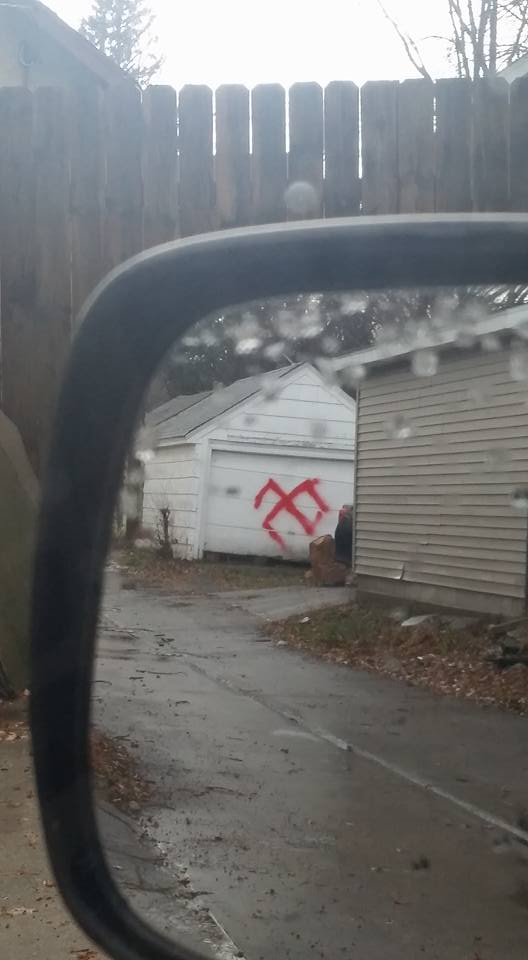
Keep the swastikas up

This story, out of the hub, is indicative of what we can expect in this newer, less tolerent, age: Barely articulate impulsive spritzes of hate. As Samantha Crossland, a probable target along with the rest of her neighborhood, says, "Some people are saying, 'I can’t believe they didn't even get it right'...But this person is so hung up on [a] symbol of hate they had to do it anyway."

Is it an isolated incident? Perhaps. That seems to depend on your viewpoint. The Southern Poverty Law Center put out a report a couple weeks ago noting 700+ reported events since election day, a number that only seems to grow larger. Meanwhile, rightwing reports debunking selected incidents make the rounds among conservatives. But even if a majority of events are proved to be more experiences of feeling than fact, that makes the incidents no less heinous. If you aren't the target, you don't get to judge what's hateful.

Some folks are making the effort to sort of retake the public images by repurposing them, probably influenced by Berlin graffiti artists, where they have had to deal with this sort of thing for a half century. I undertstand that impulse. No one wants to see that shit and what it suggests about people in or passing through their community. And I certainly wouldn't want it on my garage door.

But here's my antidote. Leave them up. Leave the swastikas and the "Black Lives Don't Matter" and the "Whites/Colored" and the anti-immigrant stuff up. Leave it all where it is. It's painful and it should be painful, like a raw wound. We should see it every day. Moreover, Trump supporters, for whom their personal desire for "something different" trumped the hate his other supporters signaled, should see it daily and be reminded that this is the America they wanted. This is the America they voted for. This is the price for the America they want.

Saturday, November 19, 2016

Truth Matters

Daniel Patrick Moynihan, a New York senator and ambassador from my young adulthood to whom I might attribute my love for politics, famously asserted, "Everyone is entitled to his own opinion, but not to his own facts." That quote has had quite a workout this past year, and if anything the recent election seems to have put the lie to it. Everyone, particularly Donald Trump and his supporters, are apparently entitled to their own facts, as if some objective concept called "truth" doesn't matter.

Let's set aside the questions of whether there is something like an Ultimate Truth or Cosmic Truth; those are both too broad and too big for a consideration of this Little Orange Man. But a few days ago I got into an argument with several co-workers, people who work with medicine and health care, for whom there has to be a down-to-the-bones truth that the body operates this way and these substances have this effect on it and cleaning the limbs this way affect it in this way in order for them to do their jobs and expect good results. They absolutely asserted that, bad as Trump "may be," Hillary Clinton was worse because she ignored the telephone call from the American embassy under attack in Libya.

Simply: Untrue. (Yes, I rely on "notoriously liberal" Snopes.com for information and credentialing because we need to have a final authority to which we can appeal, and while the site isn't perfect, and couldn't be, its fact-checkers try their best to both get at the truth and be objective and are free of the lure of advertisers and friends in high political places. Particularly now, when fake news sites are easy and profitable to create.)

It matters what is true, not only in political decisions but in everything. Medicine and biology is replicable and matters. Climate change theory is replicable and matters. Demographics matters. Donald Trump's lies matter, especially now he has won the election. This matters: Plain and simple, truth matters. Assert the truth in the face of lies.

Tuesday, November 15, 2016

We Will Not Be Silent

I've waited a week to make this post, partly out of inertia and partly out of a desire to get the message right. I am fiercely partisan, there's no getting around it. I believe strongly in the work of progressives and the liberal impulse. Christianity's most meaningful words for me are "What you do to the least of these you do to me." 

I am furious at the outcome of the presidential election. In that, I join a lot of people. I'm among the first to argue that doesn't make us right. There is a reason we don't accept majority rules in our system.

I am furious, but not at a Hillary Clinton loss. I'm not furious at a Republican win. And I'm not furious with Donald Trump. I'm furious that in the Twenty-First Century, Donald Trump ran on a platform of bigotry, misogyny, and anti-immigrant sentiment culminating in a fantasy about a literal wall between two nations (have we learned nothing from East and West Berlin?), and won.

I am furious with the people responsible for this. I am furious with Donald Trump voters and sympathizers.

I am furious that Donald Trump earned enough votes to make him the candidate in the first place. I am furious that what most of us experienced as a vanity campaign, all about him, never about the rest of us, was capable of lying about the career of a veteran politician and winning on that strength. I am furious someone endorsed by numerous white supremacy and anti-Semitic organizations, not a single one of which he disavowed, managed in 2016 to win. I am furious that in contemporary America there are a number of people who have both a genuine and deserved fear of the aftermath of a Donald Trump victory. I am furious that Donald Trump could accuse Latino/as of multiple falsities and yet garnered nearly 30% of their votes. I am furious that many politicians in the Republican Party took the drastic, courageous, and necessary step of publicaly disavowing their candidate and his views, and yet 90% of self-identified Republicans voted for him (and let us not forget the several, like Paul Ryan, Bob Dole, and Ted Cruz, who regaled the public with how poor was the reflection he gave the party, only to cynically pull the lever for him). I am furious that a person who is on record as having little but disdain for women was voted for by nearly half of them. I am furious that for the first time in modern American political history, a candidate threatened to jail his opponent if he won.

Donald Trump may, in time, come to surprise us. Once faced with the enormities of office and the necessity of compromising in order to acheive anything (as he has already learned how, despite his elevation because he is not a career politician, he simply cannot do the simplest things without them), he may become less divisive, less self-satisfied, less inflammatory. He will also then become less liked by his followers, which is always what happens to a president after an election, but seems especially likely in Trump's case. I doubt it, but it is possible.

I don't care. Donald Trump won and he won with the votes of people who, at the very least, did not give a damn how what he said and did could affect their neighbors. That will never, ever sit right with me, and it never should.

Saturday, October 8, 2016

258 candles-days 36-31

In the same way religious liberals decry that all faiths have their share of fundamentalist thinking and actions, so we must celebrate that all faiths also have a deeply progressive strain that often runs counter to that. These Pakistani clerics deserve to be recognized as pioneers.

Sunday, October 2, 2016

258 candles-days 40-37

It's been many years since I've explored that aspect of my sexuality, but I keep track of many things in the gay community, One of them, of course, has been the number of deaths in it, especially the largest recent massacre of Americans by an individual in Orlando, Florida. And while I might be late to the party when it comes to this video, I think it's both an exhilerating way of celebrating men loving one another and a unique way of supporting the families victimized by Omar Mateen. I light two candles, one for the video and the other in memory of the victims.

Monday, July 11, 2016

258 candles-day 136

It's the sort of picture that becomes iconic, although whether it becomes as much so as the ones it's being compared with, like Tank Man in Tienanmen Square or Walter Gadsden at Birmingham, is up to history. Nonetheless, it's a powerful image, so much so I don't think anyone needs to explain it. Johnathon Bachman, the photographer, reported, "It wasn’t very violent. She didn’t say anything. She didn’t resist, and the police didn’t drag her off." There are reports that the woman, who was arrested Saturday and released Sunday evening, is named Iesha Evans, and that she's a nurse and mother, although I stress that even that simple information, so soon after the event, is uncertain. What is certain is this: That the photo evokes both what we are fighting against and exactly the way and the manner in which we need to do it.