Showing posts with label holy. Show all posts

Tuesday, August 31, 2021

The Holiness of Lift and Drop


Two months ago I was asked to be part of a service celebrating the holiness of work. Most people assumed I would talk about my pastoral or chaplain work, but I wrote this about a dull, plodding job that I discovered had its own holiness. This is the five minute version I went with. I wrote a longer version to get the story out and may turn that later into a longer essay. 

THE HOLINESS OF LIFT AND DROP

    I used to work short-term jobs, most of them through an agency. There was a plant in Mankato, LMH Quality Packaging, that put together candy bags for local businesses. I rode my bike there one day and was put on the assembly line, checking bag seals. But after a little bit I was called into the foreman’s office and told, because I looked like someone who didn’t mind harder work, I would be moved.

I was taken to a room that was pretty big although there was only one table and one man in it. The fellow was a little shorter than me and what he was doing was walking around the table, which had sides about a foot tall, with a shovel. There were different candies inside and he’d dig into them and then drop them again before taking another shovelful. I was handed a similar shovel, a short-handled grain shovel, and left in the room.

The guy, whose name was Gary, told me what the work was without stopping or slowing down. What we were doing was mixing candies for the assorted candy bags you get around Halloween or party treats. About every hour someone else come along, take the table which was on wheels, and bring in an empty one. Then a half dozen other people would bring in about 20 10-pound bags of different candies—Sweet Tarts, Skittles, Peanut Butter Cups, Tootsie Rolls, the kinds of candy were always different—and dump them into the table. Our job, he explained, was to walk the length of the table and then around, dipping the shovels into the candies, and then turning the shovelful over. Every 10 minutes we’d change directions.

That was it. Not a very hard job. But shortly after starting, I was bored and my arms ached, especially my shoulders. My legs were sore from the walking and pivoting. My forearms ] jolted each time I dug my shovel into the box and it connected with the bottom. Sometimes the hard candies broke or the softer ones mushed and then I’d have to reach in and dig them out. And I was bored. God, was I bored.

At our first break, Gary gave me pointers. “Angle the shovel gently so you don’t hit the table bottom. Let the momentum carry the shovel just above the pile and then let them slide off to one side. Keep your legs bent at the knees and your legs won’t hurt as much. Stay exactly opposite me and you won’t have to hurry or slow down, just keep the same pace.” I did that and it was easier but no less boring. I hollered over to him “How do you deal with being bored?”

He said, “Bored? I never think about it. I just focus on one thing: the shovel lifting and dropping. That’s it. Everything else just gets in the way.”

I was surprised, given my experiences with Zen and meditation, I hadn’t caught onto it sooner. It was kitchen work, simply the repetition of movements without haste or worry about it’s being done. The job would never be done I realized, more tables with more candy would come in, and it would always be done by the end of the day because another two guys would take the shovels for second shift.

The rest of the week passed by with aches of course, and some foot sores. I learned to wear sneakers instead of boots, to ease the shovel because it didn’t matter how much I loaded on the shovel, it would always be added to by Gary. And I drifted, letting my mind wander away from monkey-mind, and let thoughts come, go, stay, whatever they felt compelled to do.

The work was holy, by which I mean there were people who enjoyed those candies and enjoyed the variety available. Even if no one bought the bag and it ended up in the landfill, the insects and mice would eventually eat the candy. It might not be good for them nutritionally—it wasn’t good for you or me nutritionally—but it added a little sweetness and pleasure to their lives, and I could hope for no more than that.

Sunday, February 12, 2017

Sitting quietly

While it's true, as my wife has observed, that I can't take part in a moment of silence without telling somebody that I'm observing a moment of silence, I do in fact spend most of my working day quietly. Between patient visits, of course, I do a lot of reading, usually with a radio on. And when I visit someone who is unresponsive, I'll sit close to them, preferably near a window because I like a view, and relax into my role as nonanxious presence. 

Oddly, I wouldn't have pegged me for someone for whom calm would become a natural state. I bite my nails, I tap my fingers, I hum and sing under my breath. I am a mess of jangling, banging nerves. I promised myself when I was younger that I would never be bored, and smartphones and Facebook have helped me keep that promise. Sometimes, even sitting next to the bed of a person actively dying, it's difficult not to check my email or a friend's status or my Twitter feed. I admit to giving in more often than I'd like.

But I reflect on the situation this way. As a Unitarian Universalist I accept individual and corporate dignity and worth. And a part of that is something I've heard called NODA. No one dies alone. While I can't guarantee to be with someone when death happens, I can be present for a short time as the process plays out. This ministry of presence, as I see it, is as important to a comfortable death as any drug or prayer. It's the best I have to offer, maybe the best any of us has to offer. To accept the sociability of our species, that we like to live with one another, is to accept we also like to die with one another.

Saturday, October 8, 2016

258 candles-days 36-31

In the same way religious liberals decry that all faiths have their share of fundamentalist thinking and actions, so we must celebrate that all faiths also have a deeply progressive strain that often runs counter to that. These Pakistani clerics deserve to be recognized as pioneers.

Sunday, July 31, 2016

258 candles-days 153-155

This morning's church service focused on prayer, and specifically the so-called "Serenity Prayer" of Reinhold Neibuhr. I have never been entirely comfortable with the act of prayer, or should I say the way by which most people pray. I've sermonized before about the contentious relationship Unitarian Universalists have with prayer, and I've even tried my hand at writing them. Sometimes I'm asked to come up with a spontaneous prayer and I'm especially uncomfortable with those, because I try to fulfill what my requester assumes is prayer, while simultaneously staying true to my own concept of God.

If, like me, you believe that what we call God is the reality through which we move, like fish through water, only being aware of it when we're without it, then to suggest God is somehow separate from us and needs to be addressed like any other stranger is absurd. As the medium through which we move and are, God is aware (if not the originator) of everything we say, do, think, conceptualize, swear, spit, shit, hit, breathe, fuck, feel, sweat, hear--any word you care to add there. As a result, what is the point of setting off by time or space or formality a measure of words whose creation, from initial thought to final draft, God has already been a part of? Is it only to sound learned to other people? Well, maybe. Maybe it's like some of us believe, we don't know what we think until we hear ourselves say it.

Nonetheless. I want to try my hand at it again, this time in relation to what this project is meant to be about:

Spirit of Life, I know what I want.
I want love to transform us into the people we imagine ourselves
In our best moments to be. I want
The angels of our better natures to take possession of our tongues,
Our hands, our hearts, to make us in their image. I want
Life to be the best for everyone, male, female, child,
Animal, plant, amoeba, stone and ice. I know
In my heart of hearts that will not happen.

We can't let it happen. It would take too much
(Pick your word:) Pride, freedom, independence, free will
From us. If there is one thing truly human about us,
It's the ability to see what it is we need to do
And resolutely rationalize our not doing it. But,
For one moment, can we see that we are not
What we are in our best moments? Can we
Recognize whatever our best is, we aren't there? Can we
Profess that where we want to be is a long way away
And we have to fight, not one another, but the current
We have clung to, to reach it? Can we
Hope one day to know where it is we want to go?

Wednesday, May 4, 2016

258 candles-day 64

I've been wracking my brain trying to think of what I can say that will mean anything to anyone about the current dismal, distressing state of politics in this country. And I've come to realize this: There isn't anything I can say. But there is something I can do.

My solution, based on the Chinese proverb that it's better to light a candle than to curse the darkness, is to provide daily candles in the form of links to other people's solutions, simple or complex responses to problems that they see. But as a single candle will hardly provide enough illumination to blot out the darkness that is the pettiness and meanness that characterizes this election cycle, I will light 258 candles, one each day between now and election day. In this way, I will do my part to remind each of us we are better than the baseness of the bases.

Today: We all need a little music to get us through the day. 

Monday, October 12, 2015

reposted eulogy to a homeless man

[In the five years I've blogged here I haven't reposted anything I printed (or if I have I'm not aware of it). But I'm breaking this today because I don't have better words to offer some friends.
These friends are currently visiting my wife and I. Yesterday they heard that another friend of theirs had died, apparently as a result of tainted heroin. While, yes, it's true heroin is itself tainted, to put one thing into your body expecting it's something else is an act none of us, despite however wearied we are by the world, intends. But to pretend (as most responders to the above article have) that such death is just desserts to someone poisoning himself slowly is despicable. It is to suggest that some lives (non-addicts) are more important than others (addicts). That's a determination none of us gets to make.
Almost exactly a year ago I penned a eulogy for a homeless man found in St. Paul and I posted it here. I repost it now as I'm reminded of the message I tried to impart of hopefulness and dignity for a member of a group that too often is not granted either.]

About a week ago I was contacted by a friend on behalf of his friend whose homeless father's body had been found in a park in the hub. Both his death and his homelessness was a surprise to the two families he had left behind: other than sporadic phone calls, no one had heard from him in fifteen years and had no idea where he was. His son had contacted my friend, a Lutheran minister, for a suggestion of someone to perform the funeral who was "not too religious." My friend suggested me because of my own bout of homelessness.

After a couple meetings, we held the memorial yesterday in the son's apartment. The two families--a first wife and her adult children, and a second and her teenage children--came together for the first time in a decade and a half to mourn the death and celebrate the life of a man none of them knew what had become of.

I'm not only a minister but also a member of several online homeless and vagabond Facebook groups. I put to their members what they, as people for whom exactly this situation might happen, thought I should tell the families. Their responses, numbering a couple hundred, inform the following eulogy.

We don’t know what the last hours or days or even years of [his] life was like. We do know some things. That he had multiple health problems, including heart and lung issues, that he was addicted, at least for a while, to alcohol, that he was fending for himself in a losing battle against the entropy all of us are heir to, to the extent that this man, a mere 49 years old, could be discovered dead and that it could be considered a natural death. It is fitting that the person who discovered [his] body was also probably homeless. In the final analysis, each of us has only each other.
It’s easy to mistake pride for self-sufficiency. As most of you are aware, I was myself homeless for several years, so I feel comfortable telling you that while it might be tempting to think of [his] last years in terms of unremitting pain, depression, and desperation, that isn’t all there was to it. Those elements were there, certainly, but just like we can’t subsist entirely on a diet of charred toast, his life was undoubtedly leavened by the sweetness of life. Gratitude at the kiss of warm sunlight on his face when he least expected it. Appreciation at the gifts of money and food and shelter offered him. Warmth in his belly at the taste of liquor or cigarettes, the delicious succulence of a peanut butter and jelly sandwich. The sweet release of lying down to rest, the wonder of dreams. He felt love, perhaps a little ashamed at the families he left behind, but also perhaps relief in, in his mind, rescuing them from the burden of his deterioration.
Enough with idle speculation. What we do know is this: he was ill his last years, he lived on the streets here and maybe spent time in shelters, he died from the combination of his diseases and exposure, and he did not reach out to anyone here for help. Those are hard, uncomfortable truths. Perhaps they should be. Not that anyone should feel bad at not having provided help or feel anger with [him] because he didn’t ask for it. They’re hard because people, like life itself, are complicated. For whatever reasons, to conquer whatever demons, [he] made the decisions he did and accepting them and him is the final dignity we can give him.
Loving him in death is the best we can hope for. Or, if not love, acceptance of the way he chose to live his last years. We are all each other has got, and trying to change anyone, in death as in life, only leads to frustration. [His] life and death, for all the ways it hurts us, has dignity to it, as all life has dignity. We are born, we live, and we die. A single known sandwiched between two portals to the unknown. Buddhists tell the story that the earth is made up of ocean and a single ring floats on it. Every thousand years an ancient tortoise crawls from the bottom mud and rises achingly for a breath of fresh air. He breaks free of his resting place, journeys to where the sky can be seen, gulps a single lungful of air, and descends rest again in the mud. They say as often as that tortoise crests the surface with his head in that ring during each thousand year event, just as often are we born. To be born is rare and lucky. It must be honored. [His] life was no more or less dignified than any of ours. You are lucky to have known him, to have loved him.
In my faith there’s a ritual we sometimes perform at the death of a member of our community. Will you gather in a ring and take hold of the hand of the persons next to you. We sing the words but since you don't know the tune, we'll just say them together. Please repeat after me: “Spirit of Life, come unto me. Sing in my heart all the stirrings of compassion. Blow in the wind, rise in the sea; move in the hand, giving life the shape of justice. Roots hold me close, wings set me free. Spirit of Life, come to me. Come to me.”
[Prayer] God of tears and the mysterious silence, God of suffering and God of hope, you have made for everything a season. This is the season of our sorrow, of our grief, and we pray for grace to deal with what seems impossible to deal with. We remember the promise made to those who mourn, yet too often it seems that comfort is beyond our grasp. We know that we cannot bear this burden alone. Should we pray for our grief to be transformed or, is the purpose of our grief to transform us? Will our sorrow lead somewhere unexpected? Might it lead us back to life if we follow it? Is it a reminder of the precious reality of life and love? The death of Jonathon has created a vast, empty space within our lives, a great longing within our hearts. Can it ever be filled? Can it be healed by the sacred memory that makes [him]forever a part of us?
So many questions, O God, and so much silence. May we be patient toward all that is unanswered in our hearts. And may others be patient with us, with our sorrow, our anger, our fear and our questions. We are those who mourn. We seek the comfort that we can offer each other and the blessings of divine love and grace. Amen.


[Benediction] Take courage, friends. The path is never clear, the end is always in doubt, and the stakes are very high. Take courage. Deep down, there is a greater truth: you are not alone.

Wednesday, July 22, 2015

what we talk about when we talk about death

"Ultimately, the human being is designed for dying." --paraphrase of Joan Halifax

I've been wanting to write for weeks about an experience I underwent almost a month ago, but which both circumstances and my inability to articulate it has kept me from examining too closely. This was the death of one of my patients.

A few weeks ago psychiatrist Robin Weiss published an interesting essay in the New York Times called "How Therapists Mourn." It's a good read, well-written, thought through, and full of life and death. He comes to a conclusion that holds as well for chaplains I think as for psychiatric professionals: "Therapists mourn alone."

It's not that we don't want others to share our sadness as that they are probably unable to understand it. I don't mean they don't understand the general sense of loss we feel when a patient dies so much as I think they can't understand the specific loss that patient's death means to us. We've come, through sitting and listening to them, or just sitting quietly with them, to see them in ways that others, who may know them better or more intimately, are unable to.

A month ago I visited a patient whose decline was dramatic after a period of relative energy. Inside a week she had gone from sitting in a wheelchair and actively participating in life to being bed-bound and sleeping nearly all the time. She was unconscious when I arrived so I took her hand while the RN who'd got there before I had went through her paces. She said over her prone body, after her visitor had gone, "I'll be surprised if she lasts the day."

The nurse left about 20 minutes later. We were waiting for one of her daughters to arrive and as I had no other visits that day I said I'd stay with her until she came. But a half hour after the nurse left she became agitated, having difficulty breathing, and opening and closing her eyes without seeing. Her dyspnea, called Chayne-Stokes breathing, is a series of quick, almost urgent, shallow breaths, as is she can't catch it. While I didn't know then what it was called, I was aware she was near her death.

I talked to her, letting her know I was there with her and she wasn't alone. She could be scared, I said, but I was with her and wouldn't be leaving until she was finished. She lay on her back, swallowing great gulps of nothing. I held her hand more tightly and reminded her of my presence.

There was no great shudder. No death rattle. No final words of wisdom. One moment she was breathing, which I could see from the gentle rise and fall of her chest. Then she stopped. But then she started again. This went on a few times, the shallow intake, the rise, the wheeze out, the fall. Until finally, she stopped. From my seat I could see the flutter of her carotid artery. I watched that pulse slower, until it too stopped. I touched my fingers to it but couldn't be positive if I felt it still or if it was the throb of my own pulse. After about a minute I pressed her eyelids closed and they stayed that way and I stepped out to ask a nurse to check her.

I have seen other people die, but it was always with the safety of distance. This time I had held her hand and felt her life slow until I couldn't feel it at all. I don't know exactly what I felt. It wasn't fear or anxiety or even relief at its conclusion. What comes nearest I think is humility. I felt humble in the face of what happened, struggling to hold her one hand while she held a stuffed chipmunk in the other, and keeping the live flower her daughter had placed in her hair from tipping and rolling off her pillow. My entire role came to, "I'm here." There seemed nothing else that needed to be done.

Monday, December 15, 2014

the chapel of the Holy Wheel

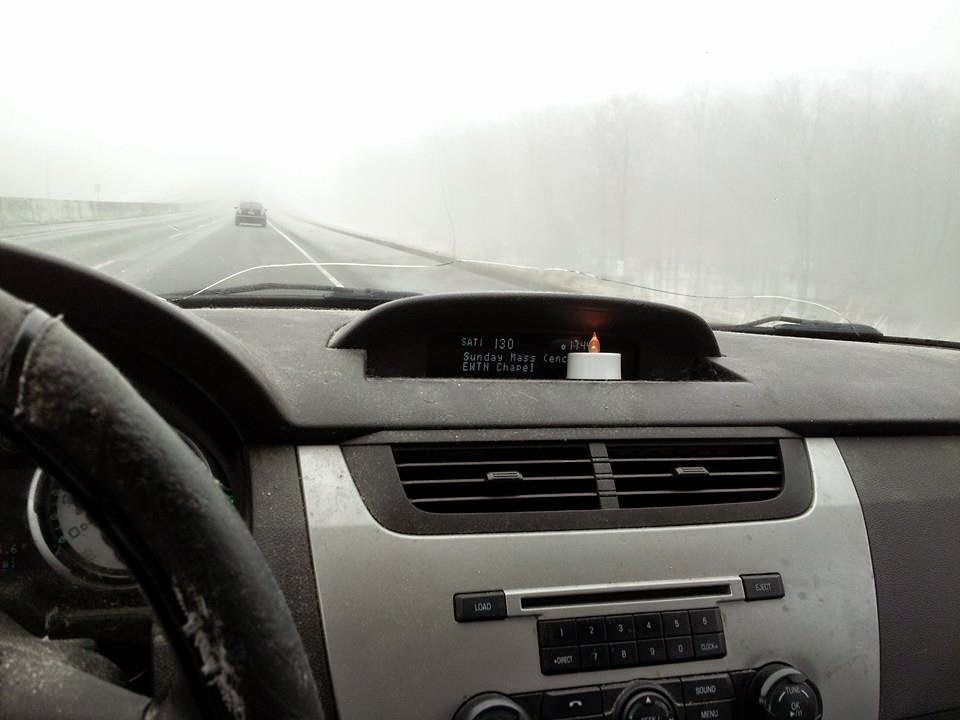
I'm a Unitarian Universalist, and I suppose it's a sop to my Puritan ancestors that the church I've been attending lately runs to six hour services. As I've mentioned in the past, we are in the process of moving from the rim to a hub on the other side of Wisconsin, and my wife and animals are already living there. As a result, my Sundays are spent driving back to the hub to minister to the kids I work with. I think of it as attending at The Chapel of The Holy Wheel.

I have my elements. My liturgy is made up of the BBC news and political shows I listen to, my hymns the music, some sacred some profane, mostly blues, I scroll through. I attend mass, partaking of the Eucharist with the crackers and grape juice I keep in the car for communion at the girls' facility (the boys are much less interested in any kind of religious services, while some of the girls want me to do almost nothing else). There is a calm that comes over me in my rolling tabernacle. I have always loved to drive, and combining the acts of reverence and of moving strikes me as a kind of mega variation on moving meditation. As if my body, ensconced in the safety of my vehicle while it hurtles down the road, mimics my body hurtling through space on the larger vehicle that I don't, can't drive. My prayers, such as they are, are for the people surrounding me. That they arrive relaxedly, like me, wherever they're going. If I succumb to grandiosity t's in seeing in myself some of the Holy Fool Neal Cassidy exhibited in his best moments.

Wednesday, July 16, 2014

another lesbian wedding homily

As it's summer here on the rim, and as it's also been a rainy one, I've been outside as often as I'm able, and so I am woefully behind on posting. But last Saturday my wife and I were the officiants for the wedding, or more accurately the renewal of vows, for friends of ours (not the couple above; that's a stock photo whose joy I really like). This is the homily I wrote for them.

Vows are important. They show seriousness of intent for doing or agreeing to something. Renewing vows, it can be argued, are even more important because they take place after the doing or the agreeing to the thing has already happened for a time, so the people taking them can’t be accused of not knowing what they’re getting into.
_________________, the vows you took together years ago were taken seriously by you, even if the state where you took them eventually decided it didn’t. But the people of the state of Minnesota, in their wisdom, have realized that the vows you take together are as beholden as anyone else’s vows. So we come together, your friends and family, the people most important to you, to reaffirm those vows.

You’ve told me you don’t remember what it was like not to be in one another’s lives. I suspect, although I don’t know, that it was like this: lonely. I’m sure you enjoyed yourselves alone and with the friends and family gathered here, and you may not have known it. But there was, somewhere deep down, a ______- and a ______-shaped hole at the core of who you were. And you may not have felt it immediately filled when the two of you met, but for years you have recognized that you complete one another.

Nonetheless, there remained another important hole in your lives. The two of you have been accepted as a couple but not as the married couple you knew yourselves to be. It is to fill that metaphorical hole that we come together today.

Those of us who are married know that, after the ceremony, if we have been a couple for a long time, outwardly nothing changes. We go on living together, making meals together, being seen together, raising dogs together. But we know that inwardly everything has changed. It may be hard to put into words but I think that what runs through our minds when we continue to do those things and we happen to glance at the other person, we think, to paraphrase what God said about Jesus, “This is my wife, with whom I am well-pleased.”

There is, we know, a point to life and it is to make connections with one another. ____________, look around you at the friends and family gathered here to celebrate your vows, and know that you have made connections, together, with each of them. Now look at one another and know you have made the deepest connection with her.

Thursday, May 22, 2014

my truth


I've begun a new position as the spiritual coordinator (read: chaplain) at a pair of boys' and girls' residential treatment facilities and next Sunday I hope to initiate my first chapel service for them. I don't know if I'll be able to read the following message, but after several weeks of trainings, meetings, observations, and time spent with the kids, I've been moved to write this as the overriding message I want my ministry to reflect.

            Ten years ago I was teaching college English at prisons in Minnesota. I really like doing that. It was important work. During break one night an inmate came up and told me he wanted me to know what he’d done to be sentenced.

            Now, I don’t know if it’s as important a thing here as it is in prison, but you don’t ask someone what he or she has done in prison. It’s a private, personal secret in a very public place, People jealously guard it and sometimes it’s literally dangerous for other people to know how you broke the law.

            So when this guy said he wanted to tell me what he’d done I said, “I’d rather you didn’t.” He asked, “why not?” and I said, “right now I’m your teacher and you’re my student and I like you. But if I find out what you did I might not like you so much anymore.”

            But he took the chance and told me. And although it was something nasty, I still like him for who he was. It doesn’t always work out like that but sometimes, when you’re lucky, it does.

            I know why you’ve come to chapel, what it is you want. In addition to a break in your day, you want the answers. You want someone to tell you what they are, about god and the afterlife and heaven and hell. Most of all, you want someone to tell you it’s all worth it.

            I’m here to tell you the not-so-good news but it’s the truth. I don’t know if it’s worth it. I don’t think anyone knows. Some people come to what they think are the answers for everyone but at best they’re just the answers for them.

            That’s not to say you won’t find answers. For some of you, you might find answers in the Bible or the Koran or the Buddhist Sutras. And those are legitimate answers but they’ll be your answers and nobody else’s and you’ll only find them after you’ve looked a long time and really hard at them.

            You want to know what the secret is and that all the crap you’ve gone through, all the worst stuff you’ve done and had done to you, is worth it. That at the end of the day the good outweighs the bad and you are happy and satisfied and the world is smiles and rainbows. That might be the case. It’s not the case for me or most of the people I know. The world is sometimes a beautiful place and sometimes it’s hellish. Most of the time it’s a balance between the two. I hate to be the one to tell you it never really does get better or easier. Not in the way you want it to: you find the pill or the therapy or make the breakthrough that makes that possible. I used to look for those and it might work for a little while. But eventually you see through that and realize it wasn’t the real answer you wanted.

Life is hard. Maybe it’s meant to be. Maybe it’s better that it’s harder for some of us than for others. I can’t promise you it won’t get harder. You’ll make breakthroughs and you’ll backslide, sometimes worse than before. That’s how life is. Someone once said the only constant is change. A Greek philosopher named Heraclitus famously said you can’t step in the same river twice. The truth is that that’s the truth. You might feel crappy as all hell today and tonight feel like yours is the best life in the world. And tomorrow you might feel exactly the opposite. I can’t promise that won’t happen all your life.

            But I can promise you one thing. This is unchanging, no matter how much you search, no matter how bad it gets, no matter how many dead ends you end up following, no matter how many times you scream and fight and curse god and those around you. There will always be someone who will help you. Call it god, call it reality, call it staff, call it the divine in other people, but there will always be people who are willing to be with you. To explain things, to tell you what you might find ahead, to comfort you and remind you that, while the bad things you’ve gone through may or may not be worth it, you are worth it. This is my truth, my good news. No matter how you feel, no matter what anyone says or how the world treats you, you are worth it.

Friday, February 14, 2014

this is what valentine's day means to me

My wife and I used to keep track of our years the same way most people do--by holidays and anniversaries and birthdays, and by the gifts we'd gotten for each other. But in the past few years, between the financial hits we've taken and the lessening of whatever capitalist sense we may begun with, important times have come instead to be tracked by the animals we took in.

Thus, my birthday in May is when we took in Beans; late summer is when we allowed Chicklet to move in. Easter is when Nilla came to live with us, and Boxing Day is the day she drove to the southern rim of the Cities to keep Mango from being euthanized. Late January, perhaps MLK Day, is Pappy's anniversary of taking up residence in our our comfy lives; and this year my birthday came around full circle to be the date Taffy became our baby. Similarly, Jesse came to us at Thanksgiving and Magellan was taken in near Father's Day. I could locate all the other animals we've ever taken in to some other day celebrated differently by other people.

Except for the cats and Beans, all of these beasts were intended to be short-term occupants. Now Olga has come to live with us, hopefully for only a week, on the night before Valentine's Day, prior to going on to live with another family. As much as our ministries have come to be for other people outside our home, inside it is a ministry of beasts. We see ourselves as a couple meant to either save an animal from death or provide it with as good a death as possible. As I have said for our two decades together, we don't get a happily-ever-after; for some animals, we are the happily-ever-after.

Tuesday, December 24, 2013

the twelve holy days


A sermon given to the

Dakota Unitarian Universalist Church

Burnsville, MN

December 22, 2013

Scholars are well aware now that Jesus, who probably existed either as an individual or as a group of men and women over the first centuries of the new millenium, certainly was not born on December 25 or anywhere in December, at least not according to the New Testament’s testimony.  It would be sometime in the spring according to the gospels, which makes a good deal more sense metaphorically, Jesus as the lamb of god and bringing in the spring of Christianity and all that.  Interestingly, the First Day of Christmas in the popular song we sang earlier is not Christmas.  In most chronicles of the twelve holy days, Christmas is considered the pre-day, day zero if you will.  It’s the day for celebrating the birth of Jesus among Christians, but it’s also associated with the births of Mithras, Attis, Aion, Horus, Dionysus and the Unconquered Sun.  Mithras you may be familiar with.  The Persian god of light, his name means “Friend” and he is often synonymous with the Sun who protects man after death.  Attis or Atys is not to be confused with Attic which means having to do with Athens, but was a young man laid claim to by the hermaphroditic fertility goddess Agdistis who was so maddened by her jealousy he castrated himself in frustration and before he could cut his throat was changed by her into a pine tree.  Agdistis herself, by the way, was also made wholly female by castration.  Aion is the Germanic term of personification for the age of the universe, an eternal being itself personified.  Horus is familiar as one of the Sky Gods as well as a Sun God and is often represented as having the head of a falcon.  Dionysus, also known as Bacchus, is the god of wine and good times.  His name in Roman, Iacchus, comes from the Latin for “shout” and is thought to have originated as an epithet for the rowdy, noisy god.

            The Unconquered Sun is an interesting character because it is both a stand-in for any of the above gods as well as a euphemism for the thing itself.  The unconquered sun is what we see in the sky along about this time.  It is equally connected with the Reindeer Man, a sort of Green Man of the North, a pagan mix of Sintaklass and Odin, who appears at this time of year with the gift of deer.

            Why twelve days?  The number twelve pops up a lot of places in both Abrahamic and pagan beliefs.  Twelve apostles, twelve months of the year, twelve zodiac signs, two twelve-hour segments to a day, the twelve of the Circular Council to the Dalai Lama, the twelve members of the Arthurian Round Table, the historical Twelve Peers of France, the twelve tribes of Israel, the twelve imams in Shi’a, the twelve principle gods of the Greeks, the twelve cranial nerves in the human cerebellum, the age 12 when a Jewish girl matures and receives bat mitzvah, the twelve sons of Odin, and even the twelve function keys on my PC keyboard—F1 through F12. 

            The true first day of Christmas is Boxing Day, so-called from the British custom of giving a servant a Christmas box the day after his masters have celebrated.  It’s also associated with St. Stephen, the proto-martyr associated with horses—it’s said his body was returned to his people on the back of a horse—and with wrens.  It’s said that to kill a wren on any day other than Boxing Day is to invite bad luck.

            The second day, December 27th, is given over to Mother Night or MotherCarey or Mother Christmas.  She is the Anglicized version of the German Frau Holle or Holda or Hulda, a figure of fertility, abundance and justice.  She was often seen, originally, as a beautiful woman in white and with a golden girdle or a sash, dispensing gifts from a sleigh pulled by her dogs.  She probably physically resembled the evil character Mrs Colter played by Nicole Kidman in the film The Golden Compass, and I wouldn’t be surprised if Phillip Pullman based this character on her. 

            But far from the nasty Miss Colter, who Pullman chooses to personify the less savory aspects of Christianity, Frau Holle, whose name means “kindly one,” was a gentle goddess specializing in the care of children.  It was up to the early church to turn her to a witch who stole unbaptized children.  But at midnight on the Eve of Epiphany, it’s said that a man walking home heard voices, many voices, behind him and stepped aside in time to allow Frau Holle and her passel of children and her flowing white train to pass him, the children laughing and running beside her.  The last of the children, the smallest, kept falling behind from tripping over his nightshirt.  The man gave him his own belt to tuck the shirt into.  Frau Holle saw this and rewarded the man with a gift that his own children would forever be without want.  It is important that we recall Frau Holle or Mother Night or Mother Carey or Mother Chrismas as a mother.  She is both nurturing and kind and a shrewd judge of character and it’s for these aspects we honor her.

            Following is Day three:  the Day of Holy Innocents.  In the Middle Ages this day of Childremass was considered particularly unlucky; nothing begun on December 28th would be completed, since children have remarkably poor attention spans and tend to wander around abstractedly.  The practice for this day is an ancient one that survived until the 18th century: regularly beating children on this day.  The idea was that by mercilessly flogging and smacking children on the 28th, one would both drive out the evil spirits that had lodged there the previous year and serve as a surrogate for any deserved beatings the following year.  The practice evolved into a call for ritual, painless token beatings between children and parents, husbands and wives, masters and servants.  On this day we honor children and correspondingly honor both our wishes for what they will become and our recognition of the reality of who they are.  We also recall our lives before their arrival, although it’s probably best not to think of that before we whip them.

            The fourth day is one we might be a little familiar with.  This is the Feast of the Fools, celebrated in the Hunchback of Notre Dame and a few other novels and a MASH episode.  This is the day when the normal order of things is reversed.  Servants become masters, pupils become teachers, women behave like men, and the fools rule.  Naturally, this is my favorite day.  Parties were held, masques given, general mayhem encouraged.  It was a ritualistic method for blowing off steam, the opportunity for people who lived by the strictest restrictions to behave in the riotous, cavalier way they had foresworn in order to keep their places in the community.  At one time, this day was more celebrated and better-remembered than Christmas.  So when someone tells you that we ought to put the Christ back in Christmas, you ought to remind him to put the Fool back in Fool’s Day.

Day five is the Feast of the Boar’s Head.  On this day, two ceremonies are honored:  the Scandinavian tradition that Frey, the god of sunshine, rides across the day atop Gulli-burstin, his golden boar, whose spikes are the rays of the sun.  The second is the older, now lost, tradition in England of the boar’s head, whose meat graced the Christmas table until probably the mid Twelfth century when it disappeared, being brought in as the final remnant of the sacred meal and distributed among the revelers.  It is meet we should remember the boars, now gone in both England and here, by leaving for them a small offering to their memory, an apple or orange, in the event one is still snuffling around.

New Year’s Eve, that most festive of drinking holidays, is day six, and in many places supersedes the celebration of Christmas itself.  In Gaelic Christmas is called An Nollaig Mhor “big yule” and New Year’s Day An Nollaig Bheag “little Yule.”  And why not?  The change of year has sturdier and more aged roots than the ostensible birth of the Christ.  Still, how anyone might have guessed this day would become the night when everything switches off for one year and switches on for the next is a feat of mathematical dexterity I couldn’t begin to fathom.  Nevertheless, December 31st’s feast is known as Hogmanay and it was the day when the Druid priests cut the sacred mistletoe and distributed sprigs among the people.  Hogmanay itself is a corruption of the French term au gui menez “lead [us] to the mistletoe,” and in some parts of France children still celebrate the day with a race during which they cry, “Au guy l’an neuf, au guy Gaulois” “to the mistletoe, to the French mistletoe.”

This is the day when we take care of the things we have missed taking care of throughout the year.  The trash is taken out and fresh sheets placed on the beds.  Socks are darned and brass and silver shined.  Pictures are hung straight.  This is the day for Reclaiming Unfinished Business, clearing up all those things we neglected the rest of the year.  Everyone experiences a new beginning, a new clearing of the old.  After sunset, juniper branches and fresh water were brought into the house.  The branches were dried out overnight, and in the morning the head of house drank the first sips from the water and sprinkled everyone else with some.  Then the dried juniper was lit, the doors and windows latched, and the house was fumigated with the burning branch.  This ensured the gifts of the new year were appreciated appropriately.  The new year’s blessing was brought by the first person to cross the threshold to visit, called “first footing.”  All the lights were put out except for a single candle, and then that first visitor must step outside, protecting the candle from the elements.  At the stroke of twelve, he reenters, is given a mug of eggnog, and sets about relighting all the candles and lanterns of the house, blessing the house with new light.  Often that person also gives a handsel, a gift of coal or whiskey to make the blessings concrete.

Day seven of course everyone sleeps in.  This is the Kalends of the new year, the hopefulness of the new day.  The old year is now officially dead and while we may not immediately see any benefits yet to the new, there is always a reason to be thankful, even if it is our ability to have made it through another year.  In contrast to New Year’s Eve day, nothing is taken out of the house this day—trash, bones, excrement, they are all left inside until the next day, to ensure blessings of the first footing do not escape. 

One of the nostalgic traditions we think of as Christmas in origin is caroling, but this is actually done on the Seventh Day and is referred to as Wassailing.  Wassail is a heated, alcoholic apple cider and is meant to be shared with the trees of the orchard as well as with the visitors who sing.  Robins are the guardians of apple trees and it was them that the wassail was intended to provoke, cake pieces and bread pieces soaked in the wassail being stuck to branches to reward them for their past year of faithful service.  On this bleak day it is beneficent to intone, “The luck of the year, it is the bird-quiet hour, the midday contemplation of the sun.  On this bleak day, when no sun shines, what wraps the birds in silence, what power blankets their song?”  It’s the day of prophesying and divination—weather divination especially, as you can imagine from a people reliant on weather for their well-being, and one saying from Scotland runs, “Wind from the west, fish and bread; wind from the north, cold and flaying; wind from the east, snow on the hills; wind from the south, fruit on trees”—and the first day’s water drawn from the well is considered especially blessed and called the flower of the well. 

The Eighth Day is the day for sitting inside to contemplate and reflect on snow.  It’s imperative that we remain on snow’s good side, since to be in opposition to snow is to be in opposition to winter and that’s simply a waste of energy.  We pay our respects to snow on this day, for its cancelling out the darkness at midwinter and its transformation of even the bleakest spaces into places of wonder and enchantment. 

The Cherokee have a story about the Ninth day, which is devoted to evergreens.  The Druids of course revered the oak and during Kalends yew and juniper play a major role.  In the middle ages there was a well-known play about the Paradise Tree, a descendant of the original Tree of Knowledge, which Adam smuggled out of Eden and planted in the outer world, where it grew to huge proportions and provided the wood for the cross on which Christ was crucified. 

Back to the Cherokee.  When the Great Mystery created all the trees and plants she wanted to give something to all of them.  But she couldn’t decide among them who best deserved it, so she proposed a contest.  Whoever could keep watch for seven days and seven nights would receive the gift.  All the trees were atwitter to be given such an important duty and had no problems remaining awake the first night.  But on the second night they found it hard to stay awake, and the flowers were the first to fall asleep.  By the third night, the birch and grasses were drooped, and by the fourth night the elms were snoring.  On the fifth and sixth nights, the maples and even the oaks had drifted off, until, by the eighth morning only a few—the pine, the cedar, the spruce and fir and holly and laurel—were still awake and watchful.  “What great endurance you have!” cried out the Great Mystery, and so she gave them the gift:  they would remain green forever and keep guard throughout the winter while all the others sleep.  The evergreens, this story says, are always awake.  And always watching. 

            Day Ten is interesting because it is two different days for men and women.  For both it was the day when each had to return to the drudgery of work after the luxurious time off afforded by the festivities of midwinter.  In the case of women who in these preindustrialized times were often employed as weavers and spinners, it was known as St. Distaff‘s Day, while for the men who were also expected to return to work, it was known as Plough Monday.  Whether the day itself fell on a Monday or not wasn’t important, it was simply another Monday in their eyes.  This became the excuse for another day of celebration as mummers, the bemasked players who appeared throughout the year at festivals and feasts, now sped through town blessing the ploughs and spindles.  Today Plough Monday has been given its own day in England, January 8, separate from the twelve holy days, but it’s thought to originate in another ancient Roman celebration, Compitaline.  In this ritual a small shrine was built where four estates met to the four directions, with a miniature plough and wooden doll set on each alter, and then the first earth-breaking of the new year was done on each property. Until now we are living in Liminal Time, the threshold between extraordinary and ordinary events that for pagans began in late October or early November with Samhain. With St. Distaff’s Day we begin a return to normalcy, what Christianity calls Ordinary Time. 

            The Eleventh day of Christmas, January 5, is the Eve of Epiphany and the Festivalof the Three Kings.  This day is given over to the Magi whose journey is often a microcosm of the journey we ourselves make spiritually.  Consider, they were themselves seekers after something and doing what felt right to them to do, going where their inner compass told them to go, and for so many of us, here today in this church, we have traveled so far and so wide only on the basis of our own compasses, be they in our hearts or our heads.  As the Magi found what they sought in the form of a child, may you find what you seek here. 

            This is the day to consider too the gifts that so often become the major focus of these holy days, forgetting as we do that we are ourselves the recipients of a gift.  I quote now from JohnMatthews: 

At a time when the commercial Christmas has a tendency to swamp the sacredness of the season, we ask and are being asked, ‘What do you want this year?’  There are certainly things we would quite like, things that we hope will be brought for us, but these are not the same as our wants.  True wants are not small things satisfied by prettily wrapped parcels:  they are the immense needs of inner space that can be overwhelmed by all our little wants and yearnings.  To consider our real needs—the things we lack in our lives—is often too frightening, opening up an abyss of need that calls our very existence into question.

Our real wants eat holes in us:  never resting, never loving, never greeting, never finding, never seeking, never being satisfied deep down.  These ravenous wants define our treasures…they create a Christmas list that no store could supply:  time to stop and really enjoy, in a space of quietness and contentment all the things we were put on earth to do.

Space to give and receive love reciprocally.  The grace to seek and find our spiritual joy.  Freedom from the tyranny and burden of other’s expectations, of what others think.  Acceptance of ourselves as we truly are.

            This then is the gift afforded us on the twelfth day.  Epiphany.  It means manifestation, making an appearance, and refers theologically to the appearance of Christ to the Three Kings.  But it’s a lot more than that.  In literature James Joyce gave us another meaning in an early draft of what would become Portrait of the Artist as a Young Man.  He describes it as a sudden insight, an instant when reality shines through an ordinary object, when “its soul, its whatness, leaps to us from the vestment of its appearance.”  It’s the appearance of what we need.  Perhaps not what we want, because that’s always going to be something good, something we like, and our epiphany is more likely to be something we haven’t considered and don’t want and, god help us, we don’t like.  For me, epiphany is often the realization that the shift from dark to light carries with it a responsibility not to continue hunkering in but, like a bear or a vole, to start the stirring for the reawakening I undergo each spring.  For you it might be a recognition that you’ve had all your needs met and now it’s time to meet them for other people.  For others it may be exactly the opposite:  it’s time to consider yourself a while rather than others.  There’s no one size fits all when it comes to epiphany.  It can come in any number of ways:  in someone’s smile, in the smell of woodsmoke where we thought there were no houses, in the sudden, unexpected taste of a good wine, in the sound of voices where we expected to be alone, in the touch of flesh on flesh that reminds us we are with one another.  These tiny moments bring us out of ourselves and into the wider world. 

            Like anything artistic, epiphany can be ruined by over definition.  Let’s take a minute of silence to reflect on what we have been given. 


Monday, December 2, 2013

holiness smiles sleeping under a blanket

[Instead] of conceiving of the church as bound by the physical space of a church building, we should think of the church as beyond walls. Just as the Occupy movement claimed the power to redefine space and create new cultural forms, the church of the multitude should also imagine creatively and not be bound by rigid traditions. Michael Hardt and Antonio Negri remind us, "The movements of the multitude design new spaces, and its journey establishes new residences." In the Occupy movement, the Jewish Kol Nidr service took place in open air...Jews, Christians, Muslims, Buddhists, and pagans shared the use of space in the faith and spirituality tents. The image of the "tent" reminds us of the moving tabernacle in which God dwelled among the people of Israel, instead of stone buildings with high steeples and stained-glass windows. Occupy Faith uses all the spaces the groups can find, meeting in church halls, university lecture rooms, seminaries, and open park spaces. The protesters have also occupied churches, in the sense that they were housed by churches after they were evicted from various campsites...
With new digital and Internet technologies, we can connect with one another and build relationships that were not possible before. BK Hipsher [writes]: "Now we live in a world where it is possible to experience remote location relationship at a level never before understood in a faith community context. Now we can participate in church from our living rooms..." The virtual environment makes the demarcation of "sacred" and "profane" increasingly complicated. A helpful way is to see virtual reality as multiple worlds, creating possibilities for people to share information, relate to one another, and build online communities in numerous ways. The church may leave a whole new generation out if it does not harness powerful modern forms of communication and visual art forms...Some people may still prefer to see physical bodies gather for worship and for action, but churches increasingly use the Internet and electronic devices to connect with people, to form online communities, and to engage the world...
Instead of "going" to church, we will focus on "doing" church or "forming" church and building relationships. Instead of fencing off Christians from the world, as if they alone are the "holy" people, the church of the multitude is firmly in the world, transforming it to usher in the reign of God...[Dietrich Bonhoeffer wrote], "It is only by living completely in this world that one learns to have faith...In so doing, we throw ourselves completely into the arms of God, taking seriously, not our own sufferings, but those of God in the world." When churches pay more attention to maintenance instead of mission, and when they turn inward and function more like middle-class clubs, the presence of the divine is not felt even in what is supposed to be "sacred space"...
If sacred space needs to be reconfigured, sacred time also needs to be infused with new meanings. Traditionally, Christians have often thought that sacred time refers to Sunday worship, which is set apart from ordinary time. Moreover, salvation history is seen as separate from secular history, such that Christians are told to be concerned about spiritual things and not to bother too much with the temporal order. But Jesus subverted this understanding of sacred time when he said, "The sabbath was made for humankind, and not humankind for the sabbath."
--from Occupy Religion: Theology of the Multitude by Joerg Rieger and Kwok Pui-Lan

I think that Thanksgiving is my favorite holiday. Even when I was a kid, I looked forward to the third Thursday of November as a special time outside gift-giving times like Christmas and Easter and my birthday. I like the food, of course, but mostly I like the getting-together. The sitting down with one another. The breaking of bread and drinking of wine for one great feast.

I have a lot of happy memories about Thanksgivings past--the ones with multiple previously unknown locals who had nowhere else to go and showed up at our massive meal on the floor, the one  in Louisiana with tamales and chili rellenos with the laborer family who'd taken me in, the one near which I witnessed a burial at the Woodstock cemetary that looked like a funeral staged by Arthur Penn, the one when I was a kid and my mom dressed up my sister and me as pilgrims in construction paper hat, collar and bonnet, the community meal in Woodstock where I met my sabra linebacker--but I think the one I like best was when my wife and I were in our second year of living in New York after marrying. We were miserable, living in a converted army barracks dropped upstate without being winterized. We heated the place with an iron stove we'd found for free that smoked so much that when we moved and took up the carpet from the living room, we found a separate layer under it made entirely of ash.

I'd got back in touch with several old friends and I found one of them living in an abandoned barn in New Paltz. I'd been after him for months to come stay with us, but he refused. But he had no plans for Thanksgiving so I said we would come get him and bring him to our place, and he'd at least stay the night. He kept refusing the stay, but I could enforce that easily since we lived ten miles from town.

I don't remember what we had for dinner, it might have been turkey but I doubt it as he's a vegetarian, but I do remember the sight of him curled up under blankets sleeping hours and hours with our little black dog snuggled next to him the next morning. That was the Thanksgiving it rained all day and when I got up into the attic space to try stopping some of the leaks I misstepped and put my foot through the pressboard ceiling. The one before the Easter when I saved up money and bought my wife a dozen Dunkin Donuts and spent an hour putting little paper bunny ears on each one only to wake up Easter morning to find the mice had taken a bite out of each one.

Sacredness, like hell and heaven, is of our own making. Like everyone else, I forget that and have to be reminded, sometimes by books, sometimes by music lyrics, sometimes by dogs or cats laying on my lap, sometimes by a smile on the face of a warm, sleeping friend under a dog. Holiness isn't outside us but what we confer or recognize in others, sometimes in ourselves, and always there. The moments we're reminded of that are sacred. Thanksgiving is one long moment to remind us of that.

Sunday, August 25, 2013

wedding homily

One of the things I'm discovering in the course of conducting weddings is that some terms with which most seminarians and religiously-interested are familiar, like homily vs. sermon, are not understood by the general public. So that yesterday, after I'd conducted my tenth wedding with my ninth couple, the bride asked me, "Did you know all along you were going to change the service?" from the previous night's rehearsal. I said I didn't understand, and she said, "All that stuff about dogs and dirt you said, you didn't say any of that during the rehearsal." I said, "No, that was the homily, I hadn't finished it until this morning; but I mentioned last night during rehearsal, 'here's where I read my homily, about five minutes.'" It turned out she had no clue what a homily is, so my wife points out I ought to rephrase my comments about it in the future to "short sermon."

Here, then, is my short sermon from yesterday's wedding.


Most of you are aware that [the bride's] dog Mistie ran off a month ago. Some of you may be aware that my wife , [the groom’s] sister, and their [other] sister and I joined in searching for Mistie for two days before she was located safe among a nearby pack of dogs. I searched the north and southwestern ends of the farm property with one of our dogs.  What many of you are not aware of is that when I first moved to Wisconsin in the early 90s I worked the farm here with Joe and his dad in exchange for room and board.  If I hadn’t had the realization before then I figured out working here that I would never make a farmer.  I’m a good farmhand:  tell me to make this big pile a littler pile I can do that.  But it never occurs to me to make the pile littler. So when I didn’t have a shovel in my hands I wandered the property. Searching for Mistie gave me the opportunity to do that again.

          While I don’t ask you to take your shoes off, this is nonetheless sacred ground. This acreage hasn’t just fed [the bride and groom]; trillions of creatures that have wandered across it over millions of years found sustenance here. Some of those creatures are still around. If you’re a farmer or a hunter or just a wanderer like me you’re likely to recognize and identify a lot of them. My dog and I noted all kinds of life as we ranged over the farm, including twice visiting the spot we’re now standing. Mistie wasn’t here, but we took pleasure in looking here anyway. Dogs are great for experiencing the sacred, maybe because they have no agenda. My dog wasn’t looking for Mistie, he was just ranging with me. You people with dogs, watch them when you walk a new place.  Their ears are more alert, they hold themselves a little taller and straighter, and have a certain bounce in their step that suggests they’re dancing. 

Mistie, of course, made it back home.  This farm is home to Mistie and Buck, of course, and to [the bride and groom]. If you haven’t spent appreciable time here you owe it to yourself to do so.   This farm is home as well to turkeys and deer, coyotes and fox, rabbits and shrews, ants and gnats, the large-footed and the tiny-footed. It’s also home to trees and brush, rocks and soil, algae and moss, bacteria and protozoa, and good old-fashioned dirt. There is life here, not only in what breathes and grows but in the plate tectonics that shift like the earth’s crust is exhaling and push stone forward and up, a kind of growth. Some of you know that just a gram of soil may contain more or less a billion microbes alone. If you climb one of those deer stands you can get a pretty good aerial view of portions of the property and help gain a better perspective of just how much life goes on here. 

          Unfortunately, [the bride and groom] can’t demand rent from these billions of neighbors but on the plus side they are unlikely to stop in to borrow some sugar or the lawnmower.

          Like any other ecosystem, marriage is composed of living things. It’s in the nature of living things to grow. [Friends], you have no intention in your second marriages to have children but that’s not to say you aren’t raising a family. Consider the improvements you’ve made on this land. Consider the improvements you’re making on your home together. Then there are all these children, sons and daughters and grandchildren and nieces and nephews and grandnieces and grandnephews. Whether any of them continue to live here after you yourselves are dead doesn’t matter. Their being here now is an improvement, a gift to you.

But in addition to Buck and Mistie, in addition to the kids, in addition to the horses and cats and raccoons and mice and flies and tadpoles and corn and soy beans and aspen and milk weed and thistle and tiger lily and blackberries and fungi and earthworms and thermophiles and bacilli and rhizomes, your marriage itself is a living being that breathes and grows in the same mysterious manner all the other things do.  It isn’t, can’t be, an inert thing that, once this service ends, comes into sudden existence and, years from now, suddenly ceases to be. Your relationship, like the soil and grass on which we stand, is a holy thing and it has its own life.  Keep your marriage safe, keep it well, keep it fed. Like a dog, like a plot of land, it will reward you with long service, a kind of love itself.