Showing posts with label I just like it. Show all posts

Tuesday, October 5, 2021

The company is good


I don't remember where I got this book, but I do remember looking at it several times before actually buying it. I finished reading it last night after several years of picking it up, reading a few chapters, and putting it back down. That's often how I read novels nowadays, in short spurts that add up. 

I wasn't always impressed by the writing--too thick in places, like an overfilled pastry, where what I want is simpler, smoother--but when I was I was deeply impressed. 

<Faith spreads the blanket over the piano. At the woodpile, she balances a log on the chopping block and hoists the ax over her head, her belly pushing her off balance. Then a contraction comes and she drops the ax. Has Ray ever said the word love? Has he ever praised Faith's beauty, or has he ever held her and whispered with his lips against her hair? How could he say those things to her last night? How could he say all the things he ever said to her? 

Balancing the wood, bringing down the ax, she stops crying and gets furious. Over and over, she thinks, He has no right. She leans into the chopping, panting, fierce. The effort seems to lessen the pain. He has no right. The words fit with the rhythm of her chopping. Ugly words, from the very start. You can watch TV if you fuck me first.>

This is the author, Goldberry Long (I may have finally chosen to buy this book simply for its author's name), describing the titular character's mother, hugely pregnant with Juniper's brother Sunny Boy Blue who will, in the first sentence of the book, throw himself off a ferry on its journey between Seattle and Bainbridge Island, setting in motion the frantic, furious memories and flight of the narrator. Sunny called information from a bar on the wharf, written her number and the name Juniper Tree Burning, on the wall next to the payphone, and then thrown himself into the spray. That last sentence above is the way both she and runaway husband Ray remember as the first words he said on meeting Faith. Juniper, now living under the name Jennifer, a medical student and newly married, has a last memory of Sunny that's damaging: Sunny Boy Blue, the Backward Boy, full of cigarettes and vodka and a constant hack, kidnapped her from her own wedding for her gifts. A book of photographs and gasoline-soaked tennis balls, lit and dropped into the Rio Grande. 

Later, when she leaves her husband in a panic, Jenny kidnaps her own jilted bride, Sarah, who will become her best friend, her sparring partner, and eventually, in some ways, her salvation. Together, like some mix of Runaway Bride and Thelma and Louise, but sans the violence or abuse, they are in search of...something. It's never really clear. But the drive is picturesque and the company good.

There are issues, of course, many of them. Much of the novel is told in flashback, sometimes from Jennifer's and sometimes Juniper's perspective, while much of the present is in present tense, sometimes by Jennifer, sometimes Juniper, sometimes an insistent third person narrator. None of that is an issue, and frankly I think Long did a good job with her self-determined unreliable narrator. 

But there are questions we end up with: The above-mentioned thick writing, so winning in places, slows down the reading of the last chapters, when Jenny/Juniper is actually moving very fast and very chaotically, and I found myself skipping large patches of text to match my reading with the action. How did Sunny Blue Boy develop from terminally coughing, sickly, piss-smelling child to often drunk, chain-smoking, world-traveling, charming speaker of several languages? In addition to Sunny, Juniper's hippie parents, disappointed mother and dissolute father, show up to the ceremony and, except for figuring heavily in the flashbacks, then disappear from the narrative. Granted, the time in the present is only a few days, but she doesn't call or even think of them in the present. And Maggie, bar-owning mechanic, where does her incredible anger toward Jennifer come from? 

But here is what Long gets right. First, there's a happy ending, and novels just don't often have happy endings any longer. (No, it doesn't involve Sunny. He remains dead.) And then this, which I didn't read until after finishing the book but which explains to me why I stayed with it for years. Not a part of the narrative, but a Note From the Author tacked onto the Reading Group Guide in my edition: 

It seems to me there are many fine books about the angry young man taking his journey of self-discovery across the American landscape. There are few, however, about the angry young woman.

Now that was worth the getting through. 


Saturday, August 10, 2019

I just like it

I've enjoyed comic books since I was a child. Hardly a revolutionary or unique statement, you can find any number of blogs and websites devoted to reading and appreciating them. You probably grew up with them too. But I have a special set of memories for the comics of the 60s and 70s, when I was most impressionable. They say the music you loved when you were 14 (David Bowie, in my case) is the music you'll love the rest of your life.

Because I read not just the comics of that period but reprints of earlier comics, strips, pulps, I enjoy the mystery around the Alan Moore League of Extraordinary Gentlemen series. The mystery comes from the sense I get reading a panel and trying to work out who is being referred to, who is being depicted, what situation is being faced. It's a little harder (and thus more thrilling) to me because most of his references are from British comics and media, which I'm not always familiar with. When I was a tween, I bought a stack of Punch magazines from the 70s, and tried understanding the references and satires of political figures. It was the progenitor of what Graydon Carter and Kurt Anderson wanted to make Spy for 80s and 90s America (and to a large degree succeeded). But what I mostly understood from Punch were the comics.

A compendium like this is wonderful for figuring out who is who, what image is being suggested, how an otherwise dissociative series of events (say, the voyages of Gulliver and the fascism of Big Brother) might lead to one another. It's as if Moore took The Avenger from the pulps, images from New Yorker cartoons, Major Hoople, Egghead, Angio Maggio, Dorothy Gale, Richard Diamond, Percy Dovetonsils, and slammed them all together in William Burroughs' Freeland. (Here too, I loved Philip Jose Farmer's Doc Savage: His Apocalyptic Life whose family tree of the Wold Newton universe was an early example I devoured with pleasure.)

All told, I'm sorry to see that the series is ending, but all good things of course. And this essay is a good wrap-up of the wrap-up.

Monday, December 12, 2016

Your silence will not protect you

To say I remember Audre Lorde fondly may seem like an odd thing--her messages were intended to generate nearly every kind of feedback except fondness--but in her I had the sensation of a fellow-traveler, a black, lesbian me who could write better and had a better sense of what it was she fought. She wrote in 1977 in "The Transformation of Silence into Languge and Action":
To question or to speak...could have meant pain, or death. But we all hurt in so many different ways, all the time, and pain will either change or end. Death, on the other hand, is the final silence. And that might be coming quickly now [she had been diagnosed with breast cancer and then with liver cancer], without regard for whether I had ever spoken what needed to be said, or had only betrayed myself into small silences, while I planned someday to speak, or waited for someone else’s words.
 I was going to die, if not sooner then later, whether or not I had ever spoken myself. My silences had not protected me. Your silence will not protect you.

Saturday, October 22, 2016

258 candles-days 20-17

This is purely a personal joy. I never identified with goths or with new wave, but I love the music of that period. And this tarot deck is just wonderful. It has been many years since I've regularly shuffled tarot but I am often drawn to the beauty of designed decks. This one is no different. It is gorgeous.

Monday, October 17, 2016

258 candles-day 21

Sometimes you need to see nothing more than the sheer joy someone takes in the work he or she does to be heartened by humanity.

Saturday, September 10, 2016

258 candles-58 days

Is hope possible to find in the interminable pain of intimate loss? As a hospice chaplain, I've been asked some variation on this question many times, and the best answer I have is that for some there can be, while for some there will never be. I have always heard the submerged wail of hope in the creak of Nick Cave's voice. Like Lou Reed, it's that undercurrent that it can be better than this that touches me and keeps me listening. As Pete Seeger taught us, "When friends by shame are undefiled, how can I keep from singing?"

My intro to Nick and the Bad Seeds came, like for many of my generation, through the lens of punk, and in my case their appearance in Wings of Desire. I've rewound and rewatched that scene so often those inches on my VHS tape show grey. (And there is no question in my mind why both Nick and Lou appear in Faraway, So Close, Wim Wenders' sequal.) But, unlike Lou's case, I have never been such a fan that I keep track of his life and what happens in it.

Which is why it was over a year after it happened that I heard about his son's accidental death. And I have only heard now in reading a, rather touching, article about his new album about, not his son's death, but about Nick and his family's grief. It may seem ironic, bitterly so, that a poet of suffering and death should have such an intimate experience of both, but why not? Death comes to us all, and sometimes it happens to our loved ones before it happens for us. When it happens to someone as thoughtful about it as Nick Cave, or to a lesser degree, a hospice chaplain, individuals seen as being, in some ways, celebrants or even friends with death, it doesn't negate our profound grief. Cave's The Skeleton Tree, of which I've only heard the three cuts included here, strikes me as an attempt to convey the odd way optimism struggles to dig itself free after burial in the ashes of grief. As Nick sings gently in the final moments of the album, "It's all right now."

Thursday, August 25, 2016

258 candles-day 156

I belong to a Facebook page devoted to current and past Barnes and Noble booksellers and this afternoon a member from the Anchorage, Alaska, store posted that a woman came in and bought every coloring book in "the vestibule"--the large display near the cash registers--to donate to local schools. It is this sort of selfless action that makes me proud to be human.

Wednesday, June 22, 2016

258 candles-day 120

Agree or disagree with their rationale for doing it, but there is no denying that these Congresspeople and Senators (all of them Democrats) are doing something both historic and meaningful. They are, in effect, putting their political futures on the line by taking a radically old-school method--the sit-in--and bringing it literally to the House floor. This is why we elect the people we elect: the hope they will find in themselves the way to make our wishes, in this case the well-documented desire of most Americans (including, famously, a majority of gun owners), known and acted on. Whether or not these laws come to pass will depend on actions like these.

Wednesday, May 4, 2016

258 candles-day 64

I've been wracking my brain trying to think of what I can say that will mean anything to anyone about the current dismal, distressing state of politics in this country. And I've come to realize this: There isn't anything I can say. But there is something I can do.

My solution, based on the Chinese proverb that it's better to light a candle than to curse the darkness, is to provide daily candles in the form of links to other people's solutions, simple or complex responses to problems that they see. But as a single candle will hardly provide enough illumination to blot out the darkness that is the pettiness and meanness that characterizes this election cycle, I will light 258 candles, one each day between now and election day. In this way, I will do my part to remind each of us we are better than the baseness of the bases.

Today: We all need a little music to get us through the day. 

Tuesday, May 3, 2016

258 candles-day 61

I've been wracking my brain trying to think of what I can say that will mean anything to anyone about the current dismal, distressing state of politics in this country. And I've come to realize this: There isn't anything I can say. But there is something I can do.

My solution, based on the Chinese proverb that it's better to light a candle than to curse the darkness, is to provide daily candles in the form of links to other people's solutions, simple or complex responses to problems that they see. But as a single candle will hardly provide enough illumination to blot out the darkness that is the pettiness and meanness that characterizes this election cycle, I will light 258 candles, one each day between now and election day. In this way, I will do my part to remind each of us we are better than the baseness of the bases.

Today: See a movie.

Tuesday, April 19, 2016

258 candles-day 53

I've been wracking my brain trying to think of what I can say that will mean anything to anyone about the current dismal, distressing state of politics in this country. And I've come to realize this: There isn't anything I can say. But there is something I can do.

My solution, based on the Chinese proverb that it's better to light a candle than to curse the darkness, is to provide daily candles in the form of links to other people's solutions, simple or complex responses to problems that they see. But as a single candle will hardly provide enough illumination to blot out the darkness that is the pettiness and meanness that characterizes this election cycle, I will light 258 candles, one each day between now and election day. In this way, I will do my part to remind each of us we are better than the baseness of the bases.

Today: The beauty of kinetic sculpture. (You may appreciate it better without sound.)

Sunday, March 6, 2016

Octopus Pie still exists!

Unrelated to the project I've been publishing, I had thought one of the online comics I used to read regularly had finished last summer. But it turns out it was only the storyline that had finished and the author and artist took a break. I've only discovered today that it's still publishing. It makes me happy.

Tuesday, February 2, 2016

no place like Manny's

I've written before about my years working in bookselling, and as a result of those years I am registered with a Facebook page for booksellers. This morning, one member posted a photo of how one section of store looked after an evening with fewer staff than usual and more customers than usual, and the ensuing chaos that she came in to today. It got me to reminiscing about Manny's.


The photo above doesn't do justice to how chaotic Manny's Art Supply was. In the 80s in New Paltz, it was given better than half over to used books. There was no pretense at arranging books in order by type or author or anything. The story was, and I believe this to be true because I heard it from a seller who watched him do it, that Manny bought books by the boxload and then simply placed them, handfuls at a time, on whatever shelves had room.


Manny's was an institution before I ever arrived, and by the time I was there the front of the store was devoted to the eponymous art supplies for which every local art student and artist came. But the rear of the store was for me the real joy. Thousands and thousands and thousands of books on hundreds of shelves scattered everywhere. More thousands in piles on the floor. Poor, sometimes non-existent lighting; I remember postponing looking over an area until an afternoon when the sun would peek through the south-facing windows and illuminate the stacks.


The prices couldn't be beat. I bought my first Oxford Bible there, a hardcover (I still have it) from the 60s, for less than a dollar. My first acquisition to what would eventually become my collection of first edition counterculture books was Applegather by John Bart Gerald (or, as it was on the cover, johnbartgerald), and it was 25 cents. I now mourn the giving away of my copy and hope the recipient--a guy I met at a dance conference that same summer--appreciated it.


There was a method to looking for books. You never went in looking for something specific because there was no way to tell, if it was there, where it would be. You started at the first set of eight foot shelves horizontal to the eastern wall, of which there were four in pairs, then the shelves running against the rest of the east wall. Then you moved to the free-standing shelving front and back in the middle of the space. Then the shelves against the central pillar which held the aborted attempt to separate mass market paperbacks from everything else. Then the shelves running along the north wall, and up against the adjoining western wall, to the next room, where you did the same thing, in roughly the same order.


Along the way, you'd read the dozens of hand-written index cards thumbtacked to the ends of rows and along shelves. The cards would be jokes Manny had heard, little bits of everyday advice, comments about Frieda, his wife and business partner, or observations Manny made. Eventually you'd end at the far southern end of the shelving against the western wall which terminated abutting the counters of art papers. You could conceivably make the whole circuit in a single afternoon, but why would you want to? You couldn't do it and scan every title or open volumes at leisure and read a couple pages (or the back copy of books) to determine what you wanted to add to an ever-growing pile or, in my case, to determine you would stop there and buy this one today, knowing you'd find what you wanted sometime, not knowing at that time it was what you wanted. When you did complete the circuit, maybe weeks later, you'd start over again at the first shelf since, in the meantime Manny had bought dozens more books and slipped them in, sometimes a copy at a time, wherever he found room. Sometimes someone would get diligent or the fire marshal had visited and declared the piles couldn't remain on the floor, so there would be a new set of shelves erected and holding a number of books whose titles you'd only read vertically and now, reading them horizontally, you'd discover there was a book you'd always wanted to read, there was a title you couldn't get out of your head, there was an author you'd just heard of, maybe this was something good to start with.


Today, Manny's is cleaned up. The bookshelves are gone. Manny is dead, Frieda rarely has time to show up, and while it's owned and run by family, it isn't the same. It's run for profit now, which isn't a bad thing, of course. But it's not the same. It was a once-in-a-lifetime sort of place, one of those things you'd find at just the right moment of your life to accept and appreciate it.

Friday, February 13, 2015

"the music you grew up with"

Since moving to a new hub, one on a lake rather than a prairie, I've needed to come up with new entertainments. In a sense, this is similar to the move I made in the late 70s from upstate New York to Boston: in that pre-McDonaldsation of media time, there were new radio stations playing unheard music and TV stations-more than three!-some devoted to showing old movies or those new technological marvels, music videos.

Television here is mostly unexplorable as we rarely hold a solid signal for long, and having recently lived in an area where we only got variants of public TV, so we aren't much interested in what might be there. But I must have music, and as nearly every station here either plays "Jesus loves me" music or a rotation of hyper-modulated American Idols trying hard to be the worst of this year's boy band/Miley Cyrus mix up, my options seemed extraordinarily limited. But I have discovered an oldies station playing mostly mid-70s to early-80s tunes. And while it's true I often have to slog through Journey yelling "Separate Ways" prior to yet another Bee Gees slice of disco DOA in order to hear Al Green wailing "Let's Stay Together," I don't deny it's more often worth it than not. The station, out of Manitowoc, bills itself as playing "the music you grew up with," and as I liken listening to it to listening to a commercial MOR station in 1983, that's at least somewhat accurate.

A more interesting entertainment, incorporating modern tech, is the Twitter feed Sheboygan Scanner. This is, apparently, someone listening to his police/fire/EMT scanner and transcribing what he (or she) hears. And the transcriber is a stickler for accuracy, often correcting previous misunderstandings of roads or injuries, and enclosing words he doesn't hear quite right in a pair of brackets with a question mark. This person is enamored of the word "bonk", using it for head injuries of the elderly, as in "older woman slipped on patch of ice and bonked her head" and "elderly man in car accident no injuries except for bonking his head on exiting the vehicle." He also, this winter of sudden freezing snow, elides many accidents into a phrase beginning "car vs"-"car vs snowflake," "car vs sign," "car vs house" and the frightening "car vs kid." Small, heartbreaking stories can come across in these short, nearly poetic peeks into other people's lives, as in this from a post about an hour ago: "24th st & Indiana ave - male pushed female, then they held hands." How can I possibly be unhappy to have moved where such an incident is worth reporting?

Sunday, December 28, 2014

the robin hood bandit of walton's mountain

This is one of my favorite Christmas movie moments: the scene in which the audience discovers that Charlie Snead, friend to the impoverished Walton clan, is the Robin Hood bandit the local sheriff seeks. I remember quite distinctly watching The Homecoming on TV in 1971, the first year it was shown and before all the 70s hoopla about The Waltons, and freezing the image of Charlie, singing "She'll be Comin Round the Mountain," driving one of the few cars on the mountain through the snow, and looking behind him into the back seat to admire the number of stolen turkeys resting there. It was, for me, a humbling moment that was difficult to process: stealing and putting oneself at risk only to give the stolen item to someone else, maybe even a stranger. I can't find a video of that moment but I have located a promo that includes Charlie thumping one of his revolution turkeys on the Walton' s table. For me it's a lovely reminder of the moment a concept became important to me.

Tuesday, December 16, 2014

two reasons i don't weep for this generation

There are actually many reasons, among them increased involvement in protest politics and recognition of the impact climatic change will have on their future, that I have faith in the millennial brood, but these are two that are personal to me.

1) The kids I work with are ages 12-18, with an average of 14 or 15. One evening at the girls' facility one of them made a comment about what she expected her future college career to look like, one-on-one interaction with her instructors, heavy and cultured class-participation, small classes-essentially her experience with groups at the facility. I disabused of that notion. She said, Thanks for shitting on my fantasy, and I flippantly responded, That's why they pay me the big bucks. And the same girl said, No, you get paid to tell us the truth.

2) Last night I was talking with a.couple of the boys about musicians they like and one was running off a list. Ozzy, AC/DC, Guns n Roses, JJ Cale. I did a double take. I said, How do you know JJ Cale? He said, My stepdad plays him all the time. He's really good. I've got a bunch of his music on my IPod. We spent a couple minutes talking about blues artists and their morphing into rock. He told me some Cale tunes I hadn't heard.

Thursday, March 27, 2014

at the mall

I know my wife doesn't understand, but I like malls. I'm not much of a shopper--with the exception of books I tend to walk into a store knowing what I want and leave as soon as I locate it--but I enjoy being in a place where I can be comfortable and see people moving around aimlessly. I like it in short doses I should explain. I don't care for the recycled air or the omnipresent mutter of music over the PA systems or the lights from stores. But give me a comfy chair and an atrium or just a skylight and locals wandering and chattering and I can spend the day there. There is, of course, the added attraction on a day like today of a warm, indoor walk. I know I can live without malls. Most of my life they were too far away or didn't exist. But like comic books and movies and drinking they add something to my life that I can celebrate.

Thursday, February 20, 2014

an underappreciated breakup album

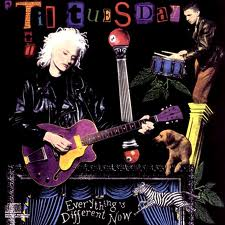
Yesterday I was driving to an appointment and had reached satiation with songs on the radio, so I grabbed the top CD off a stack I keep in my car for just such emergencies. As it happened it was Til Tuesday's final 1988 album Everything's Different Now. Most of the songs chronicle Aimee Mann's breakup with Jules Shear.

I was instantly transported to that period when it seemed all my relationships were, at best, practice at what not to do to be in a relationship. The late 80s was an especially rich sexual time for me when I experienced as much fucking as I could stand, and then more. Men and women were completely open to me, so much so I actually turned some interested parties down, which for a formerly fat kid with a complex was something I never thought I'd do.

But I tried steering some of those short-term escapades into more permanent waters and one of them was something I called The Great Marybeth Romance. Marybeth was much younger than me, 18 to my 27 (ironically, I think, for as much overthinking as I engaged in about the dicrepancy between our ages--and she wasn't even the partner with whom I had greatest age difference--I ended up marrying a woman born the same year as Marybeth and who keeps me honest [whether I want to be or not]), and our coupling was the result of sharing a bed on a weekend New England sojourn to hike the snow-covered trails with another couple.

I don't remember when I first heard music from the Til Tuesday album or where I acquired it, but when Marybeth and I inevitably crashed and burned a month or so later, I played the hell out of the tape. True, some of the songs were too specific to Mann's experience for me ("J for Jules," "Limits to Love," "Long Gone (Buddy)"), but I realized yesterday how much I had taken in all those decades ago. I could sing "Everything's Different Now," "Why Must I," "The Other End of the Telescope," and "Rip in Heaven" word for word, matching Mann's voice inflection for inflection, pause for pause.

The most deliciously painful is "(Beleived You Were) Lucky" whose message I imagined addressed to Marybeth as she sat quietly in a dark room, fantasizing (so I imagined) all the things we could have been and that (for reasons I genuinely can't remember but may have been partly because of our ages) we could never be, a heartfelt and disjointed stream-of-consciousness letter she was writing me abandoned at her feet. (And the album version has the gut-wrenching shift in one word so Mann sings how life "would be fucking great.") Two years later, enough time having gone by to allow a one-night reconciliation, the mix-tape I gave her (foolish romantics still did things like that then) did not include the song, however.

The phrase "deliciously painful" is accurate as I think anyone experienced in this can attest. Even now, there is a luscious hurt composed of equal parts shame, anxiety, pride, wish-fulfillment, and any number of other terms you'd like to add that comes bubbling up at the confluence of such a song and such memories. Some people never have that experience and I simultaneously envy and pity them. It is one of those tightly-held, jealously-guarded, queasy emotions some of us have access to and, for the lucky ones, delight in. For us, the emotion of the breakup is our best memory.

Saturday, January 4, 2014

it's the little, safe things

I have caught myself, despite my better intentions, falling quite in like with a little-known television series that my local public station plays in the 20 minute spot between other series. It's called The Cafe and the premise is that...well, you can just as easily read this Wikipedia post about it. And perhaps understand what it is that attracts me by this short scene:

I enjoy it, but what's more important to me is the small, homely (in the sense of something that is comforting and small as one's experience of home) artistic endeavors I come to appreciate especially during the winter.

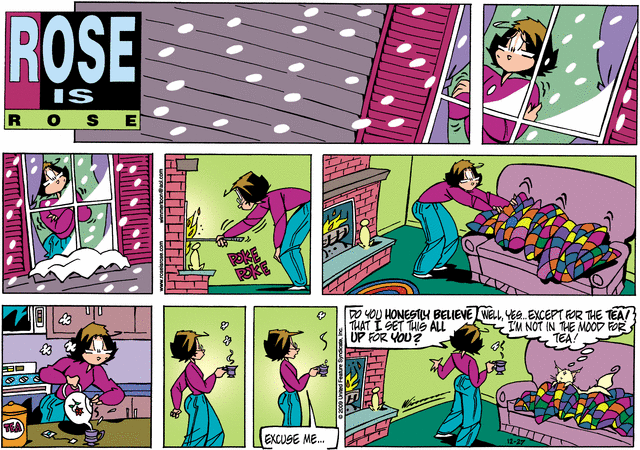
These run the gamut from comic strips


to recent music

to music from my childhood

to very, very stupid TV shows.


I think what it is is that they're little things. Small examples of tameness that manuever under my defenses and tickle something that, otherwise, I'm loathe to admit: I like consistency and safety. And wailing harmonicas.