Showing posts with label violence. Show all posts

Monday, May 11, 2026

Lionesses' Teeth


 [This is an edit of a message I originally gave at DUUC in 2013. See that post for links to information.]

         A Message Delivered to High Street

Unitarian Universalist Church 

May 10, 2026

           My contribution to Flower Communion is a freshly-plucked dandelion.  Taraxacum officinale.  We all recognize it in its omnipresence, as indestructible as love. 

          The dandelion is the cockroach of flora.  It existed long before our species rose up from the proverbial swamp and after we return to the dust they will continue to be here. 

The name “dandelion,” which I’d always assumed referred to the yellow mane of the flower and its seeming vanity, actually comes from the French dents de lion, “teeth of the lion,” and refers instead to the deeply serrated rosette of leaves that poke up from billions of lawns, in abandoned lots, between the cracks in concrete, in the clefts of mountain crags and skyscrapers, and sometimes tufting out of the useless chimneys of houses where no hearths have burned in decades.  They are perennial and rely on bees and flies to pollinate, and when they’re ready, the wind carries their seeds on tiny parachutes to new places.  Sometimes they fly as much as several hundred meters.  They do not need us at all.

          Dandelions are often used as a medicine, usually involved with blood, the liver, and gall bladder.  Its juices aids detoxification and bile flow, promotes lactation and the immune system, and helps reduce eczema and cough and asthma.  The root can be dried and ground up and added to coffee, like its close relative chicory, and the leaves are often delicious in salads (although I’ll admit I have to add a lot of butter to make them palatable).  And most of us are of an age when we have had dandelion wine.

          Had Jesus been born in, say, Kansas rather than in the Middle East, the Sermon on the Mount might have included the following: 

Consider the [dandelions,] how they grow; they neither toil nor spin; yet I tell you, even Solomon in all his glory was not arrayed like one of these. 

          Now don’t mistake all this information for anything like love for the dandelion.  There is a deep, satisfying, bottom-of-the-gut joy that comes with yanking a 3 foot long dandelion root from my gardens.  Few things are as pleasurable as watching the beasts disappear under the deck of my lawnmower.  I do not love the dandelion.  I tolerate the dandelion.

          Because, try as I might to eradicate it, the dandelion remains as much a part of my life as a part of my landscape.  I cannot escape its existence.  I mow and weed and have even sprayed the lawns, and still they come back up.  That is their unique power. 

A story now, a contemporary one, about motherhood that serves to relate how people are like dandelions.  Our relationships with our mothers, with either parent actually, can be pleasant and problematic at best.  I had what I think was a pretty good relationship with my late mother and with my dad, secure at all times in the knowledge that, no matter what, they loved me and wanted nothing but the best for me.  Those among us who are mothers or parents I hope have that same assurance that they, too, love their children no matter what. 

          This is a newsstory from over a decade ago that adds a different, more complex concept to this topic.  This is a story of three girls, now three women, in Cleveland, the first of them abducted in 2001, the last of them in 2004, all three found alive and relatively healthy in the home of their kidnapper, Ariel Castro. 

          We can have only the barest inkling what Melissa Knight, Amanda Barry, and Gina DeJesus experienced in their decade of captivity.  We should be thankful for that.  Worse perhaps, we are even less capable of imagining what the now 19 year old daughter of Amanda Barry and Castro has experienced.  If she is fortunate she herself retains little memory of what her life to now has been. 

          There are so many things to be said about this situation, about Castro’s activities and what he hoped to accomplish; about the women’s years in captivity and in physical, emotional and sexual abuse; about how this situation happened in a neighborhood of a major American city and not in some Hills Have Eyes outback; about the unwillingness of police, despite multiple reports by neighbors, to investigate beyond the front door of Castro’s home; and most especially, there are things yet to say about his neighbor CharlesRamsay and his willingness to expose his own past—because in this brave new networked world there are no past sins that can’t be found—in order to do the right thing.   

          But what I’d like to talk about is Amanda Berry and her daughter.  And how what little we know suggests about motherhood and resilience.  The story as it’s come to us is that Ariel Castro, who worked as a bus driver for Cleveland Metro School District, left his home to eat at a local McDonald’s.  He did this regularly but this day was different. Castro had failed to lock the "big inside door", although the exterior storm door was bolted. Berry did not attempt to break through the outer door because. previously, he had tested the women by leaving the house partially unlocked and exits unsecured. If they attempted to escape, he beat them. But enough was different that Amanda Berry took the opportunity to scream as near the door as she could until someone responded.  Charles Ramsay did, and it’s a testament to his heroism that this man, who had partied with Castro, eaten BBQ with him, played music with him, didn’t say “It’s a domestic matter” and turn around. After listening to her story that she was being held against her will Ramsey kicked the bottom panel out of the door.  Berry, carrying her child, squeezed through the broken panel, hugged Ramsay, begged him to take her to his house to use his phone, and then called police.

          Some of us might routinely play a mental game with ourselves in which, if we were caught in a disaster and could save only one thing, what would it be.  To make it more interesting we often presume that there are no people or animals involved, to make it a specifically material question.  What thing would we save?  Amanda Berry did not have the luxury of pretending or of there being no person involved.  The material object she left with was her daughter.

           To put this decision in perspective, consider what myriad complications must have been involved over the past six years.  Berry was just under seventeen when she was abducted.  After years of sex with her abductor she is pregnant at twenty and delivers a daughter into the dark, airless, sunless existence she’s come to figure will be her future.  We don’t know if she wanted this girl or feared for her existence, born into the same situation she’d been held captive in, and it’s likely it was a combination of both sensations and any number of others.  She may have wanted to abort the fetus, although we have heard suggestions from DeJesus and Knight that Castro beat them when they were pregnant to spontaneously abort their pregnancies.  So what we are left to guess at is that either Amanda fought vigorously to have this child or that Ariel had a change of heart over this pregnancy and allowed it to be brought to term. 

          This girl, born into a situation her mother was abducted into, and raised only in the company of the other two abducted women and Castro—what can be going through her head?  At the time of her rescue she is six years old, she has known only these 4 people in her life.  Two of them are her parents.  One of them carried her out of her world into the unknown, into what she couldn’t possibly know.  So while we can’t know what Michelle, Gina or Amanda has gone through we can, with some certainty, know what Amanda’s daughter was experiencing: Absolute, unqualified, quaking fear.

            It seems to me, as an outsider looking in on parenthood, that this is one extreme part of what it means to be a mother:  To deliver your child into great uncertainty and, when the time comes, to help her escape into greater uncertainty.  But that is what you must do.  As a coda to this story, Jocelyn Berry, as near as I can find, is doing well for someone with this experience. Ariel Castro completed suicide a little over a month into his own captivity.

          It’s well known that among lions it’s the female, the lioness, who hunts and who is really the fiercer of the species so it may be that the distinctive feature about dandelions—their serrated leaves, the dents de lion—may more accurately be termed the dents de lioness.  Perhaps the natural reaction as mothers, as parents, even as proponents of religious liberalism, is to emulate the dandelion—stubbornly resistive to any attempt to root us out, to burn us out, and even to the natural tendency by entropy to crumble us from within. 

          Our message, the message of religious liberalism, the message of people who see great complexity to parenthood—that it is better to be alive than to be dead, that to treat anyone as less than the glorious being that he or she is is itself an evil, that children and the people we’re responsible for need safe food and safe water and safe places to live, and that these are not starry-eyed ideals but necessities—must be heard.  We must endure for these messages to be heard.  We must become ubiquitous and obnoxious, unwilling to be pressed from our perch.  We must be willing to grow quietly beside the more beautiful and cozened strawberry and rose and lily so to suck up some of their excess nutrient and water until we can elbow those more popular petals aside to take the place we’ve earned.  To endure as a faith and as a people we need to be as tough, as resilient, and as uncompromising as the common dandelion. 


Thursday, February 26, 2026

“What is Happening to Me?”


A Sermon Delivered to 

High Street UU Church, 

February 15, 2026

I used to live about 45 minutes from Minneapolis. My wife says that when I start out with something like that, I should give fair warning that I’m about to tell you an amusing anecdote about myself. But this isn’t amusing and as you’ll see I’m peripheral to the story. Like today, a lot of protests and rallies were happening in the Twin Cities. Most I attended were uneventful, but in September 2008 the Republican National Convention came to town. Joining about 10,000 others on the streets of St Paul, I took with me a young member of my congregation. Keith had been to some protests in his sleepy Wisconsin town but not a large gathering or one with a sizable police presence. I suggested to him before we got out of the car he should leave his backpack of cigarettes and jacket, phone, instruments, and homemade signs in the car. But he was sure he’d need them.

We joined the anarchist contingent, a part of which was the so-called “black bloc,” the masked protesters dumping trash cans, breaking windows, setting small fires. One group eventually set a police cruiser on fire. I didn’t join them. I believe destruction gets you nothing except bad publicity, but I understand also publicity has its place.

Keith and I got separated soon after arrival and later I saw him do a brave thing. There was a large group of protestors at one end of a street and on the other end a large group of police. Now it’s a common sight today to watch videos from Minneapolis and Portland and Seattle and see all these militarized, armed cops in tactical gear and helmets, but in 2008 it was new. I stood with a part of the crowd at one end of the street, observing the standoff, when suddenly Keith emerged from the crowd. He walked to a point about midway between the two groups and sat down on the street. He sat in the lotus position, opening his arms to the cops, miming “Why?” Believe it or not, this had an ameliorating effect on the cops. They were ordered back a few blocks and the protestors marched further.

I saw a lot of things, places being vandalized, tear gas unleashed. Famously, a police car was burned. One protestor who’d thought to bring his own gas mask put it on and was surrounded and pummeled by the police about 20 feet away from where I stood. I stayed upwind avoiding the group collecting on the Wabasha Street bridge. There’s a police tactic called kettling, allowing a group to herd themselves into an area, then cutting off the means to and from that area, effectively boxing the group in. Most of those on the bridge were arrested.

There’s more to this day I’d relate but I’m talking about Keith, so I’ll skip to the end. After his action on the street, I didn’t see Keith again and when I returned to the car at our agreed-on time, he wasn’t there. I waited another hour before I called his cell phone, and it rolled into voicemail. I left a message and then drove the streets looking for him. Many streets were blocked off, however, so I knew there was a chance I wouldn’t find him. About 10 that night I called his mom and reported I hadn’t found him and needed to leave, as I had an 8 AM class next morning. She said she and her wife and her ex-husband, Keith’s father, would drive over and start looking.

Here’s the story as I heard it later. The three of them drove around the now-opened streets of Minneapolis until 3 when they found him wandering one of the streets with a small group of other teens. He’d been arrested a few blocks away from where I’d last seen him while getting a lighter out of his backpack. I knew that backpack was bad business. He’d been pressed down so hard by the cop he had a boot indentation on his back. Somewhere I still have a picture of it. He’d been taken to juvenile and kept in lockup for at least 8 hours. Juveniles don’t receive the fabled one phone call and his cell had long since died.

The cops remained on the streets of Minneapolis for about a week. The image of at least 2 officers armed with semi-automatics and bulletproof vests on every corner became a daily sight.

Here’s why I’m telling you this story. As nasty as the 2008 elections were—you remember the election? Sarah Palin was a Donald trump without either the charisma or the cash. John McCain referred to Barak Obama as “That one” in the second debate but made up for it by interrupting his own supporters’ allegations to describe him as “a decent family man with whom I have some disagreements.” Leading up to the election and after, Obama was described as anything from a secret Muslim, a Kenyan by birth, to the Antichrist. During the crackdown on the protestors that lasted a week, dozens were arrested. Some were hurt. But no one was killed. Other than gas masks when they deployed gas, I never saw a masked cop. Every one of them had his badge on the outside of his gear; Keith’s family eventually sued the officer who’d used excessive force in arresting him and we knew who she was because someone had taken a picture of her and her badge. My court appearance on Keith’s behalf was the first time I’d worn my brand-new clerical collar. People were hurt. No one died. As messy as things got, as adrenalized as everyone was.

Rush forward 18 years and things have changed. We look at one another and at ourselves differently. In under a year we have gone from, well, maybe not a Capraesque Bedford Falls, but it’s hard to deny we’re living in some version of Pottersville. You might remember in Bedford Falls there was a sizable community of hardworking immigrants, but there are no visible immigrants of any kind in Pottersville.

In my instance, I’ve come to see myself differently than before. I’m angry sometimes, at nothing in particular or at nothing I can identify. I avoid the news, and when I don’t I doomscroll. I brood. I don’t brood well. My brooding is less Heathcliff on the moors and more Charlie Brown reflecting on his team’s 156th consecutive loss. “Rats.” I snipe at people whose only crime is being related to people who continue to support trump. I don’t think of myself as depressed, rather as echoing the poet of the Biblical Book of Lamentations who writes, “My eyes! My eyes! They stream with tears! How far from me is anyone to comfort, anyone to restore my life. My children are desolate; the enemy has prevailed.”

In his “autobiographical sketch” of his childhood, “The Ethics of Living Jim Crow,” Richard Wright’s there was a clear distinction between the Black and white children. Among other things, Black children threw clumps of railway cinders at one another in play, while white boys were allowed to throw broken bottles at them. Young Richard catches one of these projectiles in his neck, requiring three stitches.

When night fell, my mother came from the white folks’ kitchen. I raced down the street to meet her…I grabbed her hand and babbled out the whole story. She examined my wound, then slapped me.

“How come yuh didn’t hide?” she asked me. “How come yuh always fightin’?”

I was outraged, and bawled. Between sobs I told her I didn’t have any trees or hedges to hide behind. There wasn’t a thing I could have used as a trench. And you couldn’t throw very far when you were hiding behind the brick pillars of a house. She grabbed a barrel stave, dragged me home, stripped me naked, and beat me till I had a fever of one hundred and two. She would smack my rump with the stave, and, while the skin was still smarting, impart to me gems of Jim Crow wisdom. I was never to throw cinders any more. I was never to fight in any more wars. I was never, never, under any conditions, to fight white folks again, and they were absolutely right in clouting me with the broken milk bottle. Didn’t I know she was working hard every day in the hot kitchens of the white folks to make money to take care of me? When was I ever going to learn to be a good boy? She couldn’t be bothered with my fights. She finished by telling me that I ought to be thankful to God as long as I lived that they didn’t kill me.

What’s happening to me, at least partly, is my disheartening realization that this self-identification with the authorities like Richard’s mother is something we have already seen. Hispanics, Blacks, and women have all joined the Border Patrol and ICE and are, maybe not unilaterally, but sufficiently content with their orders and their targets. My fantasy solution is suggested by the line of a song by The Devil Said Jump. These MFers are gonna “Make Me Buy a Gun.” So far, it remains fantasy because I’m really too much the coward and pacifist to do that. But I will admit I’ve looked up the price of high-end long-distance slingshots. My rationale around that is to echo that of the pastoral character Shepherd Book of the TV series Firefly. When the ship is attacked by government agents and along with everyone else onboard he picks up a gun to fight back, he is asked, facetiously, whether there isn’t something specific in the Bible about killing, he answers, “Quite specific. It is, however, much fuzzier on the subject of kneecaps.”

My point is it can be done, it has been done, without people dying or being maimed. We can’t support a government that acts out of the barrel of a gun. We will not support such a government, we will not forgive such a government, we will remember the government that did this and the people who cheered it on or who, at best, ignored that it was happening. People point out, rightly, if we, by which I mean the predominantly white liberal community, had refused to allow the government to behave this way with Black citizens, Asian citizens, Native Americans, we would not be dealing with the government treating people this way now. Yes, 20-20 hindsight and all that, but there’s at least a salt lick’s worth of truth to that.

I quoted Lamentations earlier. Now I quote the Psalms: “The Lord is near to the brokenhearted and saves the crushed in spirit.” We can surely use some of that certainty, can’t we, the surety of UU minister Wayne Arneson who wrote “Take courage, friends. The way is often hard, the path is never clear, and the stakes are very high. Take courage. For deep down, there is another truth: you are not alone.

It may be time, may be past time, to cut loose MAGA from political thought. Remember the John Birch Society? There’s an argument to be made that Bircherism is echoed by contemporary Trumpism. Long thought dead, it declined in membership from a high in the 1960s of 100,000 to somewhere in the hundreds. It isn’t just numbers. More Americans profess belief in UFOs than voted for Trump—yes, I looked that up—and we don’t take them into political account. They have set themselves outside society. It’s time to metaphorically vote them off the island. I remember during the first trump administration coming across the comment that the only things that would separate most of his supporters from him would be finding a dead woman or a live child in his bed, and there was some question about the dead woman. With each day revealing more evidence, it is obvious the live child makes no difference either.

Am I suggesting we drop those people from our lives? In so many words, I am. It’s possible to love someone and hate his actions. I used to teach in the Minnesota prison system. I liked my students. They were personable. I didn’t ask anyone what his crime was because, a, that’s not something you ask a person, and b, I wasn’t so certain I’d like them after finding out. They looked forward to class days and did all the work because it was a way, as one inmate put it to me, “to remind me my life isn’t just punishment.”

One of my best students and a favorite of mine insisted one evening on telling me why, in his early 20s, he had a life sentence. Without putting too much of a spin on it, he told me he’d raped and killed a young girl in his mid-teens. I had to sort out for myself whether I wanted to keep him in class. I had that kind of power, to drop anyone from class if I felt their contributions ran counter to it. It was a week of some soul searching, and I decided that despite how I felt about his crime, he had earned an opportunity to better himself. It is the same kind of self-questioning anyone with a father, brother, mother, sister, cousin in prison must ask themselves.

I like to think he took some comfort in that, that as bad as he had made his life he could read and talk about good books. I would rewrite the benediction of Reverend Arneson from “Take courage, friends” to “Take comfort.” Where do I take comfort? I take comfort in the love of my family. I take comfort in my animals, the dogs and cats who make up my pack. I take comfort in my work, helping people. I take comfort in my daily walk around my neighborhood, greeting the dogs and cats, and yes, even my neighbors who wear red caps. I take comfort in my activism, in showing up to rallies and protests and marches. I rarely help to organize these and less often speak at them, taking my comfort instead by being a part of the crowd, a quiet body standing in solidarity with like-minded people. It reminds me I am not alone. I take comfort in the words of fellow Unitarian TheodoreParker, that “The arc of the moral universe is long, but it bends toward justice.” But if we would see justice come in our lifetimes we must lean on one end.

Monday, July 15, 2024

"This only gets you this"


I remember when RFK and MLK, Jr were shot. I was 3 at the time so I don't recall JFK's assassination but I do recall the surprise I felt at the realization it had happened in my lifetime. I remember George Wallace being shot, and Jerry Ford, and John Lennon, and later Ronald Reagan. Any time violence mars the political or cultural dialogue, it's a blow against the safety we all take for granted.

Now Donald Trump has been shot at. I say "shot at" because, even after 2 days of reporting, I have yet to discern whether he was hit by a bullet or a shard from the screen behind him. It doesn't ultimately matter because the fact remains he was shot at, and this is something we can't dismiss.

Let me first reiterate, as someone else has, that the notion this was a false flag operation by his own personnel is absolutely ridiculous because there is no way anyone would sign off on putting himself in immediate danger like this. Whether it was a bullet or plastic that struck and bloodied his ear, any nearer and we would be talking about an assassination rather than an attempt. 

Trump's raised-fist response in some photos is legitimate and I'm willing to allow he is braver or at least appears so in the clutch than I would have thought (and maybe even more so than I would be). That wouldn't make him any better a president than he was before and it doesn't change any of the wrongs he's done. It makes for a great picture, is all. Let him have it.

Here is the thing. When we move from rhetoric to violence, as has happened, it diminishes us all. It says we have given up that, in MLK's words, "the arc of the moral universe...bends toward justice." If we would be content, we can't allow anger with one another, distrust in one another, or violence against one another to dictate how we behave toward one another. 

Neither should we forget Corey Comperatore, who was struck by a bullet while shielding his family, and killed, or David Dutch or James Copenhaver, both of whom were struck and hospitalized. And we shouldn't forget Thomas Matthew Crooks, who for reasons we can't begin to guess at decided to join the ranks of Lee Harvey Oswald, James Earl Ray, Sirhan Sirhan, Arthur Bremer, Lynette Fromme, Mark David Chapman, and John Hinkley. 

At some point, frustration and rage can flare into the certainty that "I must do something, no matter who it hurts." Before any of us reaches that state, we need to recognize that it's never the right response. The right response is long, arduous, exhausting work that can't take the shortcuts provided by a fist or a knife or a gun or a bomb. President Biden put it well in his address after the shooting: “In America we resolve our differences at the ballot box... Not with bullets." But perhaps Norman Lear's All in the Family put it more succinctly when the actor Gregory Sierra, playing a Jewish vigilante, tells Rob Reiner's Mike that, "One day you're gonna find out this [making Reiner's hand into a fist] is the only answer." Mike tells him he's wrong "because this [making another fist] only gets you this." 


Wednesday, January 6, 2021

Peaceful transition is the difference


 There is so much to be said about this attempt today to delegitimize the otherwise dull, ritualistic ceremony that, like clockwork, simply move forward the result of the presidential election. Like a commentator I listened to today pointed out, normally no one reports on the record of electoral college votes. It's one of those things, like asking at a wedding if anyone objects to the marriage, that is a holdover from a time when there was really a reason to make the result public. 

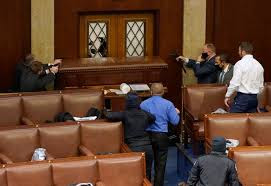
But that wasn't the case today. Hundreds, perhaps a couple thousand (reports vary) of trump supporters marched from the White House, where they were given "instructions" by trump, to disrupt the otherwise rote recitation of electoral results. They stormed the chambers and succeeded in postponing the naming of Joe Biden as the winner of the election. 

There's been a lot of anger aimed at the disruption by trump-supporters and I'm not entirely certain where I stand on that. I'll admit there's some jealousy I feel that a group I can't agree with has been able to do what groups I can identify with have been unable to do. Rituals are nice but they can and should be questioned and maybe thrown out. If these were Black Lives Matter or some anti-trump group, I might have been tempted to join them. But I am furious at the disruption of the most important facet of the American experience, the peaceful transfer of power. 

Democracy demands the loser of a contest recognize it and allow the winner, an expression of the will of the people, to take the reins. Four years ago, while it sickened me that he was that expression, trump peacefully and legally took the office. I protested him and protested his administration. But I wasn't going to join others in rioting against the ceremony or the final decision of the process. It would not have been peaceful or right.

Monday, February 13, 2017

"What is noise now will be music later"

All of us felt differently the morning of November 9, some the heady rush that what they believed was suddenly and unexpectedly given credence, and some that what they were afraid would happen now would happen. In the latter category, for many of us this has been expressed as numbness, a kind of unwillingness that other people were willing to vote their anger and fear rather than their hope and future. This essay, written by someone who watched his country go from peace to violence and noted the changes afterward: "People asked me if I had known the war was coming — I did, I'd say, I just didn't know I did, because my mind refused to accept the possibility that the only life and reality I had known could be so easily annihilated." Will Trump take us to war? My initial response is, Of course not! We are too civilized, too well-intentioned for that to happen. But of course, exactly those words were how I greeted Trump's second-- or is it third? Can anyone be certain of any fact now?--run at the White House. If this is the new normal, will compassion in government or relationships be seen as abnormal? Will gasps of apprehension become sonatas?

Thursday, June 2, 2016

258 candles-day 100

I've been wracking my brain trying to think of what I can say that will mean anything to anyone about the current dismal, distressing state of politics in this country. And I've come to realize this: There isn't anything I can say. But there is something I can do.

My solution, based on the Chinese proverb that it's better to light a candle than to curse the darkness, is to provide daily candles in the form of links to other people's solutions, simple or complex responses to problems that they see. But as a single candle will hardly provide enough illumination to blot out the darkness that is the pettiness and meanness that characterizes this election cycle, I will light 258 candles, one each day between now and election day. In this way, I will do my part to remind each of us we are better than the baseness of the bases.

Today: Make people aware of gun violence. 

Saturday, July 13, 2013

warning: this is a photo of a dead body

Yesterday morning one of the websites I normally visit published a photograph of Trayvon Martin's dead body that it had received from another person who happened to save it after it accidentally appeared on the MSNBC website and before it was taken down.  If you do not want to see this photograph, don't advance any further below or click on the following link.  Adam Weinstein, the reporter who recieved the picture and spoke with the reader who had saved it, put it on the main Gawker page where it has opened a massive can of worms.  By the time I post this, a little over thirty hours later, 94 comments have appeared with another 671 waiting to be cleared by the administrator.

I want to take a moment to explain why I think it's important for Adam Weinstein and Gawker to publish the photo and for me (and I hope other bloggers and writers) to publish it too.  I grew up as part of the generation that watched the Vietnam War play out on our television screens and about whom it was reported we had seen x amount of violent acts, real and fictional, on television by adulthood (I cannot locate the number, but it has been increased in recent years and in 2004 stood at 8ooo acts, mostly without remorse, by age 11), as well as real violence among our peers and our families, and so was argued that we had lost our sense of disgust at real instances of violence playing out before us or at least our shock at it.  Somtimes, to an extent, I think that too, at least in my case.  I have seen people die and I have grown up seeing dead bodies in photos and videos.  I'm of the generation that fetishized the gore of The Texas Chainsaw Massacre and the squirm-inducing rape sequence of The Last House on the Left and topped those off with repeated watchings of The Faces of Death series.  I can open a newsmagazine or a website to be faced with photos of dead people and continue to eat my cereal without blinking.

Does this suggest that I, and by extension many people of my generation who've had similar experiences, have become inured to horrible death?  Perhaps.  I think often I've lost my shockability, and that may not be a bad thing.  Sometimes, when shock becomes the status quo, not to react may be the more transgressive act. 

But it does not mean we are immune to reacting to the photo or the death behind it.  I'm still profoundly affected by the filmed deaths of Nega Agha-Soltan and some unknown desparate jumper and, before them, the photos of Phan Thi Kim Phuc (who did not die) and Thich Quang Duc (who did).  These four instances alone are enough to reduce me to a state of distrust of human capacity for goodness if not tears.  The photograph of Trayvon Martin minutes after his death, while I did not bat an eyelash on seeing it, has worked my guts in such a way I can hardly explain.  Except to say this.

We are anesthetized to death, especially to the deaths of strangers or people who become famous for their deaths.  That doesn't mean we don't feel them but we often are placated by the implications they suggest of permanance.  Lee Harvey Oswald in an eternal flinch.  Saddam Hussein mouthing what may be prayers or deprecations with a noose around his throat.  The almost beatific posed dead of Matthew Brady's Civil War.  We act as if those deaths are closed or their acts don't continue beyond the moment recorded, as if they don't have loved ones who mourn them loudly.  To do so is to open something uncomfortable in us because they take on a greater realism than the deaths of family or friends we aren't privy to might have.  Once we recognize they have lives outside the frame we are in danger of feeling profound loss.

These images ought to affect us that way.  They ought to make us angry or depressed or frustrated or any of a number of other things.  What they should not make us is numb.  This, finally, is the truth of the trial of George Zimmerman that we need to be reminded of.  Whatever verdict is returned, whether he is found guilty of muder or manslaughter, whether it's believed Trayvon attacked him or Zimmerman incited him to attack, whether the "stand-your-ground" law is a mistake and whether the justice system in Florida is biased, this is what the trial is about.  A 17 year old unarmed boy is dead by another person's gun.  The looks on our faces when we say that ought to be as surprised, as disbelieving, as the look on Martin's.

Tuesday, June 25, 2013

[god] has teeth

I'll admit that like almost everyone else today I get the bulk of my news from the internet.  But I still keep a toe submerged in old media, maybe because old habits are difficult to break.  I buy one of the papers from the hub three days a week, partly because I like to keep up with hub-related stories but mostly for the NYTimes crossword.  I also receive a few magazines, mostly religious, to keep up with ideas currently in play. 

I also receive Time magazine.  Its usefulness as a news source was made irrelevant a generation ago, and it really hasn't had much in the way of trenchent reporting since at least 2010, when Joe Klein wrote a shocking story about the "useless war" in Afghanistan.  It continues to print controversial images, but that's PR not information.

Still, on occasion I find something that surprises me, something I hadn't heard about before, or wasn't aware of connections between events.  Such is the story "The Face of Buddhist Terror" by Hannah Beech in the current issue.  [Note that the link is not to the story itself--Time insists on a paywall--but to a story about its subject's reaction to the story.]

It isn't that I was unaware of the use by some Buddhists to read (or willfully misread) the precepts in a way that condemns or demonizes an Other.  That is an old, old story, and Beech's somewhat lackluster closer, "It's hard to imagine that the Buddha would have approved" of the violence some monks are fomenting against Muslims, could be the tagline to any story about any religion and the beliefs of its more radical adherents.  I don't think the founder of any religion today, including L. Ron Hubbard, would recognize its contemporary version.

But many of us, and I would include myself, tend to endow Buddhism with the simplistic notion that it's all meditation, rice, and peace.  But that's to infantilize a religion.  We forget, or maybe never know, about the 1999 South Korean brawl between rival Buddhist factions over control of a major temple.  Or the importance of Buddhism to the actions of Aum Shinrikyo.  Or the role of Buddhists in Sri Lankan nationalist violence.  It is easy to forget, in our contemporary metropolism, that for many spiritual people, God, or inifinty or reality or the universe, has teeth.  And is not reticent to use them.

However, I have been aware of all those things, but I wasn't aware of the growing influence of Ashin Wirathu, the self-identified "Burmese bin Laden" who leads a group called 969. His group's violence has been felt in the deaths of many Rohingya Muslims in Myanmar, but may be poised to become more influential.  That is, at least, what I think Wirathu would like.

[On that last link, I think that Dr. Muang Zarni lets off Buddhism too gently by describing the adherents of the 969 movement as "Burmese men in monks’ robes."  This is, again, to infantilize the religion, to suggest that there is nothing in Buddhist history or scripture that can be interpreted as Wirathu does.  This is simply not true.  Zarni's attempt is equivalent to saying that Fred Phelps is merely pretending to be a Christian, that the Taliban merely put on the garb of clerics, or that Baruch Goldstein had merely emigrated to Israel in order to kill some Arabs.  Similarly, in my own faith, it is to pretend that the eugenics movement had no important Unitarian popularizers.]

Monday, March 11, 2013

the end of alice review

The End of Alice Review


(Fair Warning:  The following includes disturbingly graphic descriptions of violence on a child.)

This is a horrible, horrible book. It is disturbing, pessimistic, misogynistic, angry, flush with anger and a lust for destruction.

Which is exactly what it should be. You should not write a novel featuring child molestation and murder without breaking a whole carton of taboos. Such a novel must be written because pedophiles are our fathers and brothers and sons and, as we’re coming to increasingly discover, our mothers and sisters and daughters as well.

The End of Alice is famous, or more accurately, infamous for its portrayal of the unnamed narrator who has been imprisoned since 1971 for the rape and murder of twelve year old Alice Somerfield. The novel is told primarily from his perspective, although he has a correspondent, a nineteen year old girl, who also narrates some of the story.

More on her in a bit. Some reviewers have called A.M. Homes’ third novel a page-turner, but it wasn’t that for me, either my first time reading it, nearly a decade ago, nor my recent rereading. And again, the acts it describes and the mind Homes tries to mirror shouldn’t lead a reader to flip pages (except maybe in self-defense, the way some people hide their faces during gory horror movie scenes). But those scenes are just as important as any exposition and, in some ways, may be even more important because they present us with a safe way of seeing the world from a very different, skewed perspective.

Here is a short, less graphic scene to suggest what Homes is getting at in these stabs at an unsanctioned perspective. The narrator is telling us of his responses to many of the letters he receives in prison, “Requests on university letterhead for an interview, an extensive study, a few questions to be answered, research papers, a book.” He is uniformly dismissive in his written response.

However, if you are open to suggestion, I would wholeheartedly recommend several men here, in particular my buddy Clayton, who allegedly—and more than once—fucked men on the Christopher Street pier and then pushed them into the Hudson River…To hear Clayton [who is also the narrator’s sex partner] tell it—and he rarely does tell it—the men he fucked were so taken with the events, so absorved with the back and forth of the in and out, that when it stopped, when Clayton breathed a sigh of deep relief and shot high into their asses, the men surged forward, flinging themselves into the water. And Clayton, so suddenly drained, so recently depleted and a nonswimmer himself, would go to the edge and simply scream, howl at the water, at the night, offering his arm, his hand, his fist, to the men, who were already dipping under, flailing far from Clayton’s reach…[Good] luck with the project

Similarly, his victim Alice is viewed by him entirely differently from the way we expect a twelve year old girl to behave. She flirts obsessively with him, says “You’re my captive, my prisoner,” is stronger than he is and can pin his arms behind his back. She ties him to a tree, “surprisingly…adept, if not practiced, at the art of knot tying.” She prefers not to wear underwear because she likes “to catch the breezes.” She calls him a dolt, wears patent pumps and a black velvet dress or meets him naked in her room or in the woods, threatens to kill him.

Alice is no Lolita, a metaphor for a young, intoxicating America. She’ll never grow up to be an overweight housewife and mother. She’s a real twelve year old girl but she is not a real twelve year old girl in the narrator’s imagination. She is a temptress who knows exactly what she is doing to him, every moment, up until the moment she forces him to kill her.

Forces him, because what he remembers is that when they have finally given in to the sexual tension of their relationship in a motel room, is that, having lost her virginity, she is of course bleeding and blames him for having “done something awful to me.” He tries to explain to her it’s menstruation but she won’t hear of it, saying “Your words get in my head…Don’t try and humor me…You’re making excuses for yourself…You cut me with the knife…You did this to me…I’m in pain…” In the novel’s final pages, this is how he remembers the scene as a cacophony of images and shouts, some his own creation and some probably real.

Her hunting knife is in her hand. It’s out of its sheath. She’s flashing it at me, all the while holding her stomach…”Put it down,” I say. “It’s perfectly normal…” She cries, puts her hand over the spot, clutching herself, as if she can hold it in, push it back inside her…

The storm. Lightning crashes. The lights go off, then on again, punctuating our dialogue…I don’t know why, but I reach for the knife, take it away…

“I didn’t touch you with it,” I say. “I didn’t touch you. This is touching you,” I say, touching her with the knife. “This is fucking touching you. I didn’t touch you here.” I poke at her skirt with the blade. “Don’t you understand? I don’t want to hurt you.”

“Then why did you do this to me?”

…”Why do you make me?” I’m crying. “Don’t make me.”

The first time it plunges in, there is resistence, but I’m angry, full of fire. I force it into her gut. The next one goes into her neck, a bigger splash, bright spray, the hiss of an artery. A hot, sticky fountain of blood douses everything. She makes a face and falls back on the bed, gurgling like a little girl…Again I plunge in. She looks surprised. Again and again. I can’t stop myself…

She’s in pieces, splattered around the room. Rivers of blood form small tidal pools. I don’t know which blood is which, from whence it came. The scent is meaty, the putrid stink of slaughter. I’m embarrassed by the vigor, the extent of my outburst. It is as if I’ve lost myself, broken away.

Have I made my point?

This question, seeming at first look to be addressed ironically to the dead Alice, and then to the parole board with whom he’s meeting, is finally revealed to be addressed to the reader. While the narrator is as untrustworthy as they come, he is also absolutely convinced that he has an audience. He does of course: “[If] you are anything at all, you know who I am—and find my disguise the silly childish senility of the long-confined, of the good mind gone sour [unconvincing]”. In the final paragraphs he echoes other unreliable narrators:

To you alone I’ve told the tale, do with it what you will. That’s all there is, there isn’t any more. I’m out of breath.

The deal is done…It is summer, the end of summer now…There is sky and trees, a high wire fence, a long road, and at the end of it you are there, waiting for me.

So glad to see you, I say. Missed you so much, thought about you every day.

Finally, the narrator is addressing not only “herr reader,” but Alice herself or the Alice of his imagination, the Alice who did not end up “decapitated, her head positioned between her legs, weapon…jammed in victim’s vagina…Accused apparently continued relations with victim after her death. Victim’s face and body covered in kisses. Accused dipped his lips in victim’s blood and then kissed deceased repeatedly.” This Alice will be more like the unnamed girl correspondent.

The girl correspondent, the nineteen year old who sends the narrator letters. She is important. As I said, she narrates alternating chapters of the novel, explaining her choice and subsequent seduction of twelve year old Matthew who is, unlike Alice, absolutely a flesh and blood boy. He smells. He is sweaty and hangs out with other nasty boys. He eats scabs. He talks back and calls what the girl reveals to him her “clip.” The letters, we are told, are not as full of information as the narrator would like, so he fills in what’s missing with fantasy.

After her successful seduction she is bored with Matthew, finds she’s bored with what her life has become, tries to kill herself, and is sent by her parents to Europe where in Paris she eventually leads a blind man and his dog up to her room. “When the girl brings the man to her bed, the dog grows excited and jumps up, joining them. ‘Couche,’ the man orders the hound. ‘Couche,’ he says, and the dog waits for his master on the floor.” She sends her final letter from the airport returning to the US. She tells him, “I’m not afraid of you anymore, I’m more afraid of myself.” This is the final lesson she’s learned from him.

Except that the girl really doesn’t learn anything from the narrator. There is no girl.

That there exist such girls, nineteen year olds compelled to work up a seduction of a twelve year old boy, coeds who write to famous child murderers to brag about both their crime and their having gotten away with it, this I don’t doubt. That the two might converge is part of the suspension of disbelief we give to fiction. And that at some level Homes intends for us to take the girl as a real character, I don’t doubt this either. There’s nothing in the text to suggest that Homes is setting us up for a fall.

My reasons for thinking the nineteen year old doesn’t exist except in the narrator’s imagination are these: she is just on the cusp between teenage and adulthood, and may even be the age the narrator was when he began molesting children (we know he molested many, many girls but he has only been charged with Alice’s rape and murder); the age of her victim is the same as Alice’s; Matthew is as mundane as Alice is idealized; the girl lives an upwardly mobile, upper middle class life, significantly different from the narrator’s own childhood growing up either traveling with his seductive mother (to whom he may have lost his own virginity) between bouts in sanitariums or staying with her mother; we know the narrator is unreliable, dealing with mental illness beyond pedophilia, and there is not a page where he doesn’t remind us of that; no one ever uses her name, even in his fantasies, just as no one uses the narrator’s name, even in his “reality.”

Finally, she gets away with it. What better fantasy is there for someone who says of himself he is “finally free” only upon being returned to his cell after being denied parole?

Friday, March 23, 2012

I think I've figured it out

I cut my teeth on late 60s and early 70s comics and I still like to settle in for a while in a bookstore and read several graphic novels covertocover when I have the time. but I've come to be more and more disturbed lately by what I see, and today I think I've come to realize what the cause of that disillusionment is.

they simply are no longer realistic.

many people have noted the incredible violence being perpetrated in comics in the past decade--rapes, beheadings, fists through faces, cannibalism, that sort of thing--and that isn't so much the realistic punch that many of us readers back in what they've come to call the bronze age of comics were hoping for when we cried out that comics lacked realism. after all, we had characters who quit, who were strung out on horse, who killed villains. it was often done as if it was the only way to deal honestly with these issues, but also with an air of trepidation and sometimes coyness, almost in a sweet way.

but now we are given hyperrealistic deaths of tens, dozens, hundreds, sometimes thousands of people at a time. and almost no one is punished for it.

I'm not arguing for a return to the comic code sort of justice in which the evildoer must come to bad ends. but consider: we've told creators and companies that we want realism and grittiness and dark, dark stories where the bad guys win at least as often as the good guys. and that's not what I'm arguing against because frankly I like that. it strikes me that kickass is a more realistic comic story than batman.

but if comic stories reflected the world that we live in no murderous villain would appear more than 2ce, 3 times tops. in a conceit where the joker kills dozens of civilians and cops each time he escapes or where an ultimate (intended specifically to be a more realistic universe) green goblin slaughters multiple dozens of highly trained secret agents, both of these characters in any reality we would recognize would be executed formally or secretly shortly after being taken into custody.

we live in a reality in which a 3 strikes law requires that a person stealing a slice of pizza is given a life sentence; in which 34 states have death penalties and there are 41 separate federal crimes for which someone can be executed; in which the only ways that people like slobodon milosovich or augusto pinochet (in many ways our realities supervillains) can escape life sentences are by playing out the length of judicial rope they are allowed until they die of natural causes; or in which people like jeffrey dahmer are themselves murdered by other prisoners. that the batman would put the joker back in prison or a psychward each time (after he murdered his own partner!) without himself taking vengeance or the state stepping in and putting him to death obviates the refusal by comic writers to take their own concepts seriously. there is no reason readers ought to either.

Saturday, October 29, 2011

saturday night reading

in a short essay on the ezine he co-founded, gary kamiya has articulated some of the feelings many of us in the religious community have felt but have thus far been unable to communicate. I am in awe of his ability to simply and coherently wrap up one of the most important ideas about what occupy america is about.

"Yes, the Occupy San Francisco tent village is illegal. Yes, it is unruly. Yes, there are homeless people there. The movement is filled with oddballs and dropouts and nuts, and based on my own visits there, they outnumber the “respectable” types, the unemployed workers and students and housewives. And if real problems arise, violence or vandalism or disease, the city has the right
and obligation to take steps to remedy them. But since no such problems have arisen, it’s impossible to escape the conclusion that the hand-wringing about the tents is all about image. The Occupy San Francisco movement is flawed and unsightly, like panhandlers and street people. The tourist-friendly solution: clean it up.

"But the crazies and dropouts and street people who are part of the movement deserve to be there, deserve to be seen. For they bear inarticulate witness to the inequities the movement is protesting. Of course, they didn’t all end up there because of society’s sins; bad choices and personal responsibility also played a role. They’re not the best spokesmen for the movement. But they, too, are part of the America that the movement is trying to make better. They, too, are our brothers.

"That isn’t liberal swill. It comes from a book called the Bible."

Friday, June 24, 2011

a palestinian gandhi

"some people think that satyagraha is weakness; they believe that the angrier you are, the stronger you will be. this is their great mistake.


"causing someone to suffer the same price you have paid will never ease your pain. it doesn't help much to be right. you damage your right by just being right. one usually wants to be right only because he or she can't be honest. give me a solution...where my right is in harmony with my humanity and their right is in harmony with their humanity. nonviolent protest is where you invest your pain, a place where this pain becomes active in accordance with your humanity. you cannot practice nonviolence without listening to the other side's narrative. but first you have to give up being a victim. when you do that, no one will be able to victimize you again. I don't want the world to feel pity for me; I want the world to take responsibility, as I do."


--ali abu awwad quoted in "salt march to the dead sea: gandhi's palestinian reincarnation" by david shulman in the june, 2011, issue of harper's magazine

Tuesday, January 11, 2011

monday reading


"There are two reasons for our toleration of political violence, despite all our sincere words of grief and castigation. For one thing, America has a long history of political violence -- a dark river of brutality, even savagery, that runs through our entire national experience. For another thing, we don’t like facing up to that fact as a people or as a nation. Americans prefer instead to see each outburst of violence -- whether in physical attacks on political figures or in blasts of gunfire in our schools and shopping malls -- as aberrations, isolated incidents committed by deranged individuals who cause mayhem and slaughter like human whirlwinds. When the wind has subsided, and the casualties have been counted, we proceed as we have done before, dismissing the event as an exception, waiting for the next act of lunacy to occur, at which time we will express our shock and dismay all over again...

"[Political violence]is a troubling, but inescapable, bequest that stems from the fact that our nation was born in violence, and it derives from the reality that violence has ever since become not only the device of criminals, but also of government and those who disagree with the government. Public officials who condone the use of torture in recent times should, by rights, give pause when they try to condemn the actions of Jared L. Loughner, Timothy McVeigh or the Unabomber. But, typically, our public servants see no contradiction, no hypocrisy, in advocating extreme political violence against our alleged enemies around the globe while condemning political violence when it is aimed against the government -- or, more precisely, against them. In other words, political violence is legitimate when the government commits it; but it is appalling when individuals commit it against the government or its representatives. Political violence committed by individuals is explained by marginalizing those perpetrators as crackpots. Political violence committed by the government is justified as guaranteeing national security...

"]However,] confronting that violence, admitting its prevalence, and committing ourselves to actually doing something about it has proven to be, over the course of the American experience, something we never quite seem able to handle. In our own time, the NRA and its powerful gun lobby have ensured that deadly weapons can be easily obtained and placed in the hands of every member of the American populace, including children. Finding a weapon of choice for committing whatever act of political violence you may be contemplating is, in fact, probably easier than picking an appropriate target for that act. We console ourselves with the propaganda that guns don’t kill people, people do -- particularly crazy people. And that slogan gets us all off the hook. Violence is not an American solution. It is, we try to convince ourselves, only the solution of wingnut Americans.

"But we’re wrong. Over and over again we deny the American heritage of political violence, for though we understand that much of our past has been filled with violence, or at least marked in prominent ways by violent acts, we find it very difficult to admit that we are, in the end, a very violent people and that aggression may be found at the very core of our culture. As Americans, there is much violence that we justify and even legitimize, particularly when it comes to looking at our past. We have been ready -- proud, even -- to justify the violence of the American Revolution that won our independence from Great Britain as a necessary means toward a positive end. Likewise, our participation in wars always seems to have been for the best of reasons -- or for what at least looked like the best of reasons at the time. Violence in many forms, then, is often seen as a legitimate means to accomplish a positive purpose...

"Violence has actually formed a seamless web in our history, but the subject of violence has been suppressed in our national consciousness. As one historian, Richard Hofstadter, has put it: 'What is most exceptional about the Americans is not the voluminous record of their violence, but their extraordinary ability, in the face of that record, to persuade themselves that they are among the best-behaved and best-regulated of peoples...'

"While confronting the fact that violence erupts around us every day, not only in the cities but often in the house next door, and while we live in utter fear that violence -- especially random violence or terrorist violence or the kind of political violence that felled Rep. Giffords and so many other innocent bystanders in Tucson on Saturday -- could easily touch our own lives, we nevertheless prefer to look away from the record that shows how commonplace violence (particularly political violence) has been throughout our history, how frequently it has occurred, and how it has persisted from the past into our own times."

--from "Our Permanent Culture of Political Violence" by Glen W. Lafantasie in the 1-10-11 edition of Salon

Friday, January 7, 2011

"shots fired on campus": are we too safe?


I'm not entirely certain how I feel about this yet, but at the least I'm concerned about the unspoken assumptions of it. for the 1st time since I've taught, we faculty were trained for 45 minutes on what we should do in the event of a shooter on campus.
that there've been too many incidents to remain complacent, I agree. I show this timeline to my student each semester when talking about current school shootings (and there have rarely failed to be at least 1 shooting happening each semester). (note too that the timeline stops in early 2009; I don't know why infoplease hasn't thought to update it.) there was a school shooting only 2 days ago which left 3 people dead, including the 17 year old assailant. that students or others come to school with weapons to put us and the students we're responsible for at risk is true and I don't want to diminish that.

at the same time, what does it say of us that schools, when I was a kid thought one of the safest and dullest places in a community, are now targets?

the analogy I draw is this: what does it say of the trust we put in students, the youngest of which are in their late teens and the oldest sometimes in their 90s, that we lock them out of classrooms between classes? during the 1st weeks of class I approach this, asking them as I walk up to the door with my key out, "why are you treated like kids we can't trust?" sure, there are computers and other equipment in those rooms which would cost thousands of dollars to replace, and sure I'd be pretty pissed if I walked into a classroom where I'd intended to show a dvd only to find the equipment had been stolen. but so what? it's money and it's inconvenience, but the alternative is to treat adults as if they can't keep their hands off the candy.

as I've pointed out to students, so far as I know none of them has a history of theft. but I do. and they give me a key.

and while I don't have a history of violent behavior in school, I think we ought to err on the side of assuming that neither do our students. I'm not advocating that the training be discontinued--far from it, I think it was well done and to the point and campus security was at pains not to sensationalize the issue. unfortunately, I fear we are at a point at which teachers need to consider the possibility of student assault on them and on other students, and to that end it's good to be aware of what our options are and how we ought to deal with it. the video we watched (not available, as near as I can tell, on the internet but its title was "shots fired on campus": if you google that for videos, you'll come up with dozens of hits, most of them the titles of local stories) and the security officer presenting made mention several times that campuses are designed to be welcoming, open spaces where people feel free to enter the buildings or the property any time campus is open. such places are not intended to provide escape routes or cover against getting shot.

and there is where my concern lies. education, to be a social good, has to be available to everyone and a part of that availability is presenting itself that way. we may be on the way to locked buildings we need to enter using a swipecard and fenced grounds we need to show ID to enter, and while that may be safer, I don't think it would be right. school shooting training is not going to get us there. it makes sense to be prepared. but I still wonder what the need for it says about us and what it could say to people who'd like to join us.