Showing posts with label new paltz. Show all posts

Monday, November 27, 2023

Too Young to Lose My Best Friend


 I'm listening to my Cocteau Twins Pandora station. It was one of the groups she'd introduced me to, along with the Bush Tetras, Hazel O'Connor, the Sugarcubes and Bjork, Echo and the Bunnymen, the Violent Femmes, and dozens of others I've forgotten in the ensuing decades. 

I don't remember our meeting but I have an approximate year: 1982 or 83. I was a tutor and she was one of my students in for writing help. I don't remember what her issues were beyond misspellings and the occasional missing punctuation, but somehow we bonded beyond the needs of Composition 1 and our friendship took on greater importance as the years passed. She was the first to get me drunk. It was my 25th birthday and we celebrated with several of her housemates with Melon Balls, Kamikazes, and, in a final booze-filled marathon chess session played among a half dozen sleeping bodies, Malibu Rum. 

We attended a half dozen Rainbow Gatherings together, and at the Nantahala Forest Gathering, the 1st for both of us, she managed to dodge the dysentery that laid most of us low. After, she told me how she accidentally avoided getting arrested 60 miles inside Babylon, by absently reaching down to pet the head of the drug-sniffing dog that was about to find the stash in her pocket. The grateful animal, as she said it, "just looked up into my eyes with her tongue out and such a look of, 'Oh, hi, do you want to play?', that her handler yanked her back hard and that was the end of that. They had to let us go." 

I'm unsure which of us graduated first, or if she graduated. Those years, graduation wasn't really very important to any of us back then, although we all expected to. What was important then were adventures, the sorts of events that happened and you talked about them later. We attended a couple weekend workshops but didn't have the money to stay in a motel. So we slept in my car. At one, after we'd finished for the day and had some dinner, we found an out-of-the-way road, mostly dirt track, and figured it was remote enough to safely sleep there. Along 1 or 2 o'clock I was woken by her insistent, "Someone's at the door" next to my ear, not so much whispered as said in amazement. It was a cop. 

Windows rolled down in cars then so I rolled the one closest to me and said, very quizzically, "Hi?" He said, "Do you know the owner of this property? Has he said you could stay here?" I said, "We didn't even know it was property, we thought we were out in the woods." He said, "Well, you're in someone's driveway and he's not around apparently, but if he comes by you'll have to move." That seemed reasonable to me, the having to move part, so I agreed and he got back in his car and we went back to sleep. In the early morning as the fog lifted, we could dimly see a house at the other end of the drive. The owner had either never come home or he'd never left. 

Another story, this one not involving me, one she told me. She'd been walking through the Student Union on her way somewhere when she'd got a whiff of someone's patchouli as he walked by. The tribe we hung with loved patchouli but found it hard to locate. She walked swiftly beside him and asked, "Is that patchouli? Did you get it around here? I love patchouli and..." He stopped suddenly, looked down at her--in her story he was over 6 feet--and announced, "It's obvious you want to engage me in  conversation but I don't want to." And he strode off, leaving her open-mouthed in his wake, incredulous when she told me, as if it was impossible someone wouldn't want to talk with her. I could not imagine why not. I was honored by her friendship. 

We attended more Gatherings, went more places, did more things. Most everyone wanted to talk with one of us everywhere we went. Somewhere in there we became lovers, although never exclusive, in defiance of everything we'd thought we were to each other. What she became to me, I'm sorry to say, was the human equivalent of home, someone that when you go there she has to take you in. I told myself that's all I was to her as well. Of course, that was wrong, both factually and morally. When she stopped talking to me after I married, my wife encouraged me to contact her. "You're too young to lose your best friend," she told me. 

That's a lousy story to end on, so here's a better one. Another Gathering, we had dropped acid together (when we talked about this last week while she was in hospice and I'd driven 1500 miles to spend time with her she insisted it was her first time, a possibility her sister later doubted, so we'll let it go) and then found ourselves at night at a jam session where, for some reason, she'd needed to take medicine. She dropped it and the two of us bent in the shadows, heads down, rummaging around among the leaves and twigs and loam for the pill. Suddenly, something dropped on her head, bounced, and landed in her open hand. It was the pill. We laughed because the universe opened a rift in time below our hands and another above our heads. It had decided to fuck with us and that was all right with us. That is how I will remember her, laughing. 

Monday, April 3, 2023

Audrey and Aiden and Chambers


 I remember my first time driving into Nashville. It was 1988 and I was coming from the west. I  crested a big hill and suddenly, there it was, a beautiful shining city in a valley ringed by a haze visible in the early light. It must have been about 5 or 6 in the morning, and the haze was the residue of tobacco smoke I could clearly smell through my open window
. I saw the Cumberland River snake through the city, and I heard faint hints of music on the wind, although that was really the radio station I had on. 

I haven't spent appreciable time in Nashville since then, a quick drive=through skirting the city on my way somewhere else, so I don't know what it's like there. But my reading has given me some indication that, like most big cities, it has citizens who love and cherish it and would protect its people from their fears. For some, that's the easy accessibility of guns, and for others, it's the life-altering identities their children can access. 

I fear the proliferation of guns, myself, and I try to understand the fears of the opposite side. Usually that's a moot debate but a week ago the two fears collided in the person of Audrey Elizabeth Hale, born a woman and often seen dressed and acting like a younger kid, but also identifying as Aiden and using male pronouns. Audrey had attended the Covenant School as a child, leaving for middle school in 2006, but why Aiden went there with guns and shot three adults and three 9 year-olds, we don't know.

I'll admit to being conflicted, because I want to honor Aiden's choice and use male pronouns. But I don't want to honor what Aiden did. I'm uninterested in the rationales school shooters tell themselves and I don't want to start now. But I don't want to lend ammunition to haters telling us it was Audrey's opting to be Aiden that somehow caused the "quiet, shy girl", as Audrey is described by nearly everyone who knew her, to purchase seven (!) guns, all legally despite being treated by a doctor for an "undisclosed emotional disorder.
They try to lay Audrey/Aiden's possible use of medication containing testosterone as having been responsible for the shooting. Per experts, there's anecdotal evidence that high testosterone levels can lead to more aggressive behavior than usual.
I don't know if Audrey or Aiden took testosterone in any form but I know any doctor trusted with a patient's well-being monitors both dosage and behavior. closely I also know the desire to kill strangers is not a side effect of taking too much. Testosterone is no more responsible for this horror than it is for other male public shooters. 

So how do I deal with this conflict? Do I mourn Audrey and condemn Aiden? That may be one solution. As possible as it is to hold two conflicting thoughts in your head, it's possible to celebrate one person's life and disdain a part of the same person. If there's a model for this, it's my former friend Chambers. 

Chambers was a good man who was a road dog of mine. We traveled many places together, visited Rainbow Gatherings together, sometimes worked together. I went across country to start a new life and eventually heard from another good friend he had murdered a woman. There were probably signs most of us ignored or were blind to, but Chambers had become a dealer, and while there is much more to this story, the upshot is that one early evening he broke into another dealer's home, was surprised by her, and beat both her and her dog to death. It was neither drugs nor testosterone that gave him the impetus to kill someone, it was simple greed.

None of us knows what caused Aiden to dress in camo, take two long guns and a handgun -and shoot his way into the school, and then shoot six random people including three 9 year-olds but he left a "manifesto". Once it's read and its contents reported, we may have an idea what prompted his action. 

Meanwhile, we have a situation different from and yet too-similar to other mass shootings. A person undergoing treatment legally purchased a number of guns and then shot several vulnerable people. Despite other information we also know, it comes to that.

Tuesday, February 21, 2023

Uncomfortable Places Where I've Slept


There are no chickens in this story

MY LIVING ROOM FLOOR, NORTH CHESTNUT STREET, 
NEW PALTZ


I’d met this guy Jonathon while working semester opens at the college bookstore. He was really introverted but we got along. He invited me to a party in The City, although who he knew there I never figured out. The two of us rode out on the Trailways bus and took a subway to wherever the apartment was. I’m necessarily a little hazy on the details.

Most of the night for me was in bursts and flashes. I remember drinking tequila and then fashioning some concoction from other alcohols. I remember making out with a woman in a room away from the party but other than long reddish hair I don’t remember anything about her. This is a big part of the reason Jonathon later stopped being friends with me because I found out she was someone he liked and had hoped to get to know at this party. I wasn’t much of one for niceties like that in those years.

When the party broke up at 1 or 2 we took the subway back to Penn Station but there were no busses leaving until 7. So we joined the ranks of the homeless who squatted in the one room inside the station the cops kept open for them. Once an hour they rousted us to another end of the room, saying “No one sleeps!” But I did as I was riotously drunk and between bouts of laughing at the cops (not a practice I’d suggest) and trudging from spot to spot, I huddled on the floor and slept the fitful half-doze known to both the inebriated and those trying to have conversations with them. Jonathon spent the whole time standing and trying both to stay near me, like I was protection, and being as far from other people as he could.

Eventually the sun came up and at 630 we could buy tickets, with which we could stay the half hour to 7 while the others were bounced into the street. The bus ride was two hours but to me it seemed both like hours longer and just a few moments. We reached town, I walked with Jonathon as far as the corner of Main and North Chestnut where we parted, him to his room and me  to my apartment.

Now this is where it becomes uncomfortable.

I’m one of those lucky few born with some immunity to the bad effects of drugs and alcohol. I’ve never had a bad trip from LSD, never gotten paranoid while smoking weed or hash, never experienced anything but stupendous and unremembered epiphanies on shrooms or peyote. Never had a hangover no matter how much I drank. Except that time.

My headache began on the bus but I put it down to the sun in my eyes and lack of solid sleep. As I walked, I could feel each step travel from my foot through my body to the tiny hammer banging my brain. I had never felt so happy getting to my apartment, so much so I opened the door and did a faceplant on the floor. I didn’t feel like I could make it to bed, I just laid there and slept.

Or I tried to. It seemed that day everyone in the world I knew chose to visit me, either in groups or singly. Again, only fleeting memories but I do remember a stream of drool from my mouth to a small pool next to me when the first person, whoever it was, knocked at the door. Stupid me, it never occurred to me not to say, “Come in,” although that wouldn’t have accomplished much as I had a habit of not locking my door and encouraging people to walk in.

I alternately curled into the fetal position or spread full out like DaVinci’s Vitruvian Man. I may have even resembled that drawing a little as my hair was curly and long and sweat-plastered to the floor. I vaguely recall Jonathon coming by with another friend of ours, I don’t remember who, and looking smugly down on my pain. I probably cried once or twice. No one, fortunately, stayed long, or I don’t think they did, because I kept drifting back off to sleep after a few sentences describing my head variously as a deflated basketball, a cracked egg, a fishbowl full of fecal water, a balloon blown up by a congested drunken bum. There may have been more.

Eventually the night came, and far from being refreshed, I was so worn by the exhaustion of breathing through a mouth equal parts dry and swampy I fell finally into bed wearing the same clothes I’d worn to the party now 24 hours before and drifted in and out of consciousness until 5 or 6 the next morning, when I got up, stretched my 45 minute routine, and then put on running shorts and took a ginger mile and a half jog. Outside the day-long, incessant hammering, that was my usual start to the morning, which may have been why I didn’t usually suffer otherwise

Saturday, December 31, 2022

Uncomfortable Places I Have Slept 2


Not my vehicle

Chilcott’s Mechanics, Route 32, north of New Paltz, NY

 I spent a week at a retreat put on by Direct Centering, the cult I was involved with in the middle 80s. I’m likely to write more about this in the future, but this is what led to a morning spent at a garage.

I’d driven down two friends, and while I remember their faces, I don’t remember their names. When we returned to New York from Florida, I also gave a ride to Shelley, my occasional friend with benefits (although we didn’t call it that back then). The four of us left Florida, where the retreat had been, and drove the east coast home, dropping each person off on the way. One lived in northern Jersey, one in Brooklyn, and Shelley was staying in Riverdale with her mom. It was a long drive, and only two of us, Shelley and me, had driver’s licenses. I don’t remember how often we changed drivers but at one of them Shelley ordered me to drink a full cup of coffee.

Now, here is the place to talk about my complex relationship with coffee. Growing up, my parents had regularly downed cups of what they called coffee each morning, and it wasn’t for decades I realized what they were drinking was Sanka or sometimes Kava. The liquid smelled terrific, but the actual taste was like a brown crayon dipped in tepid tap water. I vowed never to become a bean head like them. To reinforce this, the coffee Shelley had me drink was from a pot of late-night percolated stuff on the back shelf of some station where we gassed up. It went down like moist grit.

Years after this, I was at a Rainbow Gathering where I was introduced to Cowboy Coffee at an off-trail kitchen called The Mud Hole. [Kid to the guy hunkered over a pot on an open flame: “You got any water?” The guy, from somewhere in the recesses of his gut: “Nope, got mud.” Kid: “Oh, I get it. You got any coffee?” Guy: “Nope, got mud.”] My reaction to drinking this black distillate was like The Simpson’s Barney Gumble chugging his first beer: “Where have you been all my life?” And by now, I am a fully confirmed java-head, whose father was unable to drink more than a quarter cupful generously laced with water when I made it.

Anyway, it may have been the effects of that cup that made me refuse Shelley’s offer of a nap at her mom’s place, telling her, “I’m an hour from home, I can do this.” It was also bravado, which I had in great supply.

The retreat was in mid-winter and while we were south, New York had a couple snowstorms, none very heavy, but there were a couple inches on the ground. I was renting an apartment in New Paltz then and was kinda anxious to sleep in my bed. Most of my drive was uneventful, I was holding steady at about 60 on the Thruway, a little slower than most traffic because there were patches of black ice here and there. But I was a New Yorker, had driven in snow and sleet all my life, and I knew how to avoid them.

Up until between the exits to Newburgh and New Paltz. I passed a car going slower than me and fishtailed, first to the right, then left, then careened out of control, between two other vehicles, and over the embankment rear-first, sliding through about ten feet of snow, ice, and slush to come to rest at an angle where I had no choice but to look at the sky.

My first impression was amazement that things I knew belonged in the back seat were on the dashboard. My second was that the music, in the silence now of snow and my car rattling like a tin toy slowly dying, was all too loud, so I switched the car and the radio off. The tune was Sting singing “Russians," a song I was familiar with from dozens of anti-nuke rallies. It’s funny to me when I think back how clear like window glass this memory is.

I was unharmed. I had a car with no airbags but my seatbelt held firm, and in the sudden quiet, when I turned to discover my window was broken—for days I was shedding glass shards from my long hair—I could hear the wet snow landing on the car and the drifts now beside me.

The woman whose car I’d careened past stopped and called from the side of the road to me, asking if I was all right. I’m certain the first words out of my mouth were “I’m all right!” This is a thing for me, that when I am in an accident where I ought to be hurt, I hurriedly assure whoever is around “I’m okay!” It’s a way to convince myself of my own safety, my ability to survive.

I disengaged my seatbelt and trudged up the bank to the woman’s car, my sneakers and pants cuffs soaked. This part is outside my memory: I’m certain we spoke for a while and she was very helpful to me, but I genuinely can’t remember what we said to one another and, in this decade before the first car or cell phones, can’t remember how she contacted the state troopers so quickly. Because, in my memory, a patrol car was there within minutes. I suppose I was in shock, because really the rest of my memory of this incident involves my car being pulled out of the snow and then towed, with me in the cab, to the next exit and eventually to the mechanic’s shop, a nondescript block of connected garages along the highway between New Paltz and Kingston. 

Shortly after arriving I made several phone calls to find someone who could pick me up. I found someone who could do so several hours later. In the last moments of this memory, I settled on the lounge couch, an old, overstuffed, dusty thing that reminded me of the couch in the three-season porch of the home my family moved to in the early 70s, where I spent most of my summers reading yellowed comic pages and pulp novels from the 30s and 40s. Despite my uncertainty about whether my car was repairable and how I was going to pay for it, and despite the commotion—many others had been sliding off the roads—going on around me, the couch was familiar and calming and I fell into a deep, comforting sleep.

Sunday, October 28, 2018

Some don't need to ask

I was having lunch at New Paltz's Gay 90s Bistro with a friend who lived in the same community house I had. After, we noticed a mutual friend was working the grill in the kitchen and he called her out. She stood behind the counter and he said, "Give us a hug."

She leaned across and, dutifully, did so. Then she leaned over and pulled me into one of her own. I said,"Oh, I get one too?" She said, "Of course you do. And you, you don't need to ask."

Decades later that's something that sticks with me. That there are people who need to demand hugs and those of us who get them without asking. Donald Trump, we know from his own admissions, is one of the former. Barack Obama, as we have seen for a decade, is the latter.

Tuesday, January 30, 2018

Visiting Dad, Day 5

Well, it's not really the fifth day of seeing my father. Actually, it's the ninth day in real time, but the fifth in terms of arriving, then leaving for several days to visit my sister in New York, and then returning to see dad. I arrived back in his part of Pennsylvania around four o'clock this afternoon, checked into the motel where I often stay because of both its cheapness and its proximity to dad's nursing facility. Then I walked over to see him. I was surprised because he was awake and alert and sitting in the hallway. He recognized me immediately and had even remembered I was returning to see him (although he'd forgotten the day). I sat with him and we talked for a bit about small things: the weather, his sweater, how he felt. I walked him to the dining room and then we discussed when I'd come back tomorrow, and then returned to my motel room to watch nerdy TV.

What I did while I was away: I spent Friday until this morning with my sister and her family, eating, drinking, watching pro wrestling with my niece and nephew, going out to dinner, napping. During the time I spent a day visiting an old friend back where I grew up who had a stroke a year ago and remains in a rehab facility. On my way there, I wandered along the Red Trail at James Baird State Park.

I spent another day in my old haunts in New Paltz where I ran into several old friends while walking on the Wallkill Valley Rail Trail, hung out in one of the places I most enjoyed as someone with a lot of time to kill, then visited the wife of another friend who is in Italy. It was wonderful, one of those days which, if it's true heaven is where you spend eternity reliving the most pleasurable day of your life, would be among the top twenty.

In addition, I operated a little Grammar Nazi monkeywrenching on a not-so-innocent sandwich board along the road.
 

But, because I think when people who live the type of life we live get together to catch up there is always the stories about the lost and the dead, I also learned of the sad end of a friend of mine from so long ago. This is the story the locals managed to cobble together.


Monday, September 4, 2017

My John Ashbery Story

Lost in the bustle yesterday of both Labor Day weekend and Walter Becker's death (and that is tragic; I am a closet Steely Dan fan) was the death too of American poet John Ashbery. Ashbery is eulogized quite nicely by the New York Times but I want to add my memory too.

My friend Rick Robbins has a collection titled Famous Persons We Have Known and I've often thought about writing a book with just such a title. My John Ashbery story would be one of the best, in my opinion, because I've rarely met anyone as full of grace and politesse as John.

In the late-80s, between my divorce and last marriage, I spent a lot of time spooning with many, many people (sorry, none of them were famous), and one of them was Shelley. I've spoken a little of what's become of her since but she's not the focus here. Anyway, Shelley came from money and she knew a lot of moneyed people, most of them through her dad, a nutrition guru. One day she was driving me back from somewhere up north we'd gone, Vermont or the Adirondacks, and we passed through the town I'd grown up near, Hudson, New York, in those days just becoming a tourist mecca, and as we drove down Fairview Avenue, the main drag into town, she pointed at a pretty, older home  and said, "My friend John lives there. Let's go see him."

Now, keep in mind two things. While I had grown up near the town I knew almost nothing about it or the more well-heeled people who lived there. And that this was 12:30 at night and we had been drinking wine since probably 3 the afternoon before.

Shelley swung into the driveway--there was almost no traffic on the street--and we noisily got out of the car and giggled our way to the door, where she rang the bell. The bell's sound was mellifluous, less like a buzz summoning the host and more like a relaxed chime saying, "Hello, I've come to see you." A light came on in the hallway and the curtains covering the window on the door parted a bit to admit a white, questioning face, that became more questioning as it recognized who had rung the bell.

The door opened and John Ashbery asked, "Shelley? Is something wrong?" And she said quickly, "No, we just dropped by so I could introduce my friend Bobby to you." I was a dabbler in poetry then, writing some and reading more, and while I hadn't read any of his work, I had heard the name John Ashbery, so I knew if I'd heard it then it must have been a well-known name. We shook hands and he said, "Well, come in, please." He led us to a small cozy room that I could probably remember if I'd been more sober, but I was not. He offered us something to drink, and we wisely asked for water as we had at least an hour's drive ahead of us.

So the three of us sat there in his little sitting room in the town near where I'd grown up, the so-famous-I'd-heard-of-him poet, the drunk girl from money, and the drunker me who didn't need fame or money. The two of them carried the conversation, which was good, because it mostly revolved around Shelley's family and other wealthy people they knew, and my head was reeling at the recognition we'd just rung the doorbell of a famous person and waltzed in during the middle of the night when by rights we should be sleeping our drunks off and he should have been let alone. His water I can describe in detail: It was wet and cold, probably Poland Spring and doubtless kept cold in the refrigerator, and the glass, which was the same heavy, dull glass my parents had, sweated in my hand. It tasted lemony and clear, not like the water I'd grown up with around there. John asked me some polite questions--"What do you do? Where do you live? How do you know Shelley?"--none of which really had the sorts of answers I wished I could have told him.

But I mentioned his politesse and I can describe that, if not as completely as his glass of water, then nearly so. The word I would use about him was attentive. I felt as if he was completely there in the room with us, which again remember were two people who had invaded his home in the middle of the night for no better reason than an introduction. That he should be that way with Shelley, the daughter of a friend, didn't surprise me. But that I should be treated the same way did surprise me. I remember thinking, "This man is paying attention to me, an overfed, long-haired hippie who showed up on his doorstep out of nowhere to drink his water and take up his time, and who really has no claim on that time beyond sharing his sitting room for a little while." (This is in retrospect. I think I thought more in pictographs back then as I was rarely coherent enough for words.) I never felt, either, that I was being watched closely because of what I might do or break or steal--a sort of watching I was very familiar with in those days--but because this was how he sat with everyone. This attention I think came from his being at peace with himself and with the world, an impression that he knew what his place in life was and how he was to live it. I have since tried to emulate that peace, and if I have, it's a tribute to how well John Ashbery treated me.

After about 20 minutes, he said, "Well, if it's all right with you I would like to go to bed," which sounded from him less like an invitation to leave and more a straightforward telling us of his plans. I drank the rest of my water--Shelley had gulped hers down in a quick, impulsive way, the way she did everything--and we stood up and he walked us back to his porch and bade us goodnight. We got back in the car and drove the rest of the way talking about mundane things. At one point she asked, "What did you think of John?" and I said, "I liked him. I really liked him. He was a real human being."

Here is a poem by Ashbery. I like to pretend he might have written if he'd known what my meeting him had done for me.

"My Philosophy of Life"

Just when I thought there wasn't room enough
for another thought in my head, I had this great idea--
call it a philosophy of life, if you will.Briefly,
it involved living the way philosophers live,
according to a set of principles. OK, but which ones?

That was the hardest part, I admit, but I had a
kind of dark foreknowledge of what it would be like.
Everything, from eating watermelon or going to the bathroom
or just standing on a subway platform, lost in thought
for a few minutes, or worrying about rain forests,
would be affected, or more precisely, inflected
by my new attitude.I wouldn't be preachy,
or worry about children and old people, except
in the general way prescribed by our clockwork universe.
Instead I'd sort of let things be what they are
while injecting them with the serum of the new moral climate
I thought I'd stumbled into, as a stranger
accidentally presses against a panel and a bookcase slides back,
revealing a winding staircase with greenish light
somewhere down below, and he automatically steps inside
and the bookcase slides shut, as is customary on such occasions.
At once a fragrance overwhelms him--not saffron, not lavender,
but something in between.He thinks of cushions, like the one
his uncle's Boston bull terrier used to lie on watching him
quizzically, pointed ear-tips folded over. And then the great rush
is on.Not a single idea emerges from it.It's enough
to disgust you with thought.But then you remember something William James
wrote in some book of his you never read--it was fine, it had the fineness,
the powder of life dusted over it, by chance, of course, yet still looking
for evidence of fingerprints. Someone had handled it
even before he formulated it, though the thought was his and his alone.

It's fine, in summer, to visit the seashore.
There are lots of little trips to be made.
A grove of fledgling aspens welcomes the traveler.Nearby
are the public toilets where weary pilgrims have carved
their names and addresses, and perhaps messages as well,
messages to the world, as they sat
and thought about what they'd do after using the toilet
and washing their hands at the sink, prior to stepping out
into the open again.Had they been coaxed in by principles,
and were their words philosophy, of however crude a sort?
I confess I can move no farther along this train of thought--
something's blocking it.Something I'm
not big enough to see over.Or maybe I'm frankly scared.
What was the matter with how I acted before?
But maybe I can come up with a compromise--I'll let
things be what they are, sort of.In the autumn I'll put up jellies
and preserves, against the winter cold and futility,
and that will be a human thing, and intelligent as well.
I won't be embarrassed by my friends' dumb remarks,
or even my own, though admittedly that's the hardest part,
as when you are in a crowded theater and something you say
riles the spectator in front of you, who doesn't even like the idea
of two people near him talking together. Well he's
got to be flushed out so the hunters can have a crack at him--
this thing works both ways, you know. You can't always
be worrying about others and keeping track of yourself
at the same time.That would be abusive, and about as much fun
as attending the wedding of two people you don't know.
Still, there's a lot of fun to be had in the gaps between ideas.
That's what they're made for!Now I want you to go out there
and enjoy yourself, and yes, enjoy your philosophy of life, too.
They don't come along every day. Look out!There's a big one... 

Tuesday, February 2, 2016

no place like Manny's

I've written before about my years working in bookselling, and as a result of those years I am registered with a Facebook page for booksellers. This morning, one member posted a photo of how one section of store looked after an evening with fewer staff than usual and more customers than usual, and the ensuing chaos that she came in to today. It got me to reminiscing about Manny's.


The photo above doesn't do justice to how chaotic Manny's Art Supply was. In the 80s in New Paltz, it was given better than half over to used books. There was no pretense at arranging books in order by type or author or anything. The story was, and I believe this to be true because I heard it from a seller who watched him do it, that Manny bought books by the boxload and then simply placed them, handfuls at a time, on whatever shelves had room.


Manny's was an institution before I ever arrived, and by the time I was there the front of the store was devoted to the eponymous art supplies for which every local art student and artist came. But the rear of the store was for me the real joy. Thousands and thousands and thousands of books on hundreds of shelves scattered everywhere. More thousands in piles on the floor. Poor, sometimes non-existent lighting; I remember postponing looking over an area until an afternoon when the sun would peek through the south-facing windows and illuminate the stacks.


The prices couldn't be beat. I bought my first Oxford Bible there, a hardcover (I still have it) from the 60s, for less than a dollar. My first acquisition to what would eventually become my collection of first edition counterculture books was Applegather by John Bart Gerald (or, as it was on the cover, johnbartgerald), and it was 25 cents. I now mourn the giving away of my copy and hope the recipient--a guy I met at a dance conference that same summer--appreciated it.


There was a method to looking for books. You never went in looking for something specific because there was no way to tell, if it was there, where it would be. You started at the first set of eight foot shelves horizontal to the eastern wall, of which there were four in pairs, then the shelves running against the rest of the east wall. Then you moved to the free-standing shelving front and back in the middle of the space. Then the shelves against the central pillar which held the aborted attempt to separate mass market paperbacks from everything else. Then the shelves running along the north wall, and up against the adjoining western wall, to the next room, where you did the same thing, in roughly the same order.


Along the way, you'd read the dozens of hand-written index cards thumbtacked to the ends of rows and along shelves. The cards would be jokes Manny had heard, little bits of everyday advice, comments about Frieda, his wife and business partner, or observations Manny made. Eventually you'd end at the far southern end of the shelving against the western wall which terminated abutting the counters of art papers. You could conceivably make the whole circuit in a single afternoon, but why would you want to? You couldn't do it and scan every title or open volumes at leisure and read a couple pages (or the back copy of books) to determine what you wanted to add to an ever-growing pile or, in my case, to determine you would stop there and buy this one today, knowing you'd find what you wanted sometime, not knowing at that time it was what you wanted. When you did complete the circuit, maybe weeks later, you'd start over again at the first shelf since, in the meantime Manny had bought dozens more books and slipped them in, sometimes a copy at a time, wherever he found room. Sometimes someone would get diligent or the fire marshal had visited and declared the piles couldn't remain on the floor, so there would be a new set of shelves erected and holding a number of books whose titles you'd only read vertically and now, reading them horizontally, you'd discover there was a book you'd always wanted to read, there was a title you couldn't get out of your head, there was an author you'd just heard of, maybe this was something good to start with.


Today, Manny's is cleaned up. The bookshelves are gone. Manny is dead, Frieda rarely has time to show up, and while it's owned and run by family, it isn't the same. It's run for profit now, which isn't a bad thing, of course. But it's not the same. It was a once-in-a-lifetime sort of place, one of those things you'd find at just the right moment of your life to accept and appreciate it.

Wednesday, October 22, 2014

goodbye, village voice

I don't remember when I first read the Village Voice, let alone when I first saw it. But growing up in New York it was ubiquitous. I remember buying copies when I could find them upstate from the mid-70s through the 80s, and for a time when I lived in New Paltz, I had a subscription that, I remember, promised--and made good on--delivery by Saturday after new issues came out on Tuesday.

Here's what I remember best about it. There was a sense that, by cracking open the pages, you were plugging into a source, if not of Truth, then of Questing. I learned about new things, new outrages, new music, new movies, new books, new ideas that I couldn't locate anywhere else. It's the reason why if I'm in any new town I look for the local cultural weekly. And while I couldn't always take part in them--rarely did films like The Little Theif make it upstate--sometimes I could. I took the trip down to The City (and reading the Voice you always thought of it as The City) to see that Truffaut, and somehow Stranger Than Paradise made it up there. When it did I knew I was seeing a movie by a new talent with absolutely new ideas about filmmaking and what constituted a story. By age 24 I'd seen enough explosions and guns going off. I was ready for nuance.

I read all the greats in the Voice: Mailer, Christgau, Sarris, Hentoff, Bastone, Feiffer, Stamaty, Mack, Willis, Goldstein, Johnson, Plachy (okay, I looked at her stuff, but I drank it in like it was written), Barry, Rall, Barrett, Hoberman, Brown, Indiana. Listen how those names trip off my tongue! I knew I was part of a special constituency. I read Ellen Frankfort's histrionic The Voice and Kevin McAuliffe's Great American Newspaper (which was already sounding the Voice's death knell in 78). I stuck with it through the Murdoch years and when it was funded by the sales of flea collars. I stuck with it through the disgraceful firings of Eddy, Christgau, Goldstein, Hentoff, Feingold and Musto. I even stuck with it through the painful constrictions online as it became a watered-down spacewaster where, at best, one could mine it for little nuggets of tough observation.

But no more. The final sole reason I've continued to read it online, Roy Edroso's weekly Exploring the Right Wing Blogosphere, has departed, vanished, disincorporated. It is a late column. Runnin' Scared, the blog where Edroso's column appeared, is still there, and one can read archived columns. But it's not the same. I'll continue to occasionally skim Runnin' Scared, because I like seeing what the miscreants back in The City are doing. But as a regular weekly destination, as a place where I will wait up til 10 on a Sunday night because 11 east is when he updated, it will no longer exist for me. Village Voice, I shake the dust of you from my shoes.

Thursday, February 20, 2014

an underappreciated breakup album

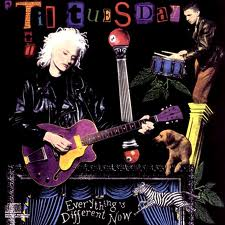
Yesterday I was driving to an appointment and had reached satiation with songs on the radio, so I grabbed the top CD off a stack I keep in my car for just such emergencies. As it happened it was Til Tuesday's final 1988 album Everything's Different Now. Most of the songs chronicle Aimee Mann's breakup with Jules Shear.

I was instantly transported to that period when it seemed all my relationships were, at best, practice at what not to do to be in a relationship. The late 80s was an especially rich sexual time for me when I experienced as much fucking as I could stand, and then more. Men and women were completely open to me, so much so I actually turned some interested parties down, which for a formerly fat kid with a complex was something I never thought I'd do.

But I tried steering some of those short-term escapades into more permanent waters and one of them was something I called The Great Marybeth Romance. Marybeth was much younger than me, 18 to my 27 (ironically, I think, for as much overthinking as I engaged in about the dicrepancy between our ages--and she wasn't even the partner with whom I had greatest age difference--I ended up marrying a woman born the same year as Marybeth and who keeps me honest [whether I want to be or not]), and our coupling was the result of sharing a bed on a weekend New England sojourn to hike the snow-covered trails with another couple.

I don't remember when I first heard music from the Til Tuesday album or where I acquired it, but when Marybeth and I inevitably crashed and burned a month or so later, I played the hell out of the tape. True, some of the songs were too specific to Mann's experience for me ("J for Jules," "Limits to Love," "Long Gone (Buddy)"), but I realized yesterday how much I had taken in all those decades ago. I could sing "Everything's Different Now," "Why Must I," "The Other End of the Telescope," and "Rip in Heaven" word for word, matching Mann's voice inflection for inflection, pause for pause.

The most deliciously painful is "(Beleived You Were) Lucky" whose message I imagined addressed to Marybeth as she sat quietly in a dark room, fantasizing (so I imagined) all the things we could have been and that (for reasons I genuinely can't remember but may have been partly because of our ages) we could never be, a heartfelt and disjointed stream-of-consciousness letter she was writing me abandoned at her feet. (And the album version has the gut-wrenching shift in one word so Mann sings how life "would be fucking great.") Two years later, enough time having gone by to allow a one-night reconciliation, the mix-tape I gave her (foolish romantics still did things like that then) did not include the song, however.

The phrase "deliciously painful" is accurate as I think anyone experienced in this can attest. Even now, there is a luscious hurt composed of equal parts shame, anxiety, pride, wish-fulfillment, and any number of other terms you'd like to add that comes bubbling up at the confluence of such a song and such memories. Some people never have that experience and I simultaneously envy and pity them. It is one of those tightly-held, jealously-guarded, queasy emotions some of us have access to and, for the lucky ones, delight in. For us, the emotion of the breakup is our best memory.

Monday, December 2, 2013

holiness smiles sleeping under a blanket

[Instead] of conceiving of the church as bound by the physical space of a church building, we should think of the church as beyond walls. Just as the Occupy movement claimed the power to redefine space and create new cultural forms, the church of the multitude should also imagine creatively and not be bound by rigid traditions. Michael Hardt and Antonio Negri remind us, "The movements of the multitude design new spaces, and its journey establishes new residences." In the Occupy movement, the Jewish Kol Nidr service took place in open air...Jews, Christians, Muslims, Buddhists, and pagans shared the use of space in the faith and spirituality tents. The image of the "tent" reminds us of the moving tabernacle in which God dwelled among the people of Israel, instead of stone buildings with high steeples and stained-glass windows. Occupy Faith uses all the spaces the groups can find, meeting in church halls, university lecture rooms, seminaries, and open park spaces. The protesters have also occupied churches, in the sense that they were housed by churches after they were evicted from various campsites...
With new digital and Internet technologies, we can connect with one another and build relationships that were not possible before. BK Hipsher [writes]: "Now we live in a world where it is possible to experience remote location relationship at a level never before understood in a faith community context. Now we can participate in church from our living rooms..." The virtual environment makes the demarcation of "sacred" and "profane" increasingly complicated. A helpful way is to see virtual reality as multiple worlds, creating possibilities for people to share information, relate to one another, and build online communities in numerous ways. The church may leave a whole new generation out if it does not harness powerful modern forms of communication and visual art forms...Some people may still prefer to see physical bodies gather for worship and for action, but churches increasingly use the Internet and electronic devices to connect with people, to form online communities, and to engage the world...
Instead of "going" to church, we will focus on "doing" church or "forming" church and building relationships. Instead of fencing off Christians from the world, as if they alone are the "holy" people, the church of the multitude is firmly in the world, transforming it to usher in the reign of God...[Dietrich Bonhoeffer wrote], "It is only by living completely in this world that one learns to have faith...In so doing, we throw ourselves completely into the arms of God, taking seriously, not our own sufferings, but those of God in the world." When churches pay more attention to maintenance instead of mission, and when they turn inward and function more like middle-class clubs, the presence of the divine is not felt even in what is supposed to be "sacred space"...
If sacred space needs to be reconfigured, sacred time also needs to be infused with new meanings. Traditionally, Christians have often thought that sacred time refers to Sunday worship, which is set apart from ordinary time. Moreover, salvation history is seen as separate from secular history, such that Christians are told to be concerned about spiritual things and not to bother too much with the temporal order. But Jesus subverted this understanding of sacred time when he said, "The sabbath was made for humankind, and not humankind for the sabbath."
--from Occupy Religion: Theology of the Multitude by Joerg Rieger and Kwok Pui-Lan

I think that Thanksgiving is my favorite holiday. Even when I was a kid, I looked forward to the third Thursday of November as a special time outside gift-giving times like Christmas and Easter and my birthday. I like the food, of course, but mostly I like the getting-together. The sitting down with one another. The breaking of bread and drinking of wine for one great feast.

I have a lot of happy memories about Thanksgivings past--the ones with multiple previously unknown locals who had nowhere else to go and showed up at our massive meal on the floor, the one  in Louisiana with tamales and chili rellenos with the laborer family who'd taken me in, the one near which I witnessed a burial at the Woodstock cemetary that looked like a funeral staged by Arthur Penn, the one when I was a kid and my mom dressed up my sister and me as pilgrims in construction paper hat, collar and bonnet, the community meal in Woodstock where I met my sabra linebacker--but I think the one I like best was when my wife and I were in our second year of living in New York after marrying. We were miserable, living in a converted army barracks dropped upstate without being winterized. We heated the place with an iron stove we'd found for free that smoked so much that when we moved and took up the carpet from the living room, we found a separate layer under it made entirely of ash.

I'd got back in touch with several old friends and I found one of them living in an abandoned barn in New Paltz. I'd been after him for months to come stay with us, but he refused. But he had no plans for Thanksgiving so I said we would come get him and bring him to our place, and he'd at least stay the night. He kept refusing the stay, but I could enforce that easily since we lived ten miles from town.

I don't remember what we had for dinner, it might have been turkey but I doubt it as he's a vegetarian, but I do remember the sight of him curled up under blankets sleeping hours and hours with our little black dog snuggled next to him the next morning. That was the Thanksgiving it rained all day and when I got up into the attic space to try stopping some of the leaks I misstepped and put my foot through the pressboard ceiling. The one before the Easter when I saved up money and bought my wife a dozen Dunkin Donuts and spent an hour putting little paper bunny ears on each one only to wake up Easter morning to find the mice had taken a bite out of each one.

Sacredness, like hell and heaven, is of our own making. Like everyone else, I forget that and have to be reminded, sometimes by books, sometimes by music lyrics, sometimes by dogs or cats laying on my lap, sometimes by a smile on the face of a warm, sleeping friend under a dog. Holiness isn't outside us but what we confer or recognize in others, sometimes in ourselves, and always there. The moments we're reminded of that are sacred. Thanksgiving is one long moment to remind us of that.

Thursday, October 3, 2013

oooh baby, it's a wild world


I could never call Shelley a girlfriend.  We were friends with benefits long before that term came into vogue. Our relationship, however it might be described, was one of those leftovers from the 60s and 70s when we accepted a lot of normality to relationships--having male and female lovers as a regular course, the occasional fuck with a good friend that neither took seriously, dating both a daughter and then sleeping with her mother (I didn't but I knew a few guys who had), even becoming friends with ex-lovers--that scandelize my teenage and young adult students. When we saw each other last summer, after an absence of over 20 years, it was almost as if the decades and their attendant baggage hadn't elapsed. She was older, heavier, weighed down with medication, but so was I, and we clung to one another like drowning sailors to flotsom. Her adult children, watching us, could only have wondered what we used to be like back when we liked each other.

I'm reminded of her because I heard Cat Stevens singing "Wild World" this morning. That was one of the songs we used to sing together on long drives. We traveled around together a lot in the mid-80s, all over the east coast, and although neither of us had voices that lent themselves to singing, there were certain songs that we sang to each other regularly:  "Me and Julio," "Brass in Pocket," a few others.  Their words didn't have any meaning beyond our liking the sounds that came out.

Wednesday, August 28, 2013

my 1980s

[Although many dissed it, I enjoyed this Wayne Koesten-baum essay reprint on Salon, so much so that I've decided to write a similar one in the same style.  Mine will be, of necessity, shorter for the simple reason I'll try to say something in fewer words and images.]

"Plus ca change, plus c'est la meme chose."
Jean-Baptiste Alphonse Karr

I wanted to be the Next Great American Writer in the 1980s. I published one very bad novel and an interesting monograph on Jerzy Grotovski and a few short stories and poems. But I wrote many, many other things.  In my teens a professor told me I was a Renaissance Man and I took that to heart, wanting to whip off novels and poems with the same alacrity as Victor Hugo or Thomas Hardy; tellingly, I didn't enjoy reading either of them at the time. I envisioned myself forever sitting up late at night writing hard, amber-clear prose that never quite satisfied me. There is a wordless comic strip from Love and Rockets by Los Bros Hernandez from that time that shows one of the characters typing and smoking late into the night in a high garret room, suddenly crushing a sheet of paper with dismay, and that's how I saw myself. I often accomplished the sitting up late, drinking instead of smoking, but rarely found anything near solid, precise wording.
***
I was married when the 80s started and divorced about midway through. It was by mutual consent and there were no kids or property to dispose of so it was relatively amicable. We had sex nearly every day because we were young and horny and it was one of the few times we didn't fight. After we divorced and I lost nearly a hundred pounds I found to my surprise she wasn't the only person attracted to me and eventually I would gain a reputation, not undeserved, for fucking nearly everyone who approached me. For a while I enjoyed sex with men as a sort of vacation from the emotional messiness of sex with women, a kind of palate-cleanser between courses.
***
I read a tremendous amount, usually on walks and under trees, from silly novels to dense philosophies. I tried to find at least one important line from every book or poem or short story or essay and then typed it on a slip of paper and taped it to the swinging door of my kitchen. I'd been given a portable manual typewriter as a graduation present and it was on this I wrote nearly everything during that time. I had had a larger manual office model someone gave me during my marriage and it was on this I wrote my novel and the monograph, but one evening after reading On the Road I stood up suddenly and began to move methodically around my little apartment collecting furniture, clothes, books, kitchen utensils, everything I decided I no longer needed, and piled them in the center of my living room floor to give away. The office typewriter was among the last items to make the pile.
***
Today I have a lot of friends who hop trains and call themselves train kids. I did that only a couple times and only for short distances, always returning to my starting point. I was alone each time and spent the whole ride hunkered close to whatever I was holding onto: my first time I clutched a pole tightly, scared shitless I would be blown off and my body found by kids a la Stephen King's "The Body," and the next times I went I belted myself to something secure. I was a road kid, spending most of my time hitchhiking or in my own car. I always had luck hitching; it was always a matter of patience and not looking angry as the cars and trucks whizzed past me. One of the few times I hitched with someone else was one of the least productive hitch times of my career; we walked hours on the side of the New York State Interstate--we were headed to Buffalo--but we made it within twelve hours of our starting by dint of catching a train outside Rochester because it was dark and no one could see out thumbs. Whenever I hear the Pet Shop Boys' "West End Girls" I go back to that time and think specifically of riding around in the back seat of a car driven by a lesbian who would come out as straight within a year and who was showing us the city.
***
I acted in porn movies for a short time, a single summer, but it was enough to fund my life for a year. $500-1000 for a weekend's worth of work was great money. It was easier and less anxiety-producing than I'd feared and I loved the sex. I never thought about AIDS, not because this was before it or I knew no one who had it--I lost several friends to its depredations and I carry a healthy hatred for Ronald Reagan and his ambivalence to this day--but because I was stupid enough to think I was immortal. I actually came through those years of mostly unprotected sex without a single STD, leading my friends to joke my mother, like Achilles', had dipped me in the River Teflon. 
***

Authors I read for the first time that decade who played an important role in how I write: Susan Sontag, Jean Genet, Bruce Chatwin, John Gardner, Joan Didion, Thomas Merton, Gary Snyder, Jack Kerouac, William Burroughs, Dominick Dunne, Tom Robbins, Louise Erdrich, Tim O'Brien, H.P. Lovecraft, Raymond Carver, John Le Carre, Henry David Thoreau, Rita Dove, Vladimir Nabokov, Charles Simic, Gore Vidal, Georges Simenon, Anne Tyler, Sylvia Plath, Audre Lord, D.H. Lawrence, Toni Morrison, Rita Adler, Carlos Castenada, Ursula K. LeGuin, Peter Straub, Stephen King, Clive Barker, John Irving, Thomas Pynchon, etc.
***
For years after my divorce I lived in New Paltz, the town where my college was located. The town is snuggled at the base of the Shawangunk Mountain range between the Hudson and Wallkill Rivers and is home to many freaks. I found myself fitting there like fingers that curl into a fist. Three years after my divorce, through some stunningly bad decisions, I was out of work and had to give up my apartment to a friend. I was in Manhattan for a job interview and, having waited too long because I was at a bar to catch the last bus out of the City, I found a quiet berth under a construction trailer on the overpass above the Grand Central Station. I was warm, safe, and it was astonishingly easy to get in and out without being seen. I ended up sleeping under that trailer for several months, until approaching winter made me decide it was time to visit my parents. They were against my returning to the trailer, or to New Paltz, where I might have slept on friends' couches, so I said, "Buy me a cheap car and I'll live in that." They found a 77 Dodge Aspen wagon for $500 and I spent a weekend making it habitable and then lit out for the road. I lived in it for three years, seeing almost all of the country and parts of Canada, before my mother's entreaties to come back out of it and go to graduate school prevailed. I disembarked in southern Minnesota and sold the Aspen and lived in a park seven miles from town, sleeping under a gazebo and riding my bike to classes. This was September, 1989, and in another nine months I would meet my second, or as she says, my last wife. 

Friday, December 28, 2012

spiritual homelessness 1

I've been busy writing this past semester, although little of it has ended up here.  But as a final requirement I've taken a course called final integrative seminar which is meant to pull together many of the threads of my years at seminary.  The exam for this course is what's called a "statement of ministry," and while it may be precocious to call it that--I don't have much of a statement to make about something unless I've been directly involved in it for a long time--it's somewhat accurate.  I'll publish it in 4 sections starting today.


Spiritual Homelessness

My Statement of Ministry


Introduction:  What is my understanding of God?

Like all stories about God, this is a story about loss.  I knew an artist named John Wolfe back east in the 80s.  He was one-legged, had had the other blown off in Vietnam, had a family, a wife, a little girl, and an awfully big talent.  One of the few New Paltz artists to have his own studio, separate from where he lived and not on campus.  He worked in oils primarily.  He didn’t want an artificial leg but hobbled around on two metal canes that ended in cuffs on his forearms, his good right leg, and his stump. 

            He told me a story that took place in the 70s.  He’d just gotten out of the service a few years before, after losing the leg, and was down and out New York.  He couldn’t take it anymore, he said, drinking all the time, angry as hell, in pain when he wasn’t high.  He was sick of people, sick of life, and sick of people in his life, so he decided one night to just get out. 

            “I wanted,” he said between puffs from his Marlboro, “I wanted to be away from people, but not away from people.  You know what I mean?  I was tired of civilization or tired of the people in it.”  He took another drag and stared off into the distance, even though all he could see across the street was the library and the bar.  “People shot at me, they took my leg.  I didn’t blame people, I blamed civilization, or what civilization done to them.  I hated that.” 

            He stubbed out the Marlboro and shook another from the pack into his mouth.  He was fair-haired, wispy bangs blown across a boyish face that was too trusting to live for long on the streets.  His eyes pincered up.  “I got together a lot of money, I don’t know, couple hundred.  Be honest, I don’t remember where I got it from.  Saved it, borrowed it.  Might have stolen some, who remembers back then?”

            He lit the Marlboro, took a long drag, and handed it to me.  I took a single toke—that’s all I did with cigarettes—and gave it back.  He stubbed it back in his mouth and talked around it.

            “I’d heard about this place, down on the Yucatan Peninsula.  Tiny town, no one goes there.  I took a flight to Mexico City, took another flight east to another town.  Had to rent a burro take me up to another town where I caught another flight.  Caught a helicopter from there, one of those passenger things, got a fat belly and room for thirty.  Picked me up from one mountain top and took me across to another mountain top.” 

            He was off in another world by then, watching people come in and out of the library and either head for their cars or the bar next door.  We were sitting in front of the bank, the nicer one in town, but the people inside had never seemed to mind anyone leaning against their wall so we leaned.

            “Whole other air up there.  I could feel like, like my lungs were filling up with something else, something I’d never breathed before.  Something people were really supposed to breathe.  I couldn’t wait for them to open the door.”

            A guy we knew came out of the bar and waved at us.  We shrugged back.  “I was standing on the ledge when the dude opens the door.  What do I see directly across the tarmac?”

            I grinned.  I knew it wouldn’t be good.

            “McDonald’s arches.”  John took a final drag like he’d sucked all the bitterness out of the Marlboro and flicked it in the street. 

            “Did you stay anyway?”

            “Course I did.  I’d put a lot into this place or what I thought it was going to be.  But it ended up it wasn’t nothing.”  He grabbed his cuffs and we headed up the street.  “I came back, started doing some reading, some meditating.  That’s when I started reading Buddhism.  Started painting.  That was the only way I could find that place.”

            John’s canvases were landscapes or cityscapes, sometimes abstractions.  He took life drawing classes on occasion to keep his hand in, but his real work was depopulated, places where people had been and gone.

            I said, “No people?” 

            “No civilization.  People I can handle.  It’s what being around other people does to them I don’t like.”

Sunday, April 22, 2012

my zen experience

I was raised a Seventh-Day Adventist in the German tradition, which meant stiff prohibitions against alcohol, coffee, premarital sex, meat and several other things.  My parents were rather relaxed when it came to religion and allowed me to leave the church in my early teens.  I experimented with several Christianities for some years as well as agnosticism and atheism, and came to Buddhism after reading Hesse’s novel Siddhartha during my second college go-round and eventually on Zen.

Zen practice fit with my lifestyle at that time, which was geared toward a massive de-emphasis on material goods.  My divorce, though amicable, had helped me recognize that my life was not what I wanted it to be.  I lived for a year after that in a tiny room in a boarding house where I had a large bed, a desk, a cabinet, a stereo and a bookshelf and not much room to move around.  If I had guests we needed to sit on the bed since it took up nearly the entire room.  Everything else was in storage at my parents’, and when I moved into an apartment on the other end of town, it quickly filled up with the things I retained from my marriage, including a lot of bad feelings.  So in the middle of the night about a month after moving, having watched the film The Razor’s Edge and being especially touched by the scene in which the protagonist stays warm by burning the pages he’s read from the one book he has, I spent several hours literally piling clothes, books, furniture, utensils and various other things into the center of the living room and called in my friends to pick through it and take what they wanted. 

After that I set about studying in earnest.  I lived in a small college town at the base of the Shawangunk Mountains which are part of the Catskills and there was no little choice of Zen classes to join.  I chose one that met at Unison Center which was a 30-minute walk west of town.  I did a great deal of reading and spent a lot of time in practice.  After I bought a car I drove northwest to Woodstock to study under John Daido Loori at Zen Mountain Monastery which I managed to attend for free for a while having done carpentry work under a friend’s brother who was doing renovations there.  Eventually I moved to Woodstock for several years and continued my studies there. 

Before that happened I spent three months in sesshin at Dhammapada in Montreal on Daido Loori’s suggestion during which I did a lot of practical study.  I didn’t advance very far in my practice; the monastery was strict Rinzai school where we sat seiza style and I discovered I really wasn’t very good at sitting or contemplation.  I looked forward to my time in the kitchen and the garden each day and that was what got me through each sitting.  I was one of those people from the joke who say to themselves, “Hey, I’ve become one with nothing. Aw, nuts.”  At one point near the end of my stay I approached the abbot in dokusan saying, “I’ve become enlightened,” to which he answered, “Oh, I’m so sorry.”  I can’t say I got very far, certainly not in my practice.  But I did learn to master my anger which was a powerful step forward. 

After I returned from sesshin I did a lot more reading and studying but almost no practice.  It was almost as if I thought of myself as having used up the practice I needed during sesshin and didn’t have to put in the painful and (in my view) futile sitting.  I remember sitting once a day on my return—often at night before bed or early in the morning after waking—then once a week, then once a month, and finally not sitting at all.  Meanwhile, my reading emphasized the ethics of Tao over the practices of sitting; I decided to drop Buddhist studies, as I saw the end result of it as retiring to a monastery, in favor of Taoism.